Monday, April 25, 2005


4. How would you describe enlightenment to someone like Razorskiss?

I don't know who Razorskiss is, but I would answer the question to anyone as "ordinary mind."

Sunday, April 24, 2005


3. This one came from Sogen Roshi, who was kind enough to write this shodou for me: East, South, North, West; what does not change?

Everything is impermanent and without independent existence (emptiness). Even East, South, North and West are relative and not always existant. It is asked "Why did Bodhidharma come from the West?" but to Americans, India is the East. If you are standing on the North Pole, whichever direction you turn to will be south - east and west, as well as north, have no meaning at the north pole.

Buddhist writings discuss the ten directions as meaning all-pervading space. The ten directions are East, South, North, West and the four points in between, as well as up and down. The Buddha, said, "When one person opens up reality and returns to the source, all space in the ten directions disappears." Master Dogen tells a story about the Chinese master Xuansha Shibei who said, "The whole universe in ten directions is one bright pearl."

The Chinese Master Changsha said, "The whole universe in ten directions is the eye of a monk." Dogen later added, "The whole universe in ten directions is a monk’s everyday speech. The whole universe in the ten directions is a monk’s whole body. The whole universe in ten directions is the brightness of the self. The whole universe in ten directions exists inside the brightness of the self. In the whole universe in ten directions, there is no one who is not himself."

So the universe in ten directions is nothing other than the self, and the self is empty of any independent existance, so everything changes, East, South, North and West.

Saturday, April 23, 2005


2. Designated hitter or pitcher hits his own?

Although I am a big Red Sox fan, and love few things more that a Red Sox-Yankees game, I have to admit despising the DH rule. The whole strategy of baseball, the game if you will, revolves around making decisions about wheter to leave the pitcher in or to put in a pinch hitter and let the bullpen pitch from there.

Imagine it's the sixth inning, and despite terrific pitching from your starter, you trail 1-0. Your team is up, and you have a man on first and second, one out, and the pitcher is due up. He's thrown maybe 75 pitches so far, still should have some game left. As the manager, do you put in a pinch hitter and try to win the game right now, or do you keep the defense strong and sacrifice an out so as not to allow any future runs? What if it were eighth inning and two outs?

It is this kind of strategy that makes baseball the interesting game that it is, and leads to the brain-boiling suspense of the most memorable games.

In contrast, the DH rule reduces the game to a home-run derby, with puffed-up steroid addicts hitting for the bleachers on every pitch, and the approximate strategy of a game to tic-tac-toe.

I once heard it said that "I'd rather watch a batter bat than a manager think." So, generally, would I, but I've at least got the ADD somewhat under control.

Friday, April 22, 2005


Due to a combination of depression and a relapse of the flu (and depression over the relapse), I have managed to fall five days behind in my blog. Allow me to atempt to make up the gap by answering Mumon's five questions.

1. You are in sesshin, and it is the fourth day. It is lunch time; so oryoki is being practiced. After serving yourself or being served, after your offering, as you mindfully eat, you notice there is a piece of a plastic fork in your food. What do you do?

I can answer this by eliminating the things that I would not do. First, I would not eat the plastic. Although the Buddha begged for his food each day and ate whatever was put in his bowl, I can see no merit in eating a piece of plastic fork.

Second, I would not leave it aside and send it back with my empty bowl. In that case, the tenzo (cook) would see the piece of fork and feel bad, despite all of his/her efforts to prepare the meal. It would not be compassionate to send it back.

It seems to me that the only alternative would be to discretely slip the plastic into a pocket and dispose of it later, say, in the bathroom or back in my room (and keep a sharp eye out in later meals).

Thursday, April 21, 2005

HONG KONG (Reuters) - Chinese men have no reason to feel inferior about the size of their penises, according to a Hong Kong study which showed local men measured up to others elsewhere in the world below the belt. "Our conclusion is that Hong Kong people are no smaller than Western men, where their penises are concerned," said Chan Lung-wai, director of the Urology Center at the Union Hospital, who headed the study. "There has always been the myth that westerners have bigger penises and their (sexual) ability is better."

A group of scientists in Hong Kong spent five months from October last year measuring 148 ethnic Chinese volunteers aged between 23 and 93.

The average length of their flaccid penises was 3.33 inches, which compared favorably with similar studies on other men overseas. Germans have average lengths of about 3.4 inches, Israelis 3.27 inches, Turks 3.07 inches and Filippinos 2.89 inches. Italians were the longest at 3.54 inches, and Americans averaged 3.46 inches.

The study did not measure the penises when they were erect.

It found that a man's height bore no relation to the length of his member, but those with higher body mass indexes, or fat content, appeared to have shorter penises. "It seems that as someone gets older and fatter, his blood vessels change, so the penile size is not static. It may be a reflection of the condition of the person's blood vessels," Chan said, adding that this could spur yet another study.

Wednesday, April 20, 2005


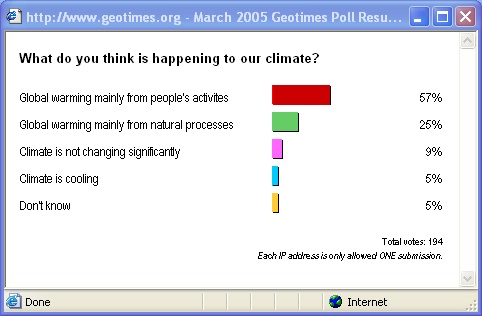
In this week's The New Yorker, Elizabeth Kolbert writes about global warming in the first of a three-part series on climate change. The following observations are based on an online interview with Ms. Kolbert.

The principles of global warming are as well established as any in physics. Nearly a hundred and fifty years ago, a British physicist named John Tyndall discovered that certain gases in the atmosphere — we now refer to these as the "greenhouse gases" —trap heat on earth by absorbing infrared radiation. There are several naturally occurring greenhouse gases, including carbon dioxide and water vapor, and together they produce the so-called "natural greenhouse effect." Without the natural greenhouse effect, the planet would essentially be frozen. Any basic earth-science textbook talks about the natural greenhouse effect; it’s a phenomenon that is not in any way debated.

All that the theory of global warming says is that if you increase the concentration of greenhouse gases in the atmosphere, you will also increase the earth’s average temperature. It’s indisputable that we have increased greenhouse-gas concentrations in the air as a result of human activity, and it’s also indisputable that over the last few decades average global temperatures have gone up. As best as can be determined, the world is now warmer than it has been at any point in the last two millennia, and, if current trends continue, by the end of the century it will likely be hotter than at any point in the last two million years.

There is a very broad consensus in the scientific community that global warming is under way. To the extent that there are conflicting views, they are usually over how exactly the process will play out. This is understandable. The climate affects just about every natural system on earth, and these systems in turn affect the climate. So making predictions is very complicated. Meanwhile, we have only one planet, so it’s impossible to run a controlled experiment. Although the news tends to want to offer a "balanced" view by interviewing opponents of the theory along with the proponents, to focus on the degree of disagreement, rather than on the degree of consensus, is fundamentally misguided. If ten people told you your house was on fire, you would call the fire department. You wouldn’t really care whether some of them thought that the place would be incinerated in an hour and some of them thought it would take a whole day.

There is a surprisingly large, even frighteningly large, gap between the scientific community and the lay community’s opinions on global warming. Many very sober-minded, coolly analytical scientists are warning of the end of the world as we know it. There are several reasons why their message hasn’t really got out. One is that scientists tend, as a group, to interact more with each other than with the general public. Another is that there has been a very well-financed disinformation campaign designed to convince people that there is still scientific disagreement about the problem, when there really is quite broad agreement. And third, the climate operates on its own timetable. It will take several decades for the warming that is already inevitable to be felt. People tend to focus on the here and now. The problem is that, once global warming is something that most people can feel in the course of their daily lives, it will be too late to prevent much larger, potentially catastrophic changes.

Tuesday, April 19, 2005

Summer Night


Late at night, the faint sound of someone pounding rice.
Dew drips from the bamboo onto the firewood pile
And the plants along the garden are also moist.
Frogs croak in the distance but then seem very close.
Fireflies light low, then high.
Wide awake; sleep is far off.
Smoothing out the pillow, I let my thoughts drift.

- Ryokan (1758-1831)

Monday, April 18, 2005


According to the 2001 National Academies of Science Report on Climate Change, "Greenhouse gases are accumulating in the earth's atmosphere as a result of human activities," and, it continues, "Global warming could well have serious adverse societal and ecological impacts by the end of this century."

On the December 10, 2004 segment of the television show 20/20, ABC news correspondent John Stossel praised Michael Crichton's State of Fear, which purports to expose concern over global warming as a media scare perpetrated by Hollywood liberals and self-serving environmentalists. He offered no countervailing view (from, say, a scientist), instead interviewing a woman ready to pee her pants in fear after seeing the movie The Day After Tomorrow - presumably representative of the hysteria on the issue. The rest of the segment was devoted to lionizing the "brave" Mr. Crichton for taking great personal risk by publishing his narrow, unscientific viewpoint. Now it seems that Mr. Stossel is ready to jump on board with Mr. Crichton as a debunker of the global warming "myth."

Mr. Stossel was interviewed on April 8 by Brooke Gladstone on NPR's On the Media:

Brooke Gladstone: Do you think that scientists are just another interest group, representing their benefactors, or is there a point at which a scientific consensus is something incontrovertible?

John Stossel: Well, [laughs] "incontrovertible" is a big word, but a scientific consensus is what I think reporters should go with, absolutely. But, what I've tried to point out in Give Me a Break is that, when I started reporting, I just took the scientists at their word. I didn't realize that, while they tend to believe in what they say, they're also subconsciously aware that they're not going to get another big grant, or they're not going to get interviewed by Good Morning America, if they don't find a problem. And I routinely found scientists finding big problems, big worries from dioxin to pesticide residues when good scientists said, you know, it's not that risky.

Gladstone: So you don't believe that there is an international scientific consensus that global warming poses a danger.

Stossel: Well, anything can pose "a danger." The question is how big a danger? Is it the crisis that I keep hearing about? And the scientists that I talk to say we don't know that that's true.

Gladstone: The scientists that you talk to say that you don't know that's true, but the vast majority of scientists that have been convened on these international panels, who have won Nobel Prizes, believe that it is true - that global warming poses a serious danger and requires some action.

Stossel: The vast majority have agreed with that? I do not believe that is the case.

Gladstone: You don't believe that is the case. The consensus seems to be clear. Why don't you believe it?

Stossel: Because scientists tell me that the people writing the alarmist reports do not reflect the majority of scientists who really understand it; that the way you characterize it is not the way I've heard good scientists characterize it; and that the idea and the tone of voice you use is very telling - it's saying "Yes, there's a crisis. How can you refute that? You're such a jerk."

Gladstone: [laughs] I'm sorry if my tone conveyed that. According to the scientists that you've spoken to, there is no immediate danger posed by global warming that requires action.

Stossel: Correct.

Gladstone: In December, you featured novelist Michael Crichton on 20/20, and you praised him for contradicting something most people believe and fear. You went on to say that environmental organizations are fomenting false fears in order to promote agendas and raise money. Why use a fiction writer to refute the scientific community?

Stossel: Because he's famous, and he's interesting, and he's smart, and he writes books that lots of people read, and I could interview the scientists for 20/20, but more people will pay attention when this particular smart fiction writer says it.

Two things jump out from this interview: first, celebrity and fame seem to count for more than qualifications and credentials to Mr. Stossel. Second, the tactic of stubbornly asserting that the false is, in fact, true ("I do not believe that is the case"), despite all evidence to the contrary, seems to be popular with the right wing. Time magazine cover girl Ann Coulter tried the same defense after ludicrously suggesting that Canada had sent troops to Vietnam:

Ann Coulter: Canada used to be one of our most loyal friends and vice-versa. I mean Canada sent troops to Vietnam - was Vietnam less containable and more of a threat than Saddam Hussein?

Bob McKeown: Canada didn't send troops to Vietnam.

Coulter: I don't think that's right.

McKeown: Canada did not send troops to Vietnam.

Coulter: Indochina?

McKeown: Uh no. Canada. . . second World War of course. Korea. Yes. Vietnam No.

Coulter: I think you're wrong.

McKeown: No, took a pass on Vietnam.

Coulter: I think you're wrong.

McKeown: No, Australia was there, not Canada.

Coulter: I think Canada sent troops.

McKeown: No.

Coulter: Well. I'll get back to you on that.

McKeown (in voice-over): Coulter never got back to us -- but for the record, like Iraq, Canada sent no troops to Vietnam.

To Stossel and Coulter, what matters is not so much what is true or not, but what one can get away with saying. This, of course, is the very essence of bullshit.

What is bullshit, after all? According to Harry G. Frankfurt, Professor Emeritus at Princeton University, it is neither fish nor fowl. In his essay "On Bullshit," Prof. Frankfurt states that bullshiters certainly aren't honest, but neither are they liars, given that the liar and the honest man are linked in their common, if not identical, regard for the truth. "It is impossible for someone to lie unless he thinks he knows the truth," Prof. Frankfurt writes. "A person who lies is thereby responding to the truth, and he is to that extent respectful of it."

The bullshit artist, on the other hand, cares nothing for truth or falsehood. The only thing that matters to him is "getting away with what he says," Prof. Frankfurt writes. An advertiser or a politician or talk show host given to bullshit "does not reject the authority of the truth, as the liar does, and oppose himself to it," he writes. "He pays no attention to it at all."

And this makes him potentially more harmful than any liar, Prof. Frankfurt writes, because any culture, and he means this culture rife with bullshit, is one in danger of rejecting "the possibility of knowing how things truly are." It follows that any form of political argument or intellectual analysis or commercial appeal is only as legitimate, and true, as it is persuasive. There is no other court of appeal.

The reader is left to imagine a culture in which institutions, leaders, events, ethics feel improvised and lacking in substance. "All that is solid," Marx once wrote, "melts into air."

So let me review for a minute - in this one post, I managed to ridicule Michael Crichton, John Stossel and Ann Coulter, quote Harry Frankfurt and Karl Marx, and use the word "bullshit" several times with a straight face. Good! I think I'm ready to hit the "Publish Post" button . . .

Sunday, April 17, 2005


This morning, I decided not to go back to the zendo and complete the sesshin, despite the very strong appeal of another dharma talk by Okumura Roshi, but instead allowed myself to finally complete the healing process of last week's devastating bout with the flu.

The Sunday Times had two excellent articles - one on the legacy of Hunter S. Thompson, and a retrospective of Dustin Hoffman's career.

Around 10:30, a landscaping crew came by to help me clean up my yard. Try as I might, I was not able to keep up with the autumn's leaves and pine needles, which managed to get all caught up in the ivy all over my yard (I don't have a grass "lawn," - this place is far too shady), and even if I could rake them all up, it would literally have taken me dozens, if not a hundred, leaf bags to collect all the droppings.

The crew had three men armed with industrial-strength leafblowers (not like the little toy that I use), and starting on the roof, blew everything down the hill, where a fourth ran the leaves through a mower to mulch them and minimize the number of leaf bags needed.

They worked hard. But finally, after about four hours, they collected the leaf bags (and their pay) and headed off to the County compost facility. The place looks much better.

So, I'm actually making some progress on my list of things to do. As depressing as it is to me to do this, here's an update on the list:

1. Fix computer. Not done.
2. Change address on driver's license/tag registration. Not done.
3. Fix toilet in condo. Done!!!
4. Get duct tape marks off car. Done!!!
5. Join a gym. Not done. But with Daylight Saving's Time back in effect (longer days) and my health finally restored, this will be accomplished soon.
6. Buy living room furniture. Done, at least enough for now. The sofa arrived in February and I bought a nice Chinese carpet in March. However, I still want to replace the plantation shutters with a more open window treatment, and there's always room for more stuff.
7. Buy mirror and sconces for bathroom. Not done.
8. Yard work. Done!!!
9. Fix up the UCV: Paint the living room walls, mantlepiece and shelves as the realtor suggested - Done!!!
I still need to re-clean the bathrooms, the kitchen, the refrigerator and the freezer, and steam clean the carpets before the Open House on April 26.
10. Body work: Colonoscopy - not done. Dermatology - not done. Dentistry - not done, despite my Mother's well-intentioned nagging, but a good dentist has been selected.
11. Reading. An endless task, that will never be done. There's always something new to read. But I still haven't finished even one of the books I bought January 30th, except for Michael Crichton's State of Fear, which I'm finished with more than finished reading.
12. Writing. Blogging is part of the reason I haven't finished my books, or written anything more than what's appeared in this blog (the "substitution effect").
13. Arithmetic: Income taxes - Done!!! And refunds already received. Still need to straighten out finances and collect monies owed me.

Saturday, April 16, 2005


Recently, I was asked about the lineage of the Atlanta Soto Zen Center. I discussed the background and lineage of our founder's teacher, Soyu Matsuoka Roshi, last July, and encourage the interested reader to refer to that post.

This weekend, we are having a special sesshin with guest teacher Shohaku Okumura Roshi. Okumura was born in Osaka, Japan in 1948. He was ordained as a Soto Zen priest in 1970 by the late Kosho Uchiyama Roshi. After graduating from Komazawa University, he trained at Antaiji in Kyoto, and received Shiho (Dharma Transmission) from his teacher in February 1975. Okumura traveled to Massachusetts to practice with two of his Dharma brothers at Pioneer Valley Zendo in 1976 and stayed there until 1981 when he returned to Japan. Until 1984, he lived by himself as a caretaker of a small nunnery, living by takuhatsu (begging), practicing shikantaza and working on translations. He started the Kyoto Soto Zen Center and practiced there until 1992, and from 1993 until 1996 he was the Head Teacher of Minnesota Zen Center. In 1996, Okumura founded Sanshin Zen Community in Bloomington, Indiana, where he now lives and practices.

Last evening and twice today, Okumura Roshi gave some very interesting dharma talks. This afternoon's talk in particular was interesting to me since he discussed many of the sutras and scriptures that I have been discussing in this blog recently. Although the topic of his talks was ostensibly the 12-Fold Chain of Interdependant Origination, he did not limit himself to a scholarly dissertation of this teaching, but instead went into the practical aspects ("practical" as in "practice") of Zen Buddhism and provided direct and personal observations from his own practice.

In his talk, Okumura quoted the famed Song-dynasty poet Su Dongbo:

"The sound of the stream is his long, broad tongue;
The mountain, his immaculate body.
This evening's eighty-four thousand verses -
How will I tell them tomorrow?"

I briefly discussed this same verse in my blog entry of March 29, 2005. As Master Dogen states in the Keisei sanshoku ("Sound of the Stream, Form of the Mountain"), "In the great Kingdom of Sung there lived the Layman Toba, whose name was Soshuku, and who was also called Shisen." All these names, as well as Su Dongbo, refer to the Chinese poet So Toba (1036-1101). Toba was the poet's pen name and Soshoku was his formal name. He also used the name Shisen. Like Buddhist monks, men of literature in China often had many different names.

Dogen notes, "He seems to have been a real dragon in the literary world (literally, "the ocean of the brush"), and he studied the dragons and elephants of the Buddhist world;" that is, he read the writings of excellent Buddhist masters. "He swam happily into deep depths, and floated up and down through layers of cloud." Here, Master Dogen was praising his ability as a poet. As the story goes, Su Dongbo visited Lushan, a region of China famed for its beautiful scenery, hears the sounds of a mountain stream flowing through the night, realizes the truth, and composes his verse.

The "wide and long tongue" is one of the thirty-two distinguishing features of the Buddha. However, Okumura went on to say that upon realization of the truth, the poet no longer distinguished between the so-called insentient babbling of the brook and the chanting of sacred sutras, just as he no longer differentiated between himself and the objects of his perception. That is to say, on listening to the stream, he no longer experienced a separation between "himself" and "other," between subject and object, and the sound of the stream was the entirety of all existence at that moment.

The Sanskrit word namarupa means name (namu) and form (rupa). Namarupa is what our minds assign to the objects perceived by our senses, that is, it is the mind's conceptualization of reality. To transcend namarupa is to no longer differentiate between "this" and "that," including between "self" and "other." Everything becomes everything, the self is forgotten and the universe is seen as it really is, without our abstract concepts. This is realization.

There is much more I would like to say about this poem, about the Keisei sanshoku, and about the Sansuigyo (The Mountains and Rivers Sutra). This will have to wait for another day, however, as Okumura want on in his dharma talk and discussed the opening lines of the Genjo Koan, which I discussed back last October.

"When all dharmas are seen as the Buddha-Dharma, then there is delusion and realization, there is practice, there is life and there is death, there are buddhas and there are ordinary beings. When the myriad dharmas are each not of the self, there is no delusion and no realization, no buddhas and no ordinary beings, no life and no death. The Buddha's truth is originally transcendent over abundance and scarcity, and so there is life and death, there is delusion and realization, there are beings and Buddhas."

As Okumura pointed out, here Dogen is saying that as long as one looks outside oneself for enlightenment, one will continue to live in delusion, for "enlightenment" then becomes just another namarupa. However, if one simply practices zazen with no goal of enlightenment or Buddhahood or of anything, and abandons discrimination among self and others and transcends namarupa, then there is realization.

Of course, here I am just skimming the surface of over 2 1/2 hours of lecture and discussion, and am scarcely doing justice to the very subtle concepts involved. You can say this post is not so much a finger pointing at the moon as a broad backhanded wave in the general direction.

Friday, April 15, 2005

Baseball's Back


Nothing like a good Red Sox-Yankees brawl to get me back up on my feet. Last night, the Red Sox were leading the Yankees at Fenway, 6-5, when Jason Varitek tripled down the right-field line in the eighth inning. The ball hugged the wall and made its way to Gary Sheffield, who bent down for it. As he did, a fan in the front row, possibly swiping for the ball, appeared to hit Sheffield in the face. "It felt like my lip busted," Sheffield said.

After gathering the ball, but before throwing to the cutoff man, Sheffield paused and appeared to punch the fan with the ball still in his hand. He went back at the fan after throwing the ball in, but resisted the impulse to escalate the fight before teammates and police intervened. Asked what he was thinking before he backed off, Sheffield said, "Ron Artest."

Two runs scored, and the Yankees lost, 8-5. They return to Fenway on July 14.

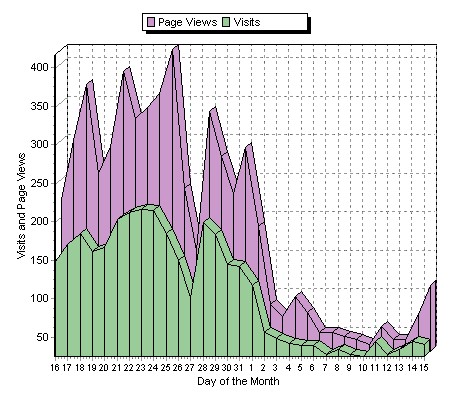
In other events, it seems that the online world has finally gotten tired of me. Hits to this blog have dropped from over 200 a day down to a mere couple dozen or so.


Now, there could be several reasons for this. First, either everybody who wanted a copy of my picture of Ray Charles finally downloaded it, or Google.images dropped me to the bottom of the search results for those looking for pictures of Ray (or Jimi or Norah or Courtney). Not that I care much; the stats indicate that very few of those who came here looking for star pictures stayed around and read much. So I'd rather have a few interested readers than hundreds of ADD downloaders.

Thursday, April 14, 2005

One Last, Vicious Gut-Kick of a Lesson on the First Noble Truth


Not entirely unexpectedly, L. decided that this was a good time to break up with me again. She had been very distant and non-committal since before I even had left for San Francisco. Although she was sympathetic and supportive when I got sick, and even brought over food for me earlier this week, there was still an iciness under the tone and mannerisms. Friday she leaves for New York for the weekend (I wasn't invited), and it became apparent that she was going to leave without even saying "goodbye" to me, so I called her tonight and asked, "What's going on?"

"Well . . .," she replied. "I was going to wait until I came back from New York and you were feeling better to talk to you, but I guess I can tell you now." As long-time readers of this blog know by now, this action is not without precedent, but this time had a finality to it that I don't think we'll overcome.

What can I say? She wants to be free, and I don't want to be her oppressor. Sesshin starts this weekend, and my dharma practice, once again, will be to let go of my attachments, to her, to us.

As the Buddha said, "Not to get what one wants is suffering." Also, "dissociation from the pleasant is suffering." Okay, First Noble Truth, the existence of suffering. I get it. Lesson over, okay?