Friday, April 01, 2005

DDT

At one point in his novel State of Fear, Michael Crichton claims that it was not necessary to ban the pesticide DDT. He states that environmentalists incorrectly warned that DDT was carcinogenic, and then attacks this false assumption, concluding that a useful and harmless pesticide was banned, resulting in unnecessary and avoidable malarial deaths in Africa and elsewhere.

This is a classic demagogic tactic – to put words in the mouth of your opponents and then attack them for statements they never made. Carcinogenicity was not the basis for banning DDT. Crichton is correct that DDT has not been proven to be a human carcinogen. However, that was not the basis for its ban. DDT was banned in 1972 due to its effects on bird reproduction, especially raptors such as bald eagles and peregrine falcons, which lay eggs with thin shells that often break before hatching when exposed to relatively low concentrations of DDT.

The environmental science behind DDT and its fate and transport, and its effects on receptors, are somewhat complex. This is unfortunate, because it both prevents an easy understanding of the processes involved, and also because it allows one or two individual facts, taken out of context of the whole process, to suggest false conclusions.

DDT, and especially its degradation product DDE, build up in plants and in fatty tissues of fish, birds, and other animals. As a results, DDT and its degradation products accumulate through the food chain, with apex predators such as raptors having a higher concentration of the chemicals than other animals sharing the same environment.

When present at comparatively low levels, DDE (not DDT) prevents normal calcium deposition during eggshell formation, and causes some species of raptors to lay eggs with thin shells that often break before hatching. Other species are relatively unaffected; for example, the chicken continues to produce normal eggs despite high levels of exposure. However, DDT has been cited as a major reason for the decline of the bald eagle in the 1950’s and 60’s, which was of particularly symbolic interest in that the eagle is the U.S. national bird.

Rachel Carson’s Silent Spring (1962) addressed toxic contamination of the food chain and led to the banning of the widespread use of DDT as a pesticide. But even more importantly, the book popularized the idea in the West that all life-forms are interdependent.

Jonathan Schell’s The Fate of the Earth (1982) and Bill McKibben’s The End of Nature (1989) addressed different global environmental problems - the worldwide consequences of nuclear proliferation and the impact of global warming. Their warnings led to major changes in national and international policy: the START treaties that negotiated nuclear arms reduction agreements between the United States and the Soviet Union, and the Kyoto agreements to cut carbon dioxide emissions. But as Donald Swearer of Swarthmore College points out, each of these books shared a similar holistic worldview, namely, as the 1975 National Academy of Sciences Report stated, that our world is a whole “in which any action influencing a single part of the system can be expected to have an effect on all other parts of the system.”

In Buddhism, this holistic worldview is expressed metaphorically in the image of Indra’s net - the concept of the universe as a vast web of many-sided jewels, each constituted by the reflections of all the other jewels in the web and each jewel being the image of the entire universe. This principle of interdependence integrates all aspects of the ecosphere in terms of mutual codependence. Individual entities are by their very nature relational, thereby undermining the dualistic concept of an autonomous self versus the “other,” be it human, animal, or vegetable. Such a worldview represents a rejection of the dominance of one human over another or humans over nature, and is the basis of an ethic of compassion that respects biodiversity.

In the view of the Thai monk Buddhadasa Bhikkhu, “The entire cosmos is a cooperative. The sun, the moon, and the stars live together as a cooperative. The same is true for humans and animals, trees, and the earth. When we realize that the world is a mutual, interdependent, cooperative enterprise . . . then we can build a noble environment. If our lives are not based on this truth, then we shall perish.”

A Western observer, noting that the term dharma not only refers to the teachings of the Buddha but also to all things in nature, characterizes Buddhism as “religious ecology.”

Master Dogen wrote, “The sutras [i.e., the dharma] are the entire universe, mountains, and rivers and the great wide earth, plants and trees.” Swearer notes that Dogen’s view can be used as support for the preservation of species biodiversity.

Thursday, March 31, 2005

Kukai


As the Millennium Ecosystem Assessment Synthesis Report shows, we are not good caretakers of the Earth. While I do not subscribe to the notion that there was a former "golden age," when man lived in perfect harmony with nature, I do think that part of the problem is in the current worldview informed by the Platonic/Judeo-Christian tradition. Belief in the natural superiority of human beings and justification for their dominion of a supposedly soulless world stem from this philosophical and religious viewpoint.

This worldview is not the only way to look at the situation, however. As Graham Parkes describes in his essay "Voices of Mountains, Trees and Rivers: Kukai, Dogen and a Deeper Ecology," when Buddhism was transplanted from India to China, some thinkers there began to ask - perhaps under the influence of Taoist ideas - whether the Mahayana vow of Buddhahood to all sentient beings went far enough. A long-running debate began in China during the eighth century over whether or not the logic of the Mahayana required that the distinction between the sentient and the nonsentient be abandoned, and that Buddha-nature be ascribed not only to plants, trees and earth, but even to particles of dust. This contrasts with the Christian tradition, which ignored Aristotle's thoughts on the vegetal soul, and in which arguments over the reaches of salvation were restricted to the question of whether animals have souls.

When Buddhist ideas from China began to arrive in Japan, they encountered the indigenous Shinto religion, according to which the natural world and human world are equally offspring of the divine. Shinto, as John Updike describes it, "has no founder, no official sacred scriptures, in the strict sense, and no fixed dogma. Nor does it offer, as atypically surviving kamikaze pilots have pointed out, an afterlife. It is based on kami, a ubiquitous word sometimes translated as 'gods' or 'spirits' but meaning, finally, anything felt worthy of reverence. . . Kami exists not only in heavenly and earthly forces but in animals, birds, plants, and stones." Kami spirits are not only of the ancestors but also of any phenomena that occasion awe or reverence: wind, thunder, lightening, rain, the sun, mountains, rivers, trees and rocks.

Such a mindset was naturally receptive to the idea that the earth and plants participate in Buddha-nature. Kukai (774-835) was the first to elaborate on the idea of Buddhahood of all phenomena and make it central to his thought.

"If trees and plants are to attain enlightenment,
Why not those who are endowed with feelings? . . .
If plants and trees were devoid of Buddhahood,
Waves would then be without humidity."

In later works, he argued for somuku, the awakened nature of vegetation. He qualified this argument by adding that the buddha-nature of plants and trees is not apparent to normal vision, but can be seen by opening one's "Buddha eye." Parkes points out the idea that the buddha-nature of the natural elements can only be seen via buddha-nature was similar to Kukai's contemporary John Scotus Erigena, a Western philosopher whose life overlaps with that of Kukai by 25 years. Erigena argued that the natural world is God "as seen by Himself."

The practical aspect of Kukai's teaching involves entering into what he called the "three mysteries," or "intimacies." By adopting certain postures (mudras), by chanting certain syllables (mantras), and by allowing the mind to enter into a state of samadhi, or concentration, the practioner will come to directly experience participation in the dharmakaya, the embodied reality of the Buddha. Obviously, those who successfully practice such a philosophy, realizing their participation in the body of the Buddha simultaneously with the divinity of natural phenomena, will treat the natural world with the utmost reverence.

Wednesday, March 30, 2005

A landmark study released today reveals that approximately 60 percent of the ecosystems that support life on Earth – such as fresh water, fisheries, grasslands, forests, farmlands, rivers and lakes – are being degraded or used unsustainably. Scientists warn that the harmful consequences of this degradation could grow significantly worse in the next 50 years.

"Any progress achieved in addressing the goals of poverty and hunger eradication, improved health, and environmental protection is unlikely to be sustained if most of the ecosystem services on which humanity relies continue to be degraded," said the Millennium Ecosystem Assessment Synthesis Report, conducted by 1,300 experts from 95 countries. It specifically states that the ongoing degradation of ecosystems is a road block to the goals agreed to by world leaders at the United Nations in 2000.

Although evidence remains incomplete, there is enough for the experts to warn that the ongoing degradation of 15 of the 24 ecosystems examined is increasing the likelihood of potentially abrupt changes that will seriously affect human well-being. This includes the emergence of new diseases, sudden changes in water quality, creation of "dead zones" along the coasts, the collapse of fisheries, and shifts in regional climate.

The report highlights four main findings:

  • Humans have changed ecosystems more rapidly and extensively in the last 50 years than in any other period. This was done largely to meet rapidly growing demands for food, fresh water, timber, fiber and fuel. More land was converted to agriculture since 1945 than in the 18th and 19th centuries combined. More than half of all the synthetic nitrogen fertilizers, first made in 1913, ever used on the planet has been used since 1985. Experts say that this resulted in a substantial and largely irreversible loss in diversity of life on Earth, with some 10 to 30 percent of the mammal, bird and amphibian species currently threatened with extinction.

  • Activities that have contributed substantial net gains to human well-being and economic development have been achieved at the costs of degradation of other resources. In the last 50 years, only crop, livestock and aquaculture production, and carbon regulation for global climate control, have been enhanced. Fisheries and fresh water resources are now being exploited well beyond levels that can sustain current, much less future, demands. Experts say that these problems will substantially diminish the resources available for future generations.

  • The degradation of ecosystems could grow significantly worse during the first half of this century. In all plausible future scenarios considered by the scientists, progress in eliminating hunger was projected, but at far slower rates than needed to halve number of people suffering from hunger by 2015.

  • The challenge of reversing the degradation of ecosystems while meeting increasing demands can be met under some scenarios involving significant policy and institutional changes. However, these changes will be large and are not currently under way. The report mentions options that exist to conserve or enhance ecosystem services that reduce negative trade-offs or that will positively impact other services.

For example, deforestation influences the abundance of human pathogens such as malaria and cholera, as well as the risk of emergence of new diseases. Malaria, for example, accounts for 11 percent of the disease burden in Africa and, had it been eliminated 35 years ago, the continent’s gross domestic product would have increased by $100 billion. Protection of natural forests not only conserves wildlife but also supplies fresh water and reduces carbon emissions.

It is the world’s poorest people who suffer most from ecosystem changes. The regions facing significant problems of ecosystem degradation – sub-Saharan Africa, Central Asia, some regions in Latin America, and parts of South and Southeast Asia – are also facing the greatest challenges. In Sub-Saharan Africa, for example, the number of poor people is forecast to rise from 315 million in 1999 to 404 million by 2015.

The over-riding conclusion of this assessment is that it lies within the power of human societies to ease the strains we are putting on the planet, while continuing to bring better living standards to all. Achieving this, however, will require radical changes in the way nature is treated at every level of decision-making and new ways of cooperation between government, business and civil society.

The warning signs are there for all of us to see. The future now lies in our hands.

Tuesday, March 29, 2005

Mountains and Water


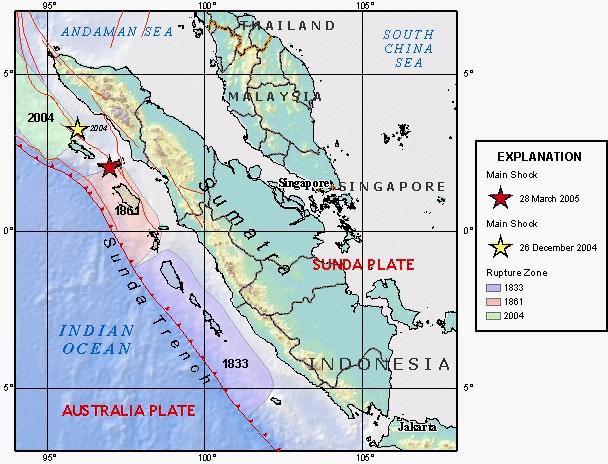
Fortunately, although hundreds have died, it looks as if the impact of yesterday's earthquake in Indonesia was not nearly as tragic as last December's quake, mainly due to the lack of an accompanying tsunami this time around. Due to the great depth (nearly 19 miles) at which yesterday's earthquake occurred, the seafloor did not pulse as much as it did last December, and relatively little wave action was generated.

The Earth moves, the oceans rise and mountains walk. Master Dogen knew this, as did the Buddhist patriarchs before him. Master Kai of Mt. Taiyo said, "The Blue Mountains are constantly walking. The stone woman bears children by night."

Master Kai, also known as Fuyo Dokai (1043-1119), was the forty-fifth patriarch from the Buddha. Having succeeded Master Tosu Gisei, Master Kai preached Buddhism on Mt. Taiyo and elsewhere, until he refused a title and a purple robe from the emperor and was banished. When he was eventually pardoned, be built a thatched hut on Mt. Fuyo and lived there in the style of the ancient patriarchs.

Master Dogen commented on this statement of Master Kai in the Sansuigyo, one of the fascicles in the Shôbôgenzô ("Treasury of the Eye of the True Dharma"). San means "mountains," sui means "waters" - rivers, lakes, and so on. Sansui then, suggests natural scenery, or Nature itself. Gyo, means Buddhist sutras. Therefore, Sansuigyo is often called "The Mountains and Rivers Sutra."

Buddhism is basically a religion of belief in the Universe, and Nature is the Universe showing its real form. So to look at Nature is to look at the Buddhist truth (dharma) itself. In Sansuigyo, Master Dogen explained the real form of Nature, giving particular emphasis to relativity in Nature.

Sansuigyo represents one of the earlier texts of the Shôbôgenzô. According to a manuscript of the work thought to be in the author's own hand, it was composed in the autumn of 1240, the year in which he seems to have begun to work in earnest on the essays that would make up his Shôbôgenzô. This was a time when Master Dogen was at the height of his literary powers, and the Sansuigyo is widely appreciated as one of the most elegant of his essays.

Several months before he wrote the Sansuigyo, Master Dogen composed another text of the Shôbôgenzô entitled Keisei sanshoku ("Sound of the Stream, Form of the Mountain"), inspired by a verse by the famed Song-dynasty poet Su Dongbo:

"The sound of the stream is his long, broad tongue;
The mountain, his immaculate body.
This evening's eighty-four thousand verses -
How will I tell them tomorrow?"


In the Sansuigyo, Master Dogen returned to the theme of this poem, to explore in detail the meaning of mountains and rivers as the very body and speech of the buddha. As he says in the opening lines, "The mountains and waters of the present are the expression of the eternal buddhas. Each abides in its own dharma state, having realized ultimate virtue."

The natural landscape that surrounds us here and now is the "expression of the eternal buddhas". The term "expression" (dô genjô) should be taken in two senses: as the words of the buddha and as his practice. In the Sansuigyo, the mountains and waters are at once preaching a sutra that reveals the dharma and themselves putting that dharma into practice.

According to Master Dogen, "Mountains lack none of the virtues with which mountains should be equipped. For this reason, they are constantly abiding in stillness and constantly walking. We must painstakingly learn in practice the virtue of this walking. The walking of mountains must be like the walking of human beings; therefore, even though it does not look like human walking, do not doubt the walking of mountains."

Mountains walk, and when they do, the Earth trembles, like it did yesterday.

Monday, March 28, 2005

Earthquake


Another large earthquake struck off Sumatra in the Andaman Sea today. The U.S. Geological Survey called it a major quake with a magnitude of 8.2. Although the quake was an aftershock from last December's magnitude 9.0 quake, it was a "very serious earthquake in its own right."

Police in Indonesia said hundreds of people may have been killed in collapsed buildings. Tremors were felt throughout peninsular Malaysia's west coast, causing thousands of residents to flee high-rise apartment buildings and hotels.

The earthquake occurred at 11:09 p.m. local time at a depth of nearly 19 miles and approximately 125 miles west-northwest of Sibolga, Sumatra, close to where the last December's tremblor struck. That undersea earthquake, the world's biggest in 40 years,and the huge tsunami it sent charging across the Indian Ocean at the speed of a passenger jet, killed more than 174,000 people and left another 106,000 missing. More than 1.5 million people were left homeless in 11 countries.

A spokesman for the USGS said that today's earthquake might also cause tsunamis. "Certainly evacuations should be occurring. I hope they are," the spokesman said.

Thousands panicked in countries across the Indian Ocean as tsunami warnings were posted. Malaysia urged residents along parts of its west coast to evacuate to higher areas. Sirens rang in the eastern Sri Lankan town of Trincomalee. India and Thailand also immediately issued tsunami warnings in coastal areas. Officials in Thailand later called their warning off, as the only tsunami reported within four hours of the earthquake was a tiny one, less than 4 inches, at the Cocos Islands.

Meanwhile, on the fundamentalist front, the Washington Post reports under the headline "Pharmacists' Rights at Front Of New Debate" that some pharmacists across the country are refusing to fill prescriptions for birth control and morning-after pills, saying that dispensing the medications violates their personal moral or religious beliefs.

This brings up rather disturbing questions as to where this might lead. Would they give medications to people suffering from venereal disease or other symptoms indicative of a "lifestyle" of which they don't approve? Will they dispense drugs for AIDS? What about life-saving antibiotics to people whose religious views conflict with theirs?

Will our medical system become hostage to a group from whom we have to seek approval before we can complete our treatment?

Saturday, March 26, 2005


Let's see, what shall I blog about today? I didn't really do much with this lovely day (the first real spring-like day of the year - the temps were in the 80s and the trees are all in blossom), so no "what I did today" blog. And I'm fresh out of dharma talks for right now. I think I've kicked religion around enought this week, anyway.

I know - I don't think I've blogged about masturbation yet.

Masturbation was apparently invented in 1712. That is the surprising assertion documented in "Solitary Sex: A Cultural History of Masturbation" (Zone Books) by Thomas W. Laqueur. Of course, that's an exaggeration, because since our primate cousins masturbate, we probably did so from our earliest beginnings. But in 1712, there was a shift in thinking about masturbation which brought it to the forefront of reform by moralists, physicians, and other do-gooders.

The ancients were nearly silent on the subject, and thought that masturbation was simply a method of ridding the body of excess sperm. In Jewish law, spilling seminal fluid was much debated by the rabbis.

The only reference in the Bible that could relate specifically to masturbation does not. Onan's crime is sometimes used as an injunction against masturbation, although the wiser commentators note that masturbation was not Onan's violation (coitus interruptus, and thereby refraining from being fruitful and multiplying, was). Early Christian teaching was that masturbation was nonreproductive, and was thus to be avoided, but it was not a big source of worry.

Then in 1712, John Marten produced his masterwork. Marten was a quack who had written on venereal disease and had been previously jailed for obscenity. But in 1712, he published "Onania; or, The Heinous Sin of Self Pollution and all its Frightful Consequences," and masturbation was never to be the same. Marten's book was basically a big advertisement for his potions, which would cure the horrid vice. Marten's new anxiety filled a need, which Laqueur claims was due to the philosophy of the Enlightenment. Masturbation was of great interest to major writers and philosophers: Voltaire, Mary Wollstonecraft, Swift, Rousseau, Kant and Whitman all thought and wrote about the "solitary vice."

It was not until well into the twentieth century that physicians stopped blaming masturbation for all sorts of illness, and now it is advocated as part of self-discovery. The famous sex shop Good Vibrations declares every May to be National Masturbation Month, and the poster last year had the slogan, "Think Globally, Masturbate Locally."

Those who want warnings on the evils of the practice can still find many religious leaders who will oblige them. Laqueur closes his study with the incident of Joycelyn Elders, who was surgeon general until 1995, when she answered a reporter's question saying that sex education should include teaching about masturbation. In the minds of some moral persons, this seemed equivalent to teaching techniques of masturbation. She had not previously pleased them with her outspoken views on AIDS or pre-marital sex, but she used the M word, causing a rift with that moral beacon, President Clinton, who said that her view of the benefits of masturbation reflected "differences with administration policy." While it amused many that there was an administration policy on masturbation, Elders was out, and the two century legacy of John Marten continued.

Friday, March 25, 2005


Let it be noted that today also marks the third full moon since the winter solstice, Purim, and the Hindu celebration of Holi. L. has been sick all week (flu), and I've spent the past few nights bringing her Kleenex, food, flowers and other essentials. Meanwhile, my antibiotic and prescription decongestant regime seems to be working - I've been able to sleep without stuffiness the last few nights.

Meanwhile, there are elements that appear to be trying to turn our country into a theocracy. Emboldened perhaps by a widely quoted but generally misunderstood exit poll last November that stated "moral values" were the main reason voters elected Bush, these elements have since tried to ban the teaching of evolution in classrooms and have intimidated those teachers who refuse to adopt their unscientific views; have appealed all the way to the Supreme Court the "right" of some southern judges to display the Ten Commandments in public, even Federal, courthouses; have threatened fines and penalties against television and radio programs that don't fit into their narrow view of "decency;" and are now trying to reverse what seems like at least 10 judicial decisions that have declared that a husband can't be denied allowing his literally brain-dead wife to die a natural death, even as they trumpet the "sanctity of marriage" (but which really means that they don't approve of gays).

It is ironic that as our government struggles to prevent Iraq from becoming an Islamic state, we ourselves are allowing this country to be transformed into a religious fundamentalist state. It is ironic that those who generally accept the death penalty, and have few qualms about the innocent Iraqis who die every day due to our aggression, are the most upset that a single woman may die after years of life support. And it is ironic that in those states that protest indecency over the airwaves the loudest, the very shows that they are against get even higher ratings than in more "permissive" states.

Don't let them bother you and don't let them intimidate you. Like all bullies, from playground punks to Joseph McCarthy to J. Edgar Hoover to any talk-radio pundit, they cannot withstand a challenge, or worse yet, to be ignored.

You might ask why I don't take my own advice and just ignore them as well, and simply go about my life and my practice, exercising the freedoms that I have, instead of ranting like some blogospheric version of Frank Rich. Well, I could show restraint instead of provocation, but what with Mercury in retrograde and all . . .

Thursday, March 24, 2005


Picture yourself on a boat on a river. That is what life is like.

Picture yourself on a boat on a river. On this boat, you are pushing along off of the bottom with a pole. You are pushing the boat, but at the same time, the boat is carrying you.

There is no "you" beyond the boat.

By pushing the boat along, the boat is being caused to be a boat. If it were not set in the water, and being poled along, this aggregate of boards and nails might have the form of a boat, but it wouldn't, in fact, be functioning as a boat. If this same coming-together of wood and steel were in the desert, could it really be called a "boat?" It is your poling it along on this river that is causing it to be a "boat."

Picture yourself on this boat on the river. In that very moment, there is nothing other than the world of the boat. Just as your poling is what causes the aggregate to be a boat, the boat is also defined by the river, and the river is defined by the shore, and the shore is defined by the land just as the land is defined by the sky. In fact, everything in the universe is defining every other thing in the universe, and they are all defining the boat, and you are pushing the boat, and at the same time, the boat is carrying you.

There is no "you" beyond the boat. "You" are defined not only by that aggregate which we are calling "boat," but which actually is the whole universe, and not only by the functions of poling and being carried, but also by your form and mass, which pushes the boat a little lower in the river, which displaces some water, which moves some air, which you are breathing in and out.

At this very moment, there is nothing other than the world of the boat, which is utterly different from moments not on the boat. While you are pushing the boat, your body and mind and circumstances and self are all essential parts of the boat; and the whole Earth and the whole of space are all essential parts of the boat.

Life is like this. Just as you are pushing the boat and the boat is carrying you, life is what you are making it, and you are what life is making you. What has been described like this is that life is the self, and the self is life.

- Shokai, based on "Zenki" by Master Dogen

Wednesday, March 23, 2005

Chronic Subacute Infection?

I returned my nose to the doctor today.

About a year and a half ago, I finally took myself to an otolaryngologist, commonly known as an ear-nose-and-throat man, to take care of a sinus situation. For all of my life, I've had trouble breathing, and have snored quite loudly. The snoring has driven many a woman from my bed, and I'm convinced that it has led, if even indirectly, to the termination of many of my relationships.

Before the otolaryngologist, I had gone to a primary health-care physician at Kaiser Permanente, who in turn referred me to a sleep clinic. Even before I saw a doctor at the clinic, they tried to sell me on the idea of sleeping at night with a CPAP machine. CPAP (Continuous Positive Airway Pressure) machines are basically gas masks that delivers high-pressure air to keep your breathing passages open, and are a common treatment for sleep apnea. I told the doctor, when I finally got to see one, that I didn't believe that I had sleep apnea, but he insisted that CPAP was what I needed, and even wrote a pissy letter to Kaiser after I declined to purchase one.

Well, shortly after that I got a new job and a better health-care program, and eventually found my way to the otolaryngologist. He took one short look up my nose and almost immediately said, "Oh, you're definitely blocked. You have a deviated septum." Forty-eight years going through life, and no one had ever told me that.


The surgery to fix the blockage wasn't all that bad, at least as far as any surgery can be considered, and I was out of the hospital the same day and back on my feet in very little time. However, the nose still felt stuffed up - sort of like a bad cold - because of swelling and bleeding from the surgery, but the doctor promised that it would pass soon.

But I was also still snoring.

The swelling and bleeding did eventually pass, but the stuffiness and snoring didn't. I went to a general physician about the stuffiness, and he prescribed various antihistimines and decongestants, which generally weren't very effective. However, one day I tried a 12-Hour Sudafed, and that changed everything.

The Sudafed cleared me right up, and I was breathing better and more fully than I ever had. And much to my delight, the snoring also stopped. My instinct was right - I didn't need the CPAP after all.

The trouble was that I would become stuffy again every 12 hours as the Sudafed wore off, so I had to keep myself constantly medicated, 24/7, or else get blocked up again. This bothered me on principal, but my doctor assured me that there was no long-term problem with taking the medication twice every day, and it sure beat the alternative of sniffling and snoring.

Now, I occasionally wondered what the reason was that I needed to stay medicated in the first place, but the whole thing was working so I didn't question it. So when I traveled from Atlanta to Brunswick to Budapest and back again last summer, I was packing Sudafed. When I was diving in Panama City and Grand Cayman, it was while I was on Sudafed. All of the things that have happened to me as recorded in this blog were all done on Sudafed.

So, naturally, I was disappointed last month when the Sudafed started to let me down. First, I noticed that it was no longer clearing me up as well or as quickly as it used to, and then L. started to complain that I was snoring again, and then it got to the point where I couldn't sleep at night because I'd get so stopped up that I couldn't breathe.

That was intolerable, so today I returned to the otolaryngologist and presented my nose to him once again. At first, he didn't see anything wrong, and I think that he might even have thought that I was being a hypochondriac, but eventually he concluded that I may be suffering from an infection.

"For the past year and a half?," I asked.

"Maybe," he replied. A chronic subacute infection."

So he prescribed me an antibiotic, Omnicaf (cefdinir) capsules, and a prescription-grade antihistimine to replace the Sudafed. I start the new regime tomorrow morning. I hope that I can sleep tonight.

Tuesday, March 22, 2005


In a dharma talk, Dogen said,
Even if you are speaking rationally (1) and another person says something unreasonable, it is wrong to defeat him by arguing logically. On the other hand, it is not good to give up hastily saying they you are wrong, even though you think that your opinion is reasonable.

Neither defeat him, nor withdraw saying you are wrong. It is best to just leave the matter alone and stop arguing. If you act as if you have not heard and forget about the matter, he will forget too and will not get angry. This is very important to bear in mind.

Chapter 1-10 from Shobogenzo-Zuimonki
______________________________

(1) The original Japanese is dori (Ch., daoli), which means 1. principal, truth, 2. reason, argument.

Monday, March 21, 2005


"Out of respect for Christians and Buddhists, in my opinion, it isn't very helpful to refer to Jesus as a bodhisattva."

The term bodhisattva comes from two Sanskrit words - bodhi meaning "wisdom," and sattva meaning "being." So therefore, bodhisattva literally means wisdom being, or wise man. The three wise men who came and visited the baby Jesus could just as easily be called the three bodhisattvas, especially because they were "from the east" (if they were from the west, they would be called "the three amigos"). In Sanskrit, there would be no translation other than "bodhisattvas" for the wise men. But was Jesus a bodhisattva?

Well, according to almost all Christian beliefs, Jesus was a being (sattva) - it is an important doctrinal point that God literally became man. And it would be doing Jesus a disservice to say that he wasn't wise (bodhi). So therefore, how could it be disrespectful to call Jesus a bodhisattva? I would think the opposite would be more true - it would be disrespectful to say that he wasn't a bodhisattva.

Of course, in Buddhism, the term also has a meaning deeper than a literal "wise man." A bodhisattva is an enlightened person who has vowed to forego his own nirvana until all other sentient beings have also been enlightened. At the end of every Zen service, we chant, "However innumerable all beings are, I vow to save them all" - the bodhisattva vow. And isn't that exactly what Jesus did, give up his own life for the salvation of all others? So how can a Buddhist deny that Jesus was anything but a bodhisattva?

Hitler was a Buddha.


Now, I know that may sound blasphemous and provocative, but in fact, not only do all sentient beings have buddha nature, but all humans are actually fully-formed Buddhas, lacking nothing, perfect and complete. Even Hitler. The problem is that they just haven't realized it yet. And in this ignorance (avidya) they imagine a separation between self and others, and thereby ultimately create great suffering. But the only real blasphemy is to deny any being's buddha nature. Even Hitler's.

"Bodhisattva
Would you take me by the hand
Bodhisattva
Would you take me by the hand
Can you show me
The shine of your Japan
The sparkle of your china
Can you show me
Bodhisattva

Bodhisattva
I'm gonna sell my house in town
Bodhisattva
I'm gonna sell my house in town
And I'll be there
To shine in your Japan
To sparkle in your China
Yes I'll be there
Bodhisattva"

- Steely Dan