Tuesday, January 04, 2005

RIP: Ray Charles and Artie Shaw


The poinsettia (Euphorbia pulcherrima) is the most popular Christmas flower. A shrub with red leaves, it is showy and colorful, but its blossoms are minuscule. Its colorful red leaves, the part most people think of as the flower, are called bracts. The actual blossoms are the tiny green or yellow buds in the center of the bracts' clusters.

It is also often mispronounced. The correct pronunciation is poin'-set-ee-ah.

Although the poinsettia has become a traditional symbol of Christmas, its history predates Christianity in the Americas.

The Aztecs put it to symbolic and practical use, prizing the plant, which was indigenous to an area south of Mexico City. From its bracts, they extracted a reddish-purple dye for textiles and cosmetics. The milky white sap, called latex, helped treat fevers. The plant also represented purity, serving as a reminder of human blood sacrifices.

In the 17th century, Franciscan friars displayed poinsettias during their Christmas celebrations, and the custom spread throughout Mexico.

In Mexican legend, a small boy knelt at the altar of his village church on Christmas Eve with nothing to offer but his prayers. Through a miracle, a brilliant red-and-green poinsettia sprang up at the boy's feet.

The poinsettia was brought to the USA from Mexico in 1829 by Joel Roberts Poinsett (1775 - 1851). Poinsett was an amateur botanist when President John Quincy Adams appointed him the first U.S. ambassador to Mexico in 1825. Poinsett became captivated by the bright red roadside plant that Mexicans call flor de noche buena, "flower of the holy night."

Poinsett became deeply involved in Mexico's politics and was soon meddling in its affairs and those of other Latin American nations. An exasperated Mexican government expelled him in 1829, declaring him persona non grata.

Poinsett took clippings of the noche buena to his South Carolina plantation, where they thrived in his greenhouse. He distributed plants to other botanists and friends, and the flower became identified with him around 1836.

Poinsett became secretary of war in 1837 and helped found the Smithsonian Institute in 1841. He died Dec. 12, 1851.

But the enduring popularity of poinsettias in the U.S. is due largely to the gardening and marketing skills of a little-known Southern Californian family.

Albert and Henrietta Ecke and their four children emigrated from Germany in 1902, planning a brief stop in Los Angeles en route to Fiji, where they planned to open a vegetarian health spa. But the rich soil and ideal climate in what would become Eagle Rock persuaded them to stay.

Albert Ecke planted fruit trees and opened a dairy farm, where he dabbled in growing gladiolus, chrysanthemums and poinsettias, selling them at roadside stands.

In 1906, as property values rose in Eagle Rock, Ecke sold the farm and relocated to Sherman, now West Hollywood, devoting a small section of the new farm to dairy cows and the rest to poinsettias. The sight of the red poinsettia fields began drawing busloads of tourists.

Ecke started experimenting with potted plants, shipping them east from his packing house on Sunset Boulevard. The packing house later became the Roxy Theatre on the Sunset Strip.

Albert Ecke died in 1919, leaving 24-year-old Paul Ecke in charge of the family business. Paul bought more land in West Hollywood for $500 an acre, and devoted time to perfect the first poinsettia that could be successfully grown as an indoor plant.

Paul Ecke promoted the poinsetia worldwide. In 1923, when urbanization encroached on his operation, Ecke moved south, to what would become 25 acres of greenhouses on 68 acres of land in Encinitas and another 60 acres in Guatemala.

A generation later, in 1949, Paul Ecke Jr. earned a degree in horticulture and went to work for his father. He persuaded his dad to sell cuttings, which were easier to transport than mother plants. The advent of jet airfreight made it possible to quickly ship delicate cuttings to growers, who could then get mature plants quickly to market.

In 1991, Paul "Mr. Poinsettia" Ecke Sr. died at age 96 and that year Congress declared Dec. 12 as National Poinsettia Day. His son, Paul Jr., died in 2002 at 76.

So successful were the Eckes at developing and promoting the poinsettia that today, including licensing deals, the Ecke Ranch is the source of more than 70% of the nation's poinsettias.


"The sea waves that have fixed themselves most firmly in the human imagination are the so-called tidal waves. The term is popularly applied to two very different kinds of wave, neither of which has any relation to the tide. One is the seismic sea wave, produced by an undersea earthquake; the other is an exceptionally vast wind wave—an immense mass of water driven far above the normal high-water line by winds of hurricane force.

"Most of the seismic sea waves, now called tsunamis, are born in the deep trenches of the ocean floor. The Japan trench, the Aleutian trench, and the Atacama trench have produced waves that have taken many human lives. A trench is a natural breeder of earthquakes; it is a place of disturbed and uneasy equilibrium, a place in which the sea floor has buckled and warped down to form the deepest pits of the earth's surface.

"The writings of man contain frequent mention of the devastation of coastal settlements by sudden great waves. One of the earliest on record rose along the eastern shores of the Mediterranean in 358 A.D., passed completely over islands, and flooded low-lying shores, depositing boats on the housetops of Alexandria, and drowning thousands of people. An hour after the Lisbon earthquake of 1755, Cádiz was visited by a wave that is said to have been fifty feet higher than the highest tide. Waves from this same disturbance travelled across the Atlantic, reaching the West Indies in nine and a half hours. In 1868, a stretch of nearly three thousand miles of the western coast of South America was shaken by earthquakes. Shortly after the most violent shocks, the sea receded, leaving ships that had been anchored in forty feet of water stranded in mud; then the water returned in a great wave and the ships were carried a quarter of a mile inland.

"This withdrawal of the sea from its normal stand is often the first warning of the approach of seismic sea waves. Natives on the beaches of Hawaii on the first of April, 1946, were alarmed when the accustomed voice of the breakers was suddenly stilled. They could not know that this recession of the waves from the reefs and the shallow coastal waters was the sea's response to an earthquake on the steep slopes of the Aleutian trench, twenty-three hundred miles away, or that in a matter of moments the water would rise rapidly but without surf, as though the tide were coming in much too fast. The rise carried the ocean waters twenty-five feet or more above normal high tide. In the open ocean, as is characteristic of seismic sea waves, the waves produced by the Aleutian quake were only about a foot or two high and would not be noticed from a vessel. Their length, however, was enormous, the distance between crests being about ninety miles. It took the waves less than five hours to reach the Hawaiian chain, so they must have moved at a speed of about four hundred and seventy miles an hour. Along the shores of the eastern Pacific, they were recorded as far into the Southern Hemisphere as Valparaíso, Chile; the distance, eight thousand and sixty-six miles from the epicenter of the earthquake, was covered by the waves in eighteen hours.
"

- Rachel Carson, The New Yorker, 1951

Monday, January 03, 2005

How Could God Have Let This Happen?


The toll from Asia's earthquake and tsunamis has climbed to 155,000 as more bodies are uncovered in Indonesia. Television commentators are referring to the disaster as being of "biblical proportions" for the way it swallowed up whole towns and villages with complete indifference.

This blog continues to get hits from web searches for topics like "buddhism + tsunami," indicating to me that many people are wondering what the Buddha's teachings have to say about the disaster. As I go to the other sites (besides this one) listed in the searches, I find few attempts to discuss this issue. While many Buddhist web sites express sympathy and compassion for the victims and survivors, and provide links to relief organizations, they don't seem to be offering a Buddhist interpretation of the events.

In today's Boston Globe, Charles Sennott addresses the question "How could God have let this happen?" He notes that deaths in war seem easier to comprehend. Even in the moral black holes of history, from the Nazi death camps to the slaughter in Rwanda, assigning blame is easier, even if the grieving is no less difficult. But when a natural disaster strikes, the question of God's role, or lack of one, presents an especially difficult challenge.

In Buddhism, "God" cannot be defined and cannot be differentiated. If anything is God, then all is God. While we like to think that man was created in the image of God, from a Buddhist point of view this is just human arrogance. So when an "act of God" results in an earthquake that kills 155,000 people, it's disturbing if we anthropomorphize "God" - then it's just another act of seemingly random cruelty.

In the particularly hard-hit Aceh Province of Indonesia, several statues of Buddha were reportedly unmoved by the flood waters. One news account quotes a Buddhist monk as saying: "The people are not living according to religious virtues. Nature has given them some punishment, because they are not following the path of the Lord Buddha. The people have to learn their lesson."

In my opinion, such a view is a fundamental misinterpretation of the Buddha-dharma. Buddhism does not accept the existence of a divine plan or intervention, but encourages its followers to seek the path that will allow them to accept the ever-changing state of the universe (impermanence) and the inevitable role of suffering in human experience (the First Noble Truth). Nature does not mete out punishment according to virtue or vice. The world is simply thus, including occasional earthquakes and tsunamis. In this world of samsara, even following the path leading to the cessation of suffering does not nullify the existence of the First Noble Truth. So no matter how sincere the practice of the people may be, rain will still fall, people will still grow old and die, and the earth will still occasional shake.

When it comes to events like this, Buddha's teaching can be very unpopular. My teacher, Michael Elliston-sensei, points out that when the Titanic went down, Sokei-An (an early teacher of Zen in America, who founded the New York Zen Institute in 1937) was giving a series of talks which were subsequently published in the newspaper. He made the point that everybody who had died on the Titanic was at least 50% responsible for their own deaths by virtue of having been born. Meanwhile, all the headhunters were trying to find who was responsible, who could be blamed, how the sinking could have been prevented, and so on. Meanwhile, Sokei-An was saying, "it's at least fifty-percent their fault."

As harsh as it sounds, each victim of the quake was at least 50% responsible for their own deaths, because each was responsible for their own birth. The law of dependent co-arising shows how each individual's existence arises out of desire, and how desire arises out of ignorance (avidya). Out of existence inevitably arises suffering, old age and death.

This is not to say that we don't have compassion for the victims and their survivors. Buddhism is at heart the never-ending commitment to relieve suffering in all its forms. So the compassion, while profound, also extends beyond just the recent events and includes the whole cycle of ignorance, desire, existence and death.

So what then is the Buddhist response to the earthquake? Certainly, support and contribute to the relief charities if you are able. But to really end the suffering, we must break the cycle of ignorance, desire, existence and death. And since the base of the chain of dependent co-arising is ignorance, the cycle is broken when ignorance is replaced by enlightenment, and all living beings are liberated from the cycle.

In Zen, enlightenment is achieved through realization of the true nature of the self:

"To study the way is to study the self.
To study the self is to forget the self.
To forget the self is to be enlightened by all things of the universe.
To be enlightened by all things is to transcend the distinction of self and other and to go on in ceaseless enlightenment forever."

- Dogen Kigen Zenji

Sunday, January 02, 2005

Insomnia


Today is the last day of my at-home vacation, my little experiment with unstructured time. But last night, I couldn't sleep. Insomnia.

I hate that sensation - tossing and turning, the mind anxiously jumping from one topic to another, including the fact that it's now 3:45 in the god-damn morning, and I have got to get to sleep right now, there's things to do in the morning and the alarm clock is going to go off in exactly 3 hours and 15 minutes and I need more than three and a quarter hours of sleep, but that will have to do, so go to sleep NOW!, which would be easier if the pillow weren't so hard/soft and the blankets weren't so heavy/light, and the noise from the furnace weren't so loud and why is the heat on now anyway, I really ought to reprogram the thermostat, last month's gas bill was three times the month's before, but don't worry about it, there's nothing I can do about it now so just go to sleep (is it 4 a.m. yet?), this really sucks, should I set the alarm for a little later, will that really make any difference anyway, tomorrow I am definitely going to get a better night's sleep . . .

And so on. At some point, whatever anxiety kept me from falling asleep in the first place was forgotten and replaced with the anxiety of not getting to sleep. A sort of self-reinforcing negative feedback loop. I once read somewhere that if you have trouble falling asleep, the best thing to do is get up out of bed to break the cycle, read a little or something, and then try going back to sleep again. I got up, drank a small bottle of fruit juice, read J.D. Salinger's "It's a Perfect Day for Bananafish" over on Tony Pierce's blog, drank a second bottle of juice (my mouth was still dry) and then went back to bed. No use. I still couldn't sleep, but now, on top of my other complaints, my stomach felt bloated from the two bottles of juice.

I had wanted to get up and go to the Sunday morning service at the zendo. I even showered and shaved my head the night before so I could get there early, but around 4:30 a.m. I realized that I wasn't going to get enough sleep to make it, so I gave up my ambitions and turned off the alarm clock.

A lack of exercise sometimes leads to insomnia, and I did spend a lot of yesterday sitting on the sofa watching college football, but after the Georgia-Wisconsin game I was too emotionally drained to focus on the other games still in progress, so I went outside to do some yardwork.

Earlier this week, I took down a small tree that was growing over the house and blew the leaves off of the roof, the back patio and the driveway, and even raked along both sides of the street to clear off autumn's deposits. But there's still a lot of yard buried under three to six inches of leaves, some areas from as long ago as the three hurricanes that blew through here last fall. My neighbors all seem to be using professional landscaping companies who send three- or four-man teams of Mexican laborers to clear off their yards, each company leaving their flyer in my mailbox, wondering perhaps why I'm holding out, but I'm stubbornly trying to do it myself. Making the work part of my Zen practice.

So anyway, after the Georgia-Wisconsin game, I went and did some raking, and broke a sweat walking up and down the steep driveway carrying the leaf bags to the street. I worked for about two hours and only quit when I finally ran out of empty bags in which to put the collected leaves and besides, it was getting dark. But my point is, I did get some exercise and I didn't spend the entire day as a couch potato, so I should have been able to sleep.

Part of the problem might have been that my body clock had shifted during my time off of work. As I had blogged on Christmas Day, anytime I'm off of work it seems that my body rhythm quickly goes nocturnal. And what with all of the late, West-coast football games on the last couple of nights, I've been staying up until 2:00, 3:00 or even later and sleeping until 10 or 10:30 in the morning. So my attempt to put myself to sleep at midnight so I could get up in time to make the 8:00 a.m. Sunday Zen service might have conflicted with my new cicadan rhythm. How will I ever get to the office tomorrow by eight?

And that anxiety also played through my head as I laid there sleepless last night.

So, other than completely messing up my sleep cycle, what did I accomplish during the week off? What did I get done during this structureless week?

Not much. I had composed a list of things to do for myself before the week began. Let's review the list and see how much I got done:

1. Fix computer. You might not know it by reading my blog, but the computer I'm using to compose these posts is running like shit. It keeps freezing up, constantly needs to be re-booted, and generally acts like it has no RAM. It has 128 megs, which ain't much (although it seemed like some real horsepower back when I bought it), but it was enough to run the computer until recently. I tried running the defrag program, ran it for almost 24 hours, but it still said "0% complete." Is it possible for a computer to get so defragmented that it can no longer run the defrag program? So my plan was to buy another 128 megs of RAM, install it, defrag the hard drive, and see if that helped. But I never did make it to the store. However, I did notice that the computer was running a little bit better after the 24 hours of running the defrag program, despite the zero percent completion, so I've been trying to continue to let the program run during non-use periods. However, I've not seen any more improvement in performance, and am worried that the whole thing might crash any day now, and I'll lose all my files, MP3s, pictures, programs, etc.

2. Change address on driver's license/tag registration. According to Georgia law, you have 30 days after you move to change the address on your driver's license and to change the county sticker on your tag (license plate). However, the way Georgia is set up, this requires two different visits to two different offices, both of which are notorious for their long lines and under-motivated public servants. Since I moved in mid-August, I was supposed to have this done by mid-September, but I've been putting it off for months now, so I resolved to take care of this during the past week. Of course, it didn't happen. I only got as far as identifying the locations of the two nearest offices, neither of which is really convenient to me, but what with holiday closures and weekends, I never made it to either office. So meanwhile I'm driving around as a ticket just waiting to be issued.

3. Fix toilet in condo. Forget about it - I never use that toilet, and besides, who wants to spend their day off in an unfurnished, unsellable condo in Vinings trying to fix a toilet they never use? Some other time . . . .

4. Get duct tape marks off car. Last October, before leaving for the Panama City dive trip, my driver's side window wouldn't roll up, and I finally had to pry it up and keep it closed using duct tape as a last-minute, desperation fix as my ride was leaving. I eventually got the window repaired, along with a host of other things, but the duct tape left marks on both the window and body that don't come off in the car wash. I was determined to clean these off this week using razor blades and solvents, but never got around to it. However, there's a good chance I will do this today.

5. Join a gym. Nope. I didn't even make it to karate this month. Besides, most gyms are overrun with "resolutionaries" in January, so it's not a good time to join. Better to focus on running and karate, and join a gym, say, this spring, when things have thinned out a little.

6. Buy living room furniture. When I moved here from the unsellable condo in Vinings last August, I had enough furniture to fill most of the house, except for the living room (the sofa and television went in the den). Which is embarrassing, because the front door leads into the living room, and the first impression a visitor gets upon entering my house is that no one really lives here, or that I've taken some sort of vow of poverty. I did get as far last week as driving to Perimeter Mall and checking out a sectional Bloomingdale's had advertised, but it wasn't to my liking. However, the salesman advised me that February is the best month to buy furniture - that's when all the big sales occur. Oh boy, just what I needed - a rationalization to procrastinate.

7. Buy mirror and sconces for bathroom. The previous owners took the mirror and lights from the main bathroom (not the master bath) with them when they moved, leaving me with big gaping holes in the bathroom wall. But unlike Task 6 above, I didn't even get as far as shopping for replacements. No alabis. Just didn't get done . . .

8. Yard work. Okay, I did make some progress on at least this one task. However, there's still plenty more left to be done, and since all the neighbors have hired professional landscapers to remove their leaves, my home is now the neighborhood eyesore, with brown leaves still all over the front yard. But at least the roof and driveway are clear.

So, what did I do with my time? Watched football. Wrote in my blog and read other blogs. Other than that, I don't really know how to account for myself. Even today, after finally getting some sleep, I wound up waking up late and am even right now squandering an otherwise sunny, beautiful day (one of only 8,549 I've got left) sitting inside writing this blog.

The lesson: I'm still not very good with big stretches of unstructured time. Fortunately, I go back to work tomorrow (if I can get up in time), and I have a sesshin next weekend. Therefore, I don't have any "free" time until January 15. And since all my other time is taken up, I probably will have "must-do" chores for that weekend, so my time will have some structure to it for at least the next two weeks.

Hopefully, that realization will allow me to get to sleep tonight.

Saturday, January 01, 2005

New Year's Day


Great, now I have an expiration date: according to The Death Clock, my personal day of death is Friday, May 5, 2028. The Death Clock estimates your longevity based on factors such as age, weight and smoking, and calculates the date of your death based on your birth date and your predicted lifespan. So, it now being 2005, I have 23 years, five months and five days left, barring any accidents, violence or the inevitable end of the world. Put another way, I have approximately 8,550 days left. How, then, will I spend today?

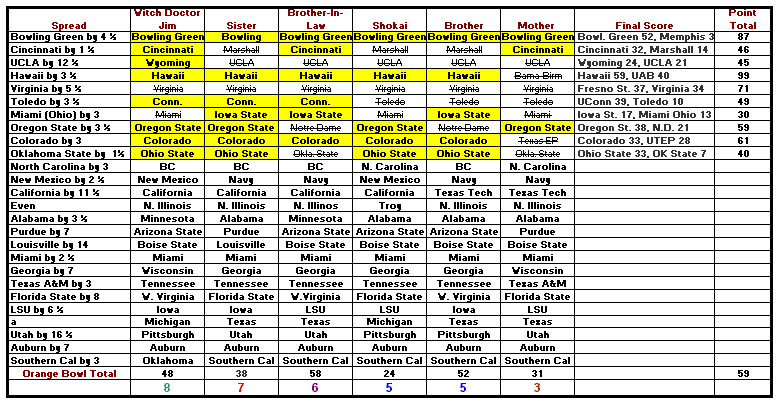
Apparently, watching football. Yes, today's the big day for the Bowls, and even though I'm now eliminated from the family pool, I can still cheer against Witch Doctor Jim. However, with only four games left to the season (as I write - there're two more games left today), the Witch Doctor holds a three-game lead. At best, my sister or the BiL can tie him and win via the tie-breaker (total points in the Orange Bowl). Here, the Witch Doctor is at a slight disadvantage - with 48 points picked against my sister's 38 and the BiL's 58, a total score has to be between 43 and 53 points for the tie-breaker to go Doc's way, and the average point total so far has been 56 points. So I find myself in the unusual position of having to cheer for Texas (Rose Bowl) and against Pittsburgh (Fiesta Bowl), and I hate Texas while I'm fond of Pittsburgh. . . but not nearly as much as I want to see the Witch Doctor lose!


Last night, I saw the New Year in at the Zen Center. It was a small turnout - sensei, myself and about six others; a couple others had left before midnight, apparently having a better place to be when the ball dropped, but another couple showed up shortly before midnight. Afterwards, we had a small (but illegal) bonfire in the back yard despite the open burning ban in Atlanta, and I allowed myself a single glass of champagne (technically, I don't drink, but I made an exception to celebrate the holiday).

I wish all a happy new year!

Congratulations in advance to whoever wins the football pool, even if it turns out to be the Witch Doctor.

Best wishes and a swift recovery to all of the tsunami survivors in Asia.

Best wishes, too, to Petra Nemcova and Simon Atlee.

And here's to a successful recovery from dioxin poisoning to Viktor A. Yushchenko.

May the New Year bring peace, prosperity and wisdom to George W. Bush, Donald Rumsfeld, Condoleezza Rice, Dick Cheney, Vladimir Putin, and Michael Crichton, even though I will continue to make fun of all of them in 2005.

Gassho to all the bodhisattvas, arhats, Buddhas, senseis and all of the other Shokais on the Internet.

But most of all, happy New Year to you.

UPDATE: The bad news: Texas just failed to cover the spread, so Witch Doctor Jim has won the Football Pool. The good news: no more spread sheets need to be posted. . .

Friday, December 31, 2004

New Year’s Eve Celebration

Friday, December 31, 2004, 6PM – Midnight(+)
with Taiun Michael Elliston, Abbot


You are invited to celebrate the New Year at the Atlanta Soto Zen Center!

This special new year’s eve service includes cleaning, sitting, soba noodles and broth, recitation of "Dogen's 108 Gates to Enlightenment", and the traditional 108 bells counting down to midnight.

Shortly after midnight we will wrap up our New Year's eve observances with a small warming fire outback. Please bring sake, champagne, non-alcoholic beverages or snacks to share.

Regular Saturday morning services will be held January 1 starting at 7:30am.

Sunday morning services January 2 will include a Fusatsu (precepts renewal) ceremony.

The Smoke Clears

. . . and I am out of it. The football pool that is. After 14 games, I only picked five correctly, and even if I win every game from here on it, I can't pass my brother. I would wind up in a four-way tie for second place with the Witch Doctor, the BiL, and my sister, although there is no second-place consolation prize.


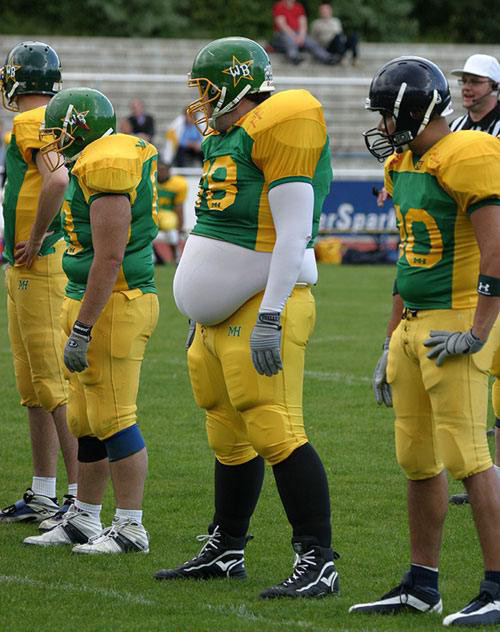
All four of my teams lost yesterday after B.C. upset North Carolina, Navy upset New Mexico, Texas Tech beat fourth-ranked California in one of the biggest upsets of the season, and Northern Illinois beat Troy (who are those guys?). It probably didn't help that the starting quarterbacks on most of my teams showed up for their games looking like this:


There's four games today, but I don't care now. I can go out and enjoy my New Year's Eve without worrying about the Boise State-Louisville point spread. On New Year's Day and beyond, I can cheer for my teams without anxiety. Years of being a Red Sox fan has taught me how to find solice in losing. That's something I hope not to lose now that the Sox are the defending World Series Champions!

The blog keeps getting hits from Europe and eastern Asia about the tsunami and the aftereffects of the earthquake. My most deepfelt sympathy and compassion goes out to all the victims, their loved ones, their families and those who care about them.


From: Paige
Sent: Friday, December 31, 2004 3:59 AM
To: Shokai2k4@hotmail.com
Subject: Blog Quote

Hey,

I like what you did for the link/content- very intriguing and a good use of representation and images. I'm happy to know that someone out there was able to understand what I was saying!
Thanks for the link too!

Have a happy new year,
Paige

HAPPY BIRTHDAY, JACKIE!

Thursday, December 30, 2004

Artie Shaw


Artie Shaw, the jazz clarinetist and big-band leader who successfully challenged Benny Goodman's reign as the King of Swing with his recordings of "Begin the Beguine," "Lady Be Good" and "Star Dust" in the late 1930's, died yesterday at his home of natural causes. He was 94.

Upon learning of his death, most people expressed surprise that he had still been alive.

Artie Shaw's virtuosity on his instrument, his groups' highly original arrangements and his explosively romantic showmanship made him one of the most danced-to bandleaders of swing and one of the most listened-to artists of jazz. He quit performing in 1954 , but the many re-releases of his discs and his informed but often sardonic comments on music and many other subjects kept him in the public ear.

Mr. Shaw impressed and amazed clarinetists of all schools. Barney Bigard, the New Orleans clarinetist who was Duke Ellington's soloist for 14 years, said he considered Mr. Shaw the greatest clarinetist ever. Phil Woods, a saxophonist of the bebop era, took Charlie Parker as his inspiration on saxophone, but he modeled his clarinet playing on Mr. Shaw's. John Carter, a leading post-bop clarinetist, said he took up the instrument because of Mr. Shaw. And Franklin Cohen, the principal clarinetist of the Cleveland Orchestra, said he found his playing unbelievable.

In the 1930s, he formed a band with the same instrumentation as Goodman's, promising it would be "the loudest band in the whole damn world." As the band developed during a long run at the Roseland-State Ballroom in Boston, the original concept changed to a concentration on smoothly swinging treatments of the music of Jerome Kern, Cole Porter, Richard Rodgers, Vincent Youmans and others.

Mr. Shaw, however, was not prepared to put up with the demands of his fans, the bobby-soxers who mobbed him and tore his clothes, and whom he called morons. In December 1939, the tension finally made him walk off the bandstand at the Cafe Rouge of the Hotel Pennsylvania in New York City and disappear.

"I wanted to resign from the planet, not just music," he said later. "It stopped being fun with success. Money got in the way. Everybody got greedy, including me. Fear set in. I got miserable when I became a commodity."

He disappeared to what was then a little-known village in Mexico - Acapulco - where he was ignored for three months until he rescued a woman from drowning and reporters found out who he was. Then he returned home to Hollywood.

In December 1941, Mr. Shaw flew to California and married Elizabeth Kern, the daughter of Jerome Kern, before enlisting in the Navy. He was ordered to form a band, and when he heard the band members he had been given, he went AWOL ("tacitly," as he said) in order to see the Secretary of the Navy. Mr. Shaw left the meeting with permission to enlist a band to be taken to the Pacific. He recruited some of the best musicians he had worked with in civilian life. The band played up and down the Pacific, on tiny islands and in jungles. It played so relentlessly that in 1943 it was sent to New Zealand to rest, and a year later it was dissolved. Mr. Shaw received a medical discharge.

In March 1954, after a playing with a small group at the Embers in New York, he announced his retirement at age 43. He never performed again.

Among other things, he became a lecturer on the college circuit offering a choice of subjects, including "Consecutive Monogamy and Ideal Divorce," in which he presented himself as "the ex-husband of love goddesses and an authority on divorce."

His source material for his lectures came from his experience with eight wives, who included, in addition to Miss Kern, three movie stars (Lana Turner, Ava Gardner and Evelyn Keyes) and an author (Kathleen Winsor, who wrote the 1940's best-seller "Forever Amber").

"People ask what those women saw in me," Mr. Shaw said. "Let's face it, I wasn't a bad-looking stud. But that's not it. It's the music; it's standing up there under the lights. A lot of women just flip; looks have nothing to do with it. You call Mick Jagger good-looking?"

All his marriages ended in divorce.

- John S. Wilson (former jazz critic for The New York Times, Mr. Wilson died in 2002)

Image Is Everything

There's been quite a difference in the search engine hits this site has been getting, as evidenced by these results from the past 24 hours:

1. buddhism - sri lanka earthquake, Yahoo, from the Pacific Rim (Russian Federation Zone 5)

2. burma tectonic plate, Yahoo, from the U.S. Central Time Zone

3. buddhism tsunami, Yahoo, from Hong Kong

4. phuket tsunami, Technorati, from Central European Time Zone

5. hindu worshipers hit tsunamis, MSN, from the U.S. Central Time Zone

6. top ten world's deadliest tsunamis, Yahoo, from the U.S. West Coast

7. deadliest tsunamis last 100 years, MSN, from the U.S. East Coast

8. graph of deadliest tsunamis, Yahoo, from the U.S. East Coast

9. india/burma geological plate, MSN, from the Rocky Mountain States

10. india plate burma plate, AllTheWeb.com, from the U.S. West Coast

11. tsunami,aceh,picture, Yahoo, from the Pacific Rim (West Australian Standard Time)

12. buddhism tsunami and buddha, tsunami, Yahoo, from the China Coast (Russian Federation Zone 7)

13. indonesian earthquake msn, MSN, from the Alaska-Hawaii Time Zone

14. india burma tectonic plate, OptusNet Search, from Australia

15. tsunami picture sumatra, Yahoo, from the Pacific Rim (West Australian Time Zone)

16. missing tsunami, HotBot, from Germany

Sure, there was still one more Michael Crichton hit, a Shokai search, and, interestingly, an AltaVista search from Germany for the words Messner, Nanga and DNA which referred all the way back to my June 26 blog entry. But what I see today is that many people are searching the Internet for news, information, and spiritual guidance on the disaster in Asia. And if 16 of those searches led to this crappy little insignificant blog, I can only imagine how much traffic is out there at the useful sites.

So, it seems that in addition to Americans, there are Chinese, Australians and Europeans who have visited this site looking for information or opinion about the tragedy. And what do they find here? Pictures of Petra Nemcova! I hope that my readers realize that I did not single her out as the lone victim to discuss because my compassion is so limited that I only care about the hot supermodel victim, or that my sympathy does not extend to the now 120,000 Asians who have perished so far. I meant it more as an ironic statement about the American news coverage of the event, which has focused more on the tourists in Phuket and the European and American victims than on the vastly greater number of Asian victims.

In her blog "C'est What?," Paige points out that there is no great set of images to link us to this event, and quotes Guy-Ernest Debord: "In societies where modern conditions of production prevail, all of life presents itself as an immense accumulation of spectacles. Everything that was directly lived has moved away into a representation." She says, "The tsunami has become another 'Us' versus 'Them,' in which Western media and society doesn't care what happens to the 'others.'" In other words, the disaster is just plain bad television, and we've become so infatuated by the media that if it can't be represented in a single iconic image or a 10-second film clip, we get bored, and click the remote to the next channel.

This is Paige:

Blogger extraordinaire Tony Pierce, author of How To Blog, uses provocative pictures to lure horny guys to his site and to keep them coming back. "Men are easily distracted, visual creatures," he says, "therefore you need to make your page visually appealing to them. Especially if your content is so-so." And as I said, the single iconic image is more important in today's media than the content . . .

Things didn't work out very well for my Mom in the football pool last night - both of her teams lost, and she is now alone in last place, trailing the Witch Doctor by five games. I trail by three, but I'm hoping to pick up a game on the Witch Doctor with a North Carolina win over BC. Also, I'm the only one who picked Troy State over Northern Illinois (who are these guys?), so a win there would give me one-up on everybody else. Since there's four games today, a lot of smoke will have cleared by the end of the day.


Sent: Wed 12/29/2004 5:33 AM
Subject: RE: Quake Disaster - How you can help

Dear Colleaques,

Thank you to all who e-mailed to express their concern. All Singapore & Malaysia staff and their families are fine although we have not been able to contact a staff currently on leave.

Malaysia was less impacted by the tsunami compared to Thailand and Indonesia while Singapore was not affected at all. Nevertheless, we're all shocked by the scale of the tragedy and the locations affected - these are places that we would likely vacation at with our families.

A number of relief and humanitarian agencies such as the International Red Cross and Red Crescent are available in Singapore and Malaysia to receive donations as well. At the moment, at least in Singapore, the agencies have only asked for donations.

Take care,
Juliana D.
Singapore

Wednesday, December 29, 2004

Petra Nemcova


Supermodel Petra Nemcova was injured and her boyfriend, British photographer Simon Atlee, was missing after the pair were caught up in the Asian tsunami disaster. Nemcova and Atlee had been vacationing in the resort of Phuket when the waves swept over them on Sunday. Nemcova, who appeared on the cover of 2003 Sports Illustrated swimsuit issue, clung to a tree for eight hours as the water swirled around her. She suffered a shattered hip and internal injuries. British authorities have no word on the status of Atlee.

Last night was somewhat interesting in the football pool (note: the pool was interesting - the games continue to be unremittingly dull). After the Iowa State upset of Miami (Ohio), the BiL briefly moved into a first-place tie with the Witch Doctor, and my brother moved ahead of my Mom and I, leaving us tied for last place. However, both my brother and the BiL chose Notre Fucking Dame over Oregon State, the only ones to do so, so they quickly lost their good fortune when the Irish lost 38-21. So the Witch Doctor's still in the lead, with my sister and the BiL behind by one game, and my brother, my mother and I all three back.


Tonight's games are probably only interesting to my Mom. Everyone but her picked Colorado over UTEP, so she might be able to pick up one game there. Next, she and the BiL were the only ones to choose OK State over Ohio State, so if things go their way, Mom could catch up with my sister and the BiL can once again tie the Witch Doctor.

Alternately, Mom might find herself all alone in last place, trailing my brother and I by two games.

WASHINGTON (CNN) -- A comment Defense Secretary Donald Rumsfeld made during a Christmas Eve address to U.S. troops in Baghdad has sparked new conspiracy theories about the terrorist attacks of September 11, 2001.

In the speech, Rumsfeld made a passing reference to United Airlines Flight 93, which crashed in Pennsylvania after passengers attempted to stop al Qaeda hijackers.

But in his remarks, Rumsfeld referred to the "the people who attacked the United States in New York, shot down the plane over Pennsylvania."

A Pentagon spokesman insisted that Rumsfeld simply misspoke, but Internet conspiracy theorists seized on the reference to the plane having been shot down.

Was it a slip of the tongue? Was it an error? Or was it the truth, finally being dropped on the public more than three years after the tragedy?

Some people remain skeptical of U.S. government statements that, despite a presidential authorization, no planes were shot down September 11, and rumors still circulate that a U.S. military plane shot the airliner down over Shanksville, Pennsylvania.

A Pentagon spokesman insists Rumsfeld has not changed his opinion that the plane crashed as the result of an onboard struggle between passengers and terrorists.

The independent panel charged with investigating the terrorist attacks concluded that the hijackers intentionally crashed Flight 93, apparently because they feared the passengers would overwhelm them.

Tuesday, December 28, 2004

Welter & Waste

". . . the earth then was welter and waste and darkness over the deep and God's breath hovering over the waters . . ."

Survivors of the gigantic undersea earthquake on Sunday that swallowed coastlines from Indonesia to Africa - which officials now describe as one of the worst natural disasters in recent history - recovered bodies today, hurriedly arranged for mass burials and searched for tens of thousands of the missing in countries thousands of miles apart. The reported deaths from the disaster climbed today to more than 50,000, with some reports placing the number near 60,000. A third of the dead are said to be children. With hundreds of thousands of people stranded in the open without clean drinking water, epidemics of cholera and other waterborne diseases could take as many lives as the initial waves.

There are some interesting blogs about the disaster written by survivors here, here and here. They also provide information on relief organizations. It's kind of hard for me to add anything to what they have to say, so I won't try.

I met my friend K. for coffee this moring at Starbucks, then went to the office to answer a few emails (I know I'm on vacation, but clients are still important). The rest of the day was spent finishing the yard work I started yesterday - I took down a tree, blew the leaves off the roof, and raked/swept/blew the leaves from the back patio all the way around to the street.

I trail Witch Doctor Jim by three games in the pool now, along with my Mom and my brother. For the next four games (tonight and tomorrow), our picks are the same, so I can't make up any ground on the Witch Doctor until North Carolina beats BC (by more than three points) on Thursday. The BiL and my sister trail the Witch Doctor by 1 and 2 games, respectively. A Miami (Ohio) win over Iowa State (by >3) would get me one game closer to them, and an Oregon State win over Notre Fucking Dame (by 3 1/2) would tie me with the BiL. So if everything goes my way tonight, my Mom and I will be in a three-way tie for second place with the BiL, and my poor brother will be left all alone in last place with only two wins to his name.

Recent Web Searches

Christmas Day, soyu matsuoka, from AOL on the East Coast

Christmas Day, Chattanooga zazen, from Comcast on the East Coast

December 26, Arden's Garden, from Dogpile on the East Coast

December 27, paper that dissolves in water, on MSN in the Central Time Zone

December 28, michael creighton + State Of Fear, a Google search from the East Coast (fourth reference on page)

December 28, shokai, another Google on the East Coast (seventh reference, Otsuka Corporation of Japan's home page was the first reference).


In the Beginning, God Did Not Create the Heavens and the Earth.

THE FIVE BOOKS OF MOSES
A Translation With Commentary.
By Robert Alter. 1,064 pp. W. W. Norton & Company. $39.95.

Reviewed by Edward Rothstein
The New York Times: December 29, 2004

The King James Bible puts it too neatly: "In the beginning" could mean that the creation was God's first act, or that the creation was itself the beginning, but wasn't something there before? The sentence also reads like a topic sentence, bluntly introducing that account that follows.

Things are actually far more mysterious and inchoate, as Robert Alter keeps reminding us in his astonishing translation of the original Hebrew text of the first five books of the Bible. There are so many accretions of meaning and assumption layered over the Biblical text, so many commentaries, so many doctrines; even the English language has been influenced by the glories (and errors) of the 17th-century King James translation.

Return, then, to the Hebrew text of the Pentateuch - the Torah - where pronouns are often ambiguous, words are compacted with multiple meanings and clauses can begin to make sense not in the ordinary sequence of reading but only in the course of doubling back and rereading. Here is how Mr. Alter renders that first sentence of Genesis:

"When God began to create heaven and earth, and the earth then was welter and waste and darkness over the deep and God's breath hovering over the waters, God said, 'Let there be light.' "

That sentence unsettles. The creation is not a completed act, but part of a process. The act of speaking is the focus of attention, coming after an almost breathless catalog of elements in a world "without form and void" (as the King James version puts it), in which "welter and waste and darkness over the deep" and "God's breath" are components of a primordial earth.

It isn't likely that this rendering will soon replace the old. It doesn't easily scan. But it is so weirdly convincing, and so evocative of matters beyond conventional understanding, that it anticipates not just the story of Creation but the epic enterprise of translation and commentary into which Mr. Alter leads us.

Monday, December 27, 2004

Tsunami


According to today's The New York Times, the death toll in Asia from Sunday's tsunamis now exceeds 19,000, with untold numbers still missing in six countries.

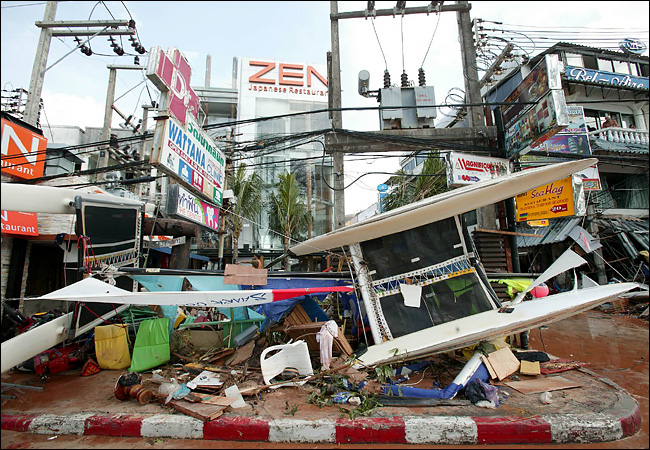
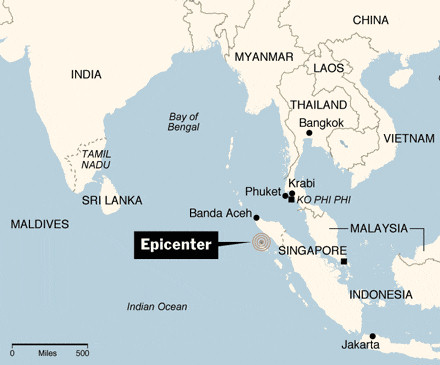
The world's most powerful earthquake in 40 years erupted underwater off the Indonesian island of Sumatra on Sunday and sent walls of water barreling thousands of miles. The earthquake, which measured 9.0 in magnitude, set off tsunamis that built up speeds of as much as 500 miles per hour, then crashed into coastal areas of Sri Lanka, India, Thailand, Indonesia, the Maldives and Malaysia as 40-foot-high walls of water, devouring everything and everyone in their paths.

It took several hours in some cases on Sunday for the waves to build and reach their targets after the earthquake struck. But none of the most affected countries had warning systems in place to detect the coming onslaught and alert their citizens to move away from the coastline.

The tsunamis were generated by underwater seismic disturbances, in this case the interface of the India and Burma tectonic plates. Seismologists with the U.S. Geological Survey said the ocean west of Sumatra and the island chains to its north was a hot zone for earthquakes because of a nonstop collision occurring there between the India plate, beneath the Indian Ocean seabed, and the Burma plate under the islands and that part of the continent.

The India plate is moving at about two inches a year to the northeast, creating pressure that releases, sporadically, in seismic activity. But this was an especially devastating earthquake, the fourth most powerful in 100 years.

Television images showed bodies floating in muddied waters. Cars went out to sea; boats came onto land. Snorkelers were dragged onto the beach, and sunbathers out to sea. Aid agencies were rushing staff and equipment to the region, warning that rotting bodies were threatening health and water supplies.

Indonesia reported nearly 4,500 dead, most in the Banda Aceh area of Sumatra, a region that has been the site of a continuing civil war. In Sri Lanka, at least 6,000 were dead. In India, an estimated 2,300 died, with at least 1,700 confirmed dead in Tamil Nadu, the southern state that is home to the coastal city of Madras.

The death toll is expected to climb. Many areas from the atolls of the Maldives to the Nicobar Islands of India were simply out of reach, with communication lines snapped. Thousands more people in those places are feared marooned or dead.

Below is a list of the deadliest quakes of the past 100 years, according to the U.S. Geological Survey. In some cases, death tolls include those killed in ensuing fires and collapses.

1976 China, Tangshan - 255,000 dead (7.5 magnitude)

1927 China, near Xining - 200,000 (magnitude unknown)

1920 China, Gansu - 200,000 (8.6)

1923 Japan, Kwanto - 143,000 (magnitude unknown)

1948 Turkmenistan - 110,000 (7.3)

1908 Italy, Messina - up to 100,000 (7.2)

1932 China, Gansu - 70,000 (7.6)

1970 Peru - 66,000 (7.9)

1935 Pakistan, Quetta - up to 60,000 (7.5)

1990 Iran, Gilan - 35,000 (7.7)

2003 Iran, Bam - 31,000 (6.8)

With all of this suffering, it is hard to blog about my own little pissant problems. It's hard to blog about football. There're two games on today (the football pool continues). The first, Virginia v. Fresno State in the MPC Computers Bowl (2:00 p.m.), is a non-event, since everyone in the pool picked Virginia. We'll all go up or down one game together, but no one will pick up a game on anybody else. The second game, Toledo v. UConn in the Motor City Bowl (5:30 p.m.), should be more interesting. I can pick up a game on the Witch Doctor and the BiL with a Toledo victory (by 3 1/2 points), but I will miss at least the second half of the game as tonight is my Monday night opening at the Zen Center.

But meantime, I have yardwork to do - leaves to be blown, branches to be cut down, and ivy to be trimmed.

AN END TO SUFFERING
The Buddha in the World

By Pankaj Mishra
Illustrated. 422 pages. Farrar, Straus & Giroux. $25

Reviewed by William Grimes
The New York Times: December 27, 2004

In an Age of Strife, What Would Buddha Do?

The Indian novelist and journalist Pankaj Mishra had two ideas when he came up with the subtitle "The Buddha in the World." Always, in his rambling meditations on the history and meaning of Buddhism, he struggles to place the Buddha in historical context. He evokes the physical settings, socioeconomic changes and political tensions of Northern India six centuries before Jesus, the world in which Siddhartha Gautama first spread his radical message.

At the same time, his own spiritual quest pulls the story into the present, as he sorts out his conflicted feelings about Buddhism and its relevance to the world of terrorist bombings, multinational corporations and seething third-world discontent.

Mr. Mishra, the author of a highly praised novel, "The Romantics," has written an odd, uneasy book. It began life as a projected historical novel about the Buddha. Mr. Mishra, who grew up in northern India, traveled from one Buddhist site to another, reading widely and deeply along the way, then returned to Mashobra, a village in the Himalayas, where he sorted out his thoughts and reflected. These journeys, and the fruits of Mr. Mishra's study, have been stored and reworked into a highly personal history, not too remote in spirit from works like "The Education of Henry Adams."

It's easy to see why Mr. Mishra was attracted to Buddhism. Nietzsche, analyzing Buddhism's appeal to its early audience, spoke of "races grown kindly, gentle, overintellectual who feel pain too easily." The description fits Mr. Mishra, and his own self-description rounds out the portrait. Part of a Hindu family clinging tenuously to the middle class, he grew up in an India obsessed with emulating the West and transforming itself into a modern society.

Like so many others, his father abandoned his native his village for the city. But by the late 1970's and 80's, Mr. Mishra writes, "these aspirations had lost some of their force." The British administrative system, in Indian hands, had deteriorated, and Mr. Mishra's university in Allahabad, once known as the Oxford of the east, was now a sorry sight: "It had become a battlefield for rival caste groups, a setting for the primordial struggles for food and shelter, of violence and terror."

Mr. Mishra intended to study commerce, if only to avoid medicine and engineering, the standard avenues to success for Indians of his class. But he was besotted with Nietzsche and the French existentialists. He worshiped the great European novelists like Flaubert, Tolstoy and Proust, writers who dramatized, as he saw it, "the fate of the individual in society." (It's telling that he found his way to "Questions of King Menander," an early Buddhist text, through a short story by Borges.) Diffidently, he declared himself a writer, although he had no idea what, exactly, he would write about. Like one of the "superfluous men" in the novels of Turgenev, another of his models, he had been equipped with a sensitive nature and a passion for social justice, but modern India offered him no place. Looking around him, he saw misery, poverty, failed social institutions and a rising tides of political violence. In short, like the Buddha, he looked out on the world and saw suffering.

Mr. Mishra offers a highly attractive introduction to the basic thinking behind Buddhism. He stresses what he sees as its practicality and workability. The Buddha identified a problem, the restless, ego-driven striving that inevitably leads to frustration and unhappiness. He then developed a set of introspective techniques designed to make the suffering individual more self-aware, and through this self-awareness to move systematically beyond the self and its vain strivings toward a state he called nirvana.

Mr. Mishra's Buddha is a practical philosopher, engaged in the here and now. "It was the Buddha's achievement," he writes, "as it was that of Socrates, to detach wisdom from its basis in fixed and often esoteric forms of knowledge and opinion and offer it as a moral and spiritual project for individuals."

Mr. Mishra presents these concepts simply and clearly. He also lends them dramatic immediacy, tying them closely to specific events and places in the Buddha's life, highlighting the arguments and counterarguments that they provoked at the time. At every turn, he draws parallels between the social problems of the Buddha's era and the myriad social and political torments of our own age. Mr. Mishra paints a vivid, painful picture of the developing world, bewildered by the disruptive forces of modernity.

He remains a skeptical Buddhist, though, if he is a Buddhist at all. He admits to finding the Buddha's dialogues "long-winded and repetitious," with "little of the artistry so evident in Plato." He points out that Buddhist thinkers threw their support behind Japan's militarist government in the 1930's and supported the Sinhalese in violent civil war with the Tamils in Sri Lanka. As a political force, Buddhism comes across as, at best, benevolent but ineffectual.

In the end, it's hard to know exactly where Mr. Mishra stands as he meanders, circles back on himself and, dropping his historical inquiries, heads off to remote locales. Visiting a Zen meditation center in Northern California, where an old American friend has become a monk, he feels awkward. A prayer is recited. He finds the words incomprehensible. The rituals annoy him. "I couldn't but feel their irrelevance to the world I was growing up in," he writes. A monk circulating among the worshipers to check their prayer postures stops and regards him suspiciously, which, in a way, is how he looks at himself.

Mr. Mishra's journey of a thousand miles leads him right back to the beginning. For him, it seems, there is no end to suffering.

Sunday, December 26, 2004

Tragic

A dark, dark day. Every time I open my web browser, the news is worse on The New York Times On-Line, my home page. First, 3,000 dead, then 7,000, now 10,000. And the earthquake that caused the tsunamis has gone from a preliminary 8.7 to a 9.0, according to the U.S. Geological Survey. This was the fourth largest earthquake in the world since 1900 and the largest since the 1964 Prince William Sound, Alaska earthquake.

It's ironic that this is the second year in a row that a devastating earthquake hit on the day after Christmas. Last year, 30,000 people died in an earthquake in the Iranian city of Bam.

Words cannot express the sorrow I feel for those lost, and for those griving for their lost ones. Excuse me if I don't say anything "funny" today.

The History of the Universe in Approximately 200 Words

Quantum Fluctuation. Inflation. Expansion. Particle-Antiparticle Annihilation. Deuterium and Helium Production. Matter Domination. Recombination. Blackbody Radiation. Local Contraction. Large-Scale Structure Formation. Violent Relaxation. Virialization. Galaxy Formation. Turbulent Fragmentation. Contraction. Ionization. Massive Star Formation. Deuterium Ignition. Hydrogen Fusion. Hydrogen Depletion. Core Contraction. Envelope Expansion. Helium Fusion. Carbon, Oxygen, and Silicon Fusion. Iron Production. Implosion. Supernova Explosion. Metals Injection. Star Formation. Universal Acceleration. Supernova Explosions. Star Formation. Planetesimal Accretion. Planetary Differentiation. Crust Solidification. Volatile Gas Expulsion. Water Condensation. Carbon Dioxide Solution. Water Photodissociation. Escaping Hydrogen. Ozone Production. Ultraviolet Absorption. Polymerization. Coacervate Formation. Molecular Reproduction. Protein Construction. Fermentation. Photosynthetic Unicellular Organisms! Oxidation. Mutation. Evolution. Cell Differentiation. Respiration. Sexual Reproduction. Multicellular Organisms. Evolutionary Diversification. Fossilization. Trilobite Domination. Land Exploration. Comet Collision. Dinosaur Extinction. Mammal Expansion. Homo Sapiens Manifestation. Language Acquisition. Glaciation. Innovation. Religion. Animal Domestication. Fermentation. Food Surplus Production. Inscription. Civilization! Exploration. Warring Nations. Empire Creation and Destruction. Expansion. Scientific Explanation. Colonization. Revolution. Constitution. Vaccination. Industrialization. Emancipation. Invention. Mass Production. Urbanization. Migration. World Conflagration. Suffrage Extension. Penicillin. Depression. World Conflagration. Fission Explosions. Computerization. United Nations. Space Exploration. Population Explosion. Environmental Degradation. Superpower Confrontation. Liberation. Terrorism. Lunar Excursions. Resignation. Inflation. Internet Expansion. Globalization. Reunification. Dissolution. Union. World Wide Web Creation. Composition. Terrorism. Invasion. Extrapolation?

Copyright 1996-2000 by Eric Schulman