Saturday, February 12, 2005

Shokai Gets His Groove Back

This morning, my sofa finally arrived. I ordered it from Pottery Barn on January 6, and as they predicted, it took about six weeks to arrive. I received a call yesterday from the delivery company saying that they would arrive between 9 and 1, and I was all prepared to wait around for them all day, but they arrived at about 9:05 a.m.

Here's what the sofa looks like in the Pottery Barn catalog:

Don't be alarmed: I didn't order it in white. The sofa that arrived today is described by the catalog as "Sage Green."

The good news was that the early delivery left me plenty of time to make it to my 12 o'clock karate class.


L. is in New York this weekend, preparing for a lecture she'll be giving later this year. Even though she's now out of my life, I wish her well, and hope that she gets some time to see "The Gates," Christo's installation opening up in Central Park today.


My mother called me this morning after reading in this blog that L. and I broke up again (yes, my mother reads my blog), and I think she was surprised to find that I was doing well. Even though L. is now gone, I had a fun month with her, and now I'm back to where I was the morning of January 9, when I re-met her for the third time. It's not a bad place to be, this pre-January 9th place, and I haven't really lost anything that I had back then.

Life goes on.

Friday, February 11, 2005

A Broken Heart Can Harm Your Health


Let's see . . . what shall I blog about today? Global warming? Negativland? Dharma teachings? I think I've covered all of those recently. How about this, then: last night, L. and I broke up again, after only about a month back together.

The Buddha taught that our suffering comes from our attachments. Not recognizing the emptiness of all things, we fail to grasp their impermanence and wish that those things we cherish could last forever. But life is change, and we're disappointed when we realize that everything is temporary, that nothing lasts forever.

The secret of happiness is simply accepting the brief moments of joy when they occur, and not cling to them or try to make them last any longer than they would on their own. It's like holding water in your hands, the tighter you squeeze it, the more it just squirts out. It's better just to let it run naturally through your fingers, like a hand under a faucet, than to try to hold on to it.

A broken heart harms your health
by Jessica Ebert,
Nature, February 9, 2005
Emotional stress causes an unusual type of heart disease.

Being 'broken-hearted' as a result of emotional trauma may be a more apposite turn of phrase than we imagined. US researchers have shown how sudden emotional stress can release hormones that stun the heart into submission, resulting in symptoms that mimic a typical heart attack.

People suffering from stress cardiomyopathy, or 'broken-heart syndrome', seem to be having a heart attack: they have chest pain, fluid in the lungs, shortness of breath and heart failure. But although the ability of the heart to pump is significantly reduced and the heart muscle is weakened, it is not killed, or infarcted, as in a classic attack.

"The tissue is alive," says Hunter Champion of Johns Hopkins Hospital in Baltimore, Maryland, who led the study. "It's just not moving."

The researchers found that initial levels of hormones called catecholamines (particularly adrenaline) in the patients with broken heart syndrome were 2 to 3 times greater than those in classic heart-attack patients, and between 7 and 34 times greater than in healthy people. "This is the first time the strong association of elevated catecholamine levels and this syndrome has been shown," says Dr. Champion.

Stress cardiomyopathy has been known for ten years in Japan, where it is called takotsubo cardiomyopathy, after an octopus trap with a round bottom that resembles the appearance of a stunned heart. The disease has so far gone relatively unrecognized in the West, but studies such as Dr. Champion's are bringing it to the fore.

It will be important that doctors appreciate the difference between broken-heart syndrome and classic heart disease when examining patients. By spotting broken-heart sufferers, unnecessary procedures could be averted. What's more, as doctors learn to recognize the syndrome's unique features, more cases are likely to be documented.

"This may be the tip of the iceberg," says Dr. Champion. "It may occur much more frequently than we think."


Great. Now I may not even make it to May 5, 2028 after all . . .

Thursday, February 10, 2005

2005 May Be Warmest Year Ever Recorded


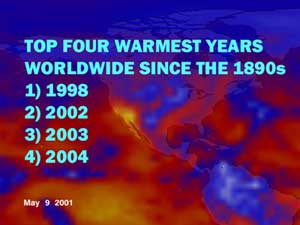
2004 was the fourth warmest year on average for our planet since the late 1800s, according to data released February 8, 2005 by NASA. However, that record may be surpassed by an even warmer 2005. Compared to the average temperatures from the 1951 to 1980 period, the largest unusually warm areas of 2004 were in Alaska, near the Caspian Sea, and over the Antarctic Peninsula. But compared to the previous five years, the United States as a whole was quite cool, particularly during the summer.

Globally, 1998 was warmest year on record, with 2002 and 2003 coming in second and third, respectively. "There has been a strong warming trend over the past 30 years, a trend that has been shown to be due primarily to increasing greenhouse gases in the atmosphere," said Dr. James E. Hansen, director of NASA's Goddard Institute for Space Studies. The main source of such gases is smokestack and tailpipe emissions from burning coal and oil.

Global temperatures vary from year to year and place to place, but weather stations and satellite data provide accurate records. By recording the temperatures over time, scientists have developed a record of the climate, and have been able to see how it's been changing.

Some of the changes in climate are due to short-term factors like large volcanic eruptions that launched tiny particles of sulfuric acid into the upper atmosphere (stratosphere) in 1963, 1982, and 1991. These natural events can change climate for periods of time ranging from months to a few years. Other natural events, like El Ninos, when warm water spreads over much of the tropical Pacific Ocean, also have large short-term influences on climate. The large spike in global temperature in 1998 was associated with one of the strongest El Ninos of recent centuries, and a weak El Nino contributed to the unusually high 2002-2003 global temperatures.

Even though big climate events like El Nino affect global temperatures, the increasing role of human-made pollutants plays a big part. Scientists, like Dr. Hansen, have been trying to predict how human impacts on climate will affect the annual world temperature trends in the future.

Dr. Hansen said Earth's surface now absorbs more of the Sun's energy than gets reflected back to space. That extra energy, together with the weak El Nino, is expected to make 2005 warmer than the years of 2003 and 2004 and perhaps even warmer than 1998, which had stood out as far hotter than any year in the preceding century.

The unusual nature of the recent warming was separately corroborated by a new analysis of 2,000 years of indirect temperature records in tree rings, stalagmites, seabed layers, and other evidence from around the Northern Hemisphere. That study, published in the journal Nature, found that previous peaks of warming, particularly during medieval times about 1,000 years ago, were as warm as the 20th-century average but that no spikes in the last 2,000 years matched the warming since 1990.

This is one of several recent studies challenging a longstanding view that temperatures in the Northern Hemisphere were relatively unvarying until the recent warming, a pattern enshrined in a graph scientists have taken to calling the hockey stick for its long horizontal "shaft" and upward-hooking "blade."

The lead author of the new paper, Anders Moberg of Stockholm University in Sweden, said it was important to recognize that natural influences on climate could either amplify or mask human-caused warming in years to come. But his paper "should not be a fuel for greenhouse skeptics in their arguments," Dr. Moberg said, adding that there were ample signs that the warming was now outside nature's recent bounds.

Wednesday, February 09, 2005

Reading My Email

Sent: Sun 2/6/2005 10:53 PM
Subject: Asia Ofices Closed

Singapore office will be closed noon Feb 8 - 11 for the Lunar New Year.
Shanghai and Beijing offices will be closed from Feb 9 to Feb 15 for Chinese Lunar Year.
Malaysia office will be closed too...... from the 9th Feb to 11th Feb to celebrate the Year of the Rooster!
Wishing all Chinese colleagues "Gong Xi Fa Cai."

Juliana D.
Singapore

Meanwhile, speaking of Asia, what a mess in Nepal! Last week, the king ended the country's 15-year experiment with democracy and took power for himself, imposing a state of emergency and suspending civil liberties, including freedom of expression. Those in politics and the news media feel particularly under siege.

In a televised address last Tuesday morning, King Gyanendra said he was taking power for three years because the political parties had failed to hold elections or bring Maoist rebels to peace talks. As he spoke, phone lines and Internet connections were being cut, political and student leaders were being detained and soldiers were arriving at news organizations' offices to take on their new role as censors.

Nepal now has no freedom of assembly, expression or opinion; no right to information, property or privacy; and no protection from preventive detention. The government has banned any criticism of the king's action for six months, and any public comment that could affect the morale of the security agencies.

Widespread international condemnation has done nothing to slow the arrest of political and student activists, with the military insisting that the detentions are necessary to prevent protests against the king. The new government acknowledges having 27 politicians under house arrest or in detention, but human rights activists say dozens more people, many of them student leaders, have "disappeared" into custody. Those who have not been arrested have gone underground or to India.

Sent: Mon 2/7/2005 12:58 PM
Subject: News

As some of you may know, a nephew of Mary's was killed last week in Iraq. As you can imagine, it is a very sad time for her and her family. She will be out of town and not working this week - and possibly some of next week.

Well, that certainly brings the war back home. This interoffice email at my place of work profoundly saddens me. Maybe I’ve been sheltered, but this is the first direct contact I’ve had with the impacts of that myopic war in Iraq. My heart goes out to Mary and her family – words cannot express the sense of loss they must feel.

Sent: Wed 2/9/2005 3:58 PM
Subject: Watch Out!

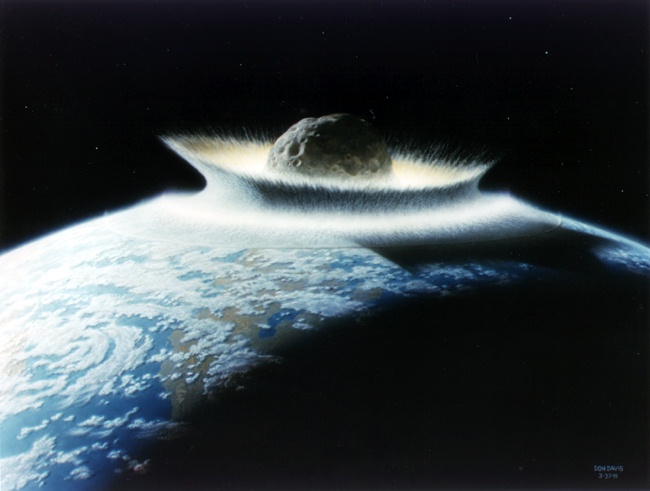
In 2029, an asteroid is expected to fly past Earth inside the orbits of some satellites, and will be visible to the naked eye. No other asteroid has ever been clearly visible to the unaided eye. The flyby will be visible from Europe, Africa and western Asia.

Two house-sized asteroids have made closer passes, but they were not visible without telescopes. The approaching asteroid is roughly estimated to be a little more than 1,000 feet wide. A stony meteoroid about 10 feet wide can produce an explosion of around 20 kilotons, similar to the bomb that flattened Hiroshima.

The rock, catalogued as 2004 MN4, was discovered last June. For a time, scientists said it had the highest odds of hitting Earth ever given to a space rock. Subsequent observations refined the future path and eliminated those odds for the 2029 flyby. It’d not expected to hit the Moon, either. On April 13, 2029, the asteroid will be about 22,600 miles from Earth's center. That is just below the altitude of geosynchronous satellites.

Of the ten known closest asteroid flybys, 2004 MN4 is by far the largest object. Only two have come closer, and they were only tens of yards wide. On average, one would expect a similarly close Earth approach by an asteroid of this size only every 1,300 years or so.

Were an asteroid the size of 2004 MN4 to hit Earth, it would cause local devastation and regional damage, similar to the Tunguska event, an aerial explosion that occurred in Siberia on June 30, 1908. The size of that blast was later estimated to be between 10 and 15 megatons, similar to the atomic bomb dropped on Hiroshima in 1945, and felled an estimated 60 million trees.

At around 7:15 AM, Tungus natives and Russian settlers in the hills northwest of Lake Baikal observed a huge fireball moving across the sky, nearly as bright as the Sun. A few minutes later, there was a flash that lit up half of the sky, followed by a shock wave that knocked people off their feet and broke windows up to 400 miles away. The explosion registered on seismic stations across Eurasia, and produced fluctuations in atmospheric pressure strong enough to be detected by the recently invented barographs in Britain. Over the next few weeks, night skies over Europe and western Russia glowed brightly enough for people to read by.

Had the object responsible for the explosion hit the Earth a few hours later, it would have exploded over Europe instead of the sparsely-populated Tunguska region, producing massive loss of human life.

In any event, since I am going to die on May 5, 2028, I will miss this event by one year. Also, the Inca calendar, developed upon their astronomical observations, ends in December 2028, meaning either that the world will have already ended before the asteroid approaches, or one set of calculations – either the Incan end-of-time or the modern asteroid flyby – is off by a few months.

Tuesday, February 08, 2005

Negativland, Part Two

As if the storm of controversy over Christianity Is Stupid wasn’t hectic enough, what Negativland did next was nearly enough to do itself in permanently. In 1991, while the world was anxiously awaiting the next U2 album, the song I Still Haven’t Found What I’m Looking For had been in the Top Forty for quite some time, and Casey Kasem had introduced it so many times he was sick and tired of it, Negativland did something truly original.

With barely any advance publicity — but all too suspiciously timed to appear just before U2's Achtung Baby album was to be released — Negativland let out a two-song single called U2. The record’s contents were two radically different versions of I Still Haven't Found What I'm Looking For, incorporating the song lyrics with a bizarre background of Casey Kasem outtakes in which Kasem swore and repeatedly bashed the song (i.e. “It’s dumb and I have to read this shit about some fucking dog that died? These guys are from England and who gives a shit?”).

Barely a week had passed before Negativland was hit with a 117-page lawsuit, taking the band for all that it was worth. First U2’s label forced the release to be withdrawn after only a few days of being in the stores (supposedly without the knowledge of U2's members themselves). Mr. Kasem found out what happened as well and launched his own lawyers onto the case. Things then got even worse for the band when SST Records suddenly turned on the group, with Mr. Ginn seeking to recoup his financial losses via the bandmembers. The ensuing barrage of claims and counterclaims found Negativland beset by legal and monetary woes that almost sank it.

At the same time, what had been a joke and a dare soon became a new focus for the bandmembers, who inadvertently made a name for themselves as crusaders for both artistic integrity and a freer interpretation of copyright law in opposition to corporate control. According to a 1998 statement released by the band:

"Negativland is an experimental-music and art collective that has been recording and self-releasing music/audio/collage works since 1979. Negativland has become, by necessity, interested in copyright law and the ‘fair use’ statute within it. What began as a natural attraction to found sound in a society overflowing with disposable media has now become a conscious desire to show by example the crucial difference between pirating or counterfeiting another’s work straight across in order to profit from the saleability of that single source, and the creative transformation of material from multiple sources into new, ‘original’ works. This is known in the art world as COLLAGE and it has had an undisputed legitimacy in virtually all art forms since the turn of this century. However, the owners and operators of mass marketed music, being the latest medium in which collage is being practiced, continue to naively attempt to criminalize the technique of audio collage as if it was an illegitimate intruder on originality and nothing more than a form of theft."

This fresh direction, though one which grew naturally out of Negativland’s previous work, helped reinvigorate the group. After extricating itself as much as it could from the legal matters, as well as completely severing all links with Mr. Ginn and SST Records, Negativland kept on. The Over the Edge radio show continued as always, with an increasing number of old and new shows edited for presentation as formal releases.

Negativland's 1997 release, Dispepsi, looked to be another red flag, though whether out of foolhardiness or calculation is up to the individual to decide. Negativland wasn’t trying to pretend otherwise with Dispepsi — Pepsi, along with Coca-Cola and the whole conceit of advertising, were under the gun. The open courting of controversy didn’t pan out into as much attention as U2 (inadvertently?) gained, but the band had enough samples from commercials, speeches, and more to work with, and did. Nearly every song had to do with some sort of corporate branding, whether it’s the deadpan lyrics about things like Hi-C and Hawaiian Punch on the semi-folk singalong Drink It Up or the nature of the Coke-Pepsi “wars” on songs like I Believe It's L. Dispepsi alternates between semi-straightforward songs and elaborate sample/tape-loop constructions. Perhaps most unsettling in context are the continuous snippets from various interviews and speeches from industry insiders and observers about the psychology of marketing. Though the band’s general fears and contempt for advertising and branding are clear enough here to make Naomi Klein happy, the wistfully off-kilter humor of the whole presentation sugared this particular pill. Regardless, Dispepsi didn’t bring down the wrath of Pepsi-Cola on the band’s head even though the cover art was clearly a riff on the brand’s distinctive logo.

FCC and copyright laws have yet to figure out what to do with the increased use of sampling in postmodernist music. As Mr. Hosler stated:

"Almost everything we do is illegal. Usually I do it first and find out later . . . of course I steal a lot of stuff. I just play all kinds of things like on TV and radio and records . . . People just, you know, basically want to be entertained. They don't care whether what you're doing is actually legal or not."

However elaborate Negativland's albums are, they are more successful with the live multimedia performance with videos, film, ad-lib sampling, etc. Instead of using album material at their shows, Negativland produced completely new, conceptual spectacles, such as the “Mercury Monarch” show in which they gave away a group member’s car in a game-show format, and “The Last Supper” based around food and religion, complete with kids dressed as singing/dancing toast.

“A live show has to be more than listening to a record. It has to be very tactile and visual. We try to think about that -- all of the different aspects of what ‘being present’ means, which is sound, sight, smell and everything.”

Monday, February 07, 2005

Negativland


"AS ARTISTS, our work involves displacing and displaying bites of publicly available, publicly influential material...."

"THE URGE TO MAKE one thing out of other things is an entirely traditional, socially healthy, and artistically valid impulse which has only recently been criminalized in order to force private tolls on the practice (or prohibit it to escape embarrassment). These now all-encompassing private locks on mass media have led to a mass culture that is almost completely "professional," formalized and practically immune to any form of bottom-up, direct-reference criticism it doesn't approve of."

- Negativland, 1999

Negativland take their name from a track by the cult German band Neu!. Based in the San Francisco area, Negativland originally revolved around the talents of Mark Hosler and Richard Lyons, multi-instrumentalists with an ear for tape manipulation of all sorts. Their inspired stroke of genius was to recruit David Wills, more famously known as the Weatherman in later years, to make up the original trio. Mr. Wills, a cable TV repairman by trade, was just as obsessed with home recording and experimentation as the other two, and his wry, drawling vocals became the core trademark for many of Negativland's most notorious releases.

In 1981, the band recruited Don Joyce. Mr. Joyce had started a free-form radio show, Over the Edge, on the Bay Area’s KPFA station that explored humor and social commentary much like Negativland itself. As a result, Negativland appeared on the show shortly after it began, and since then Mr. Joyce has not only been the only constant member of Negativland aside from Mr. Hosler, but Over the Edge has become the regular sonic testing ground for most of the band’s releases, still running strong after 20 years.

In the postmodern era, where the “real thing” is irrelevant, distinguishing the “cool” from the “uncool” is difficult. Former notions of “selling out” to the capitalist market are no longer the simple litmus tests that they used to be. Nearly everything is mixed up with corporate music industry one way or another. So “cool” postmodern music, while not totally escaping the properties of commodity, is not merely filler between commercials, or a commercial in itself. In turn, it avoids the effect of turning a reader/spectator into a decentered, schizophrenic, paralyzed vegetable. “Cool” postmodernist music does not exclusively use pastiche. Parody, humor and fun are also important.

Another facet of “cool” postmodernism is an agenda of counter-hegemony. Such an agenda goes against leading hegemonic features of postmodern society including the increased power of advertising and the electronic media, the advent of universal standardization, neocolonialism, institutional xenophobia, racism, sexism, homophobia, the schizoid pastiche of the fading sense of a history, and the “consciousness industry.” Baudrillard's “consciousness industry” is the new predominance of technologies and practice concerned with the exchange, promotion, distribution and manipulation of signs, from raw information, to cars, to fashion, to the images of pop stars, actors and governments, as well as the fabrication of public opinion. Counter-hegemonic postmodernist culture might offer ways of resisting or surviving its most baleful tendencies.

Negativland are one group of “cool” postmodernists who have been especially successful in going beyond even parody to play with and manipulate the texts around them, even creating "real" news fiascos to supply new ammunition for their work. The members are an anti-group -- a middle-aged polar antithesis of the Village People. They are computer programmers, graphics designers, nursery school teachers, telephone salesmen and cable TV installers. Sometimes appearing only to please themselves, other times they appear to be willfully courting adverse attention without consideration of the possible results.

Negativland play with the ambiguous, blurred distinctions between “reality” and “fiction:”

DON: We have a definite appreciation for found stuff, even if it's our own stuff.
MARK: When you talk about something on the radio show that's really going on with enough bizarre details that people believe that it's real, then you throw in enough things that you just made up or that fit in with what the rest of that particular show's about, then you create that weird middle zone where people don't know what they're hearing, psychodrama, or
DON: Docu-fiction.
MARK: Like that time I accidentally bit off a piece of my tongue on the air.
CHRIS: But that was real.

The trio’s debut self-titled release was notable as much for its packaging (each album featured individually wallpapered covers) as for its fragmented songs and textures. Apparently the still-teenage Mr. Hosler wanted it completed in part so he could feel he had accomplished something by the time he graduated from high school, a reasonable enough goal.

The next official Negativland album was the group's unquestionable breakthrough, 1983’s A Big 10-8 Place. Negativland’s first truly ambitious work was cut from literally a million tape edits to reinflate the classic story of going home to suburbia. Threaded throughout the aural collage are directions to 180-G, leading to a house in a nearby California suburb.

DAVID: Somebody followed the directions and went there and disturbed the people who live there.
CHRIS: Do they have a copy of the record?
MARK: Imagine if you were this normal family in the suburbs, would you like it if you got a record album in the mail that described to the whole planet how to get to your house? It would terrify you!
CHRIS: Talking about your dogjuice and your orange carpet and the ants in the mailbox.
DAVID: Whipped cream on the Corvair. That was one thing left out. [long silence]

Synthesizing the band’s love of aural theater and subversion of expected pop and rock approaches. When asked to do a video of Theme from A Big 10-8 Place, Negativland declined. According to Mr. Hofler:

"If we were going to make videos, we weren't going to turn around and make videos to our music. We'd start from scratch and make something totally new. The radio show doesn't try to be the records and the live shows don't try to be the radio shows. They're all different and they all try to utilize the medium to its best advantage."

A Big 10-8 Place was an at once hilarious and quietly harrowing vivisection of suburbia, winning them new fans and a growing reputation. Their reputation grew to the point where they were formally signed to Greg Ginn’s legendary punk label SST Records, a decision that would have unexpected consequences some time later.

Negativland decided to use the mass media itself to its best advantage after their 1987 Escape From Noise album, which took the scope of A Big 10-8 Place to even wider levels, touching on everything from a rendition of Over the Rainbow sung by a little girl plagued with hiccups to how many time zones are covered by Russia, featuring a well-known personality at ABC who has his own talk show. The found speech on the album is examined and repeated, revealing many rhythms and melodies not apparent after one listening. A reviewer in Greed magazine said,

"That's the point of the album - you don't need bands to make up songs for you. They're out there happening all around, on radio talk shows & television soap operas, on playgrounds, in McDonald's, at riots, on subways . . . If you can't listen to this album, how can you even go outdoors? It’s a sonic life. Live it."

Maintaining Negativland’s blend of wit and darker themes, the album might have simply remained a cult classic were it not for the appearance of the throbbing, creepy song, Christianity Is Stupid. The song features a found sample vocal of Reverend Estus Pirkle from a sermon recorded in 1968, and consists of a loop repeating, “Christianity is stupid. Communism is good. Give up,” and ends with “Shop as usual . . . and avoid panic buying.” It was soon going to be used for an even grander effect.

A few months after the album’s release, a teenager, David Brom, committed mass murder against his family in Rochester, Minnesota. The Broms were described as a devout Roman Catholic family, and an article mentioned that the murders may have resulted from an argument over a music tape that David listened to. Having seen tour plans fall through at around the same time, Negativland decided to send a phony press release to SST Records which attributes the cancellation of the tour to pressure from “Federal Official Dick Jordan” who has advised the band not to leave town pending an investigation into the Brom murders. The release implied the tape in question in the Brom case was their song Christianity Is Stupid.

Many stories soon appeared, restating the “facts” from the Negativland press release with no trace of skepticism, even though no one verified the story with the source. When Hal Eisner from KPIX Channel 5 interviewed the band, they did not comment on their link to the Brom case, but discussed the American news media, their appetite for the sensational and their tendency to create their own “news.” This discussion was cut from the air, and the lead story took the purported connection for granted, and included footage of the Brom family being carried from their home in body bags. Many following stories got the “facts” wrong as a result of their dependence on other media stories as their only source material, which resulted in a slew of publicity and confusion over what the truth of the situation was.

Some condemned the group’s actions as tasteless exploitation, but Negativland preferred to think of it as an examination of media assumptions, and the whole affair became the backbone of 1989’s Helter Stupid. “It is now abundantly clear that the major source for news is other news,” wrote Negativland in their liner notes for the Helter Stupid album.

"We all swim in an ocean of mass media that fills our minds with people and events with which we have no actual contact at all. We commonly absorb these media presences as part of our own “reality,” even though any media experience consists only of one-way, edited representations of reality. Negativland uses this electronic environment of factual fictions as both source and subject for much of our work, keeping in mind that to experience a picture of a thing is not to experience the thing."

In postmodernist fashion, Negativland tossed a pebble in the mass media ocean, watched the ripples turn into tidal waves, sampled them and played them back in a sharp-witted aural collage, including the Channel 5 tapes and a call from Rolling Stone that would make any newsperson red in the face. In their version of counter-hegemony, Negativland condemns the media witch hunt that sells papers at the expense of all involved and sensationalizes the story for all it was worth without checking the facts. In turn, they condemn the “uncool” properties of postmodernist society -- information for commodity, not knowledge, lack of interaction and accountability in media, and the creation of an uncritical audience of decentered, schizophrenic spectators who will consume any bogus “facts” from the “media meat grinder.”


Sunday, February 06, 2005

I'm A Believer


If you happen to be looking for a good '60s mashup, this Beatles-meet-The-Monkees file might be just the thing for you.

Saturday, February 05, 2005

Michael Crichton and State of Fear


"This is a work of fiction. Characters, corporations, institutions, and organizations in this novel are the product of the author’s imagination, or, if real, are used fictitiously without any intent to describe their actual conduct. However, references to real people, institutions, and organizations that are documented in footnotes are accurate. Footnotes are real."
- disclaimer from "State of Fear" by Michael Crichton

As Bruce Barcott pointed out in the New York Times, "there's a problem with Michael Crichton's new thriller, and it shows up before the narrative even begins. . . Footnotes? Yes, there will be footnotes."

Much has been made of the footnotes in Mr. Crichton’s new book, "Stae of Fear." However, all this talk of footnotes may lead those who haven’t read the book to think that his position on global warming (he thinks it’s all just a conspiracy by ill-informed, or worse, malevolent, tree-huggers) is a well-researched and considered opinion, presented in the form of an intriguing novel.

Nothing could be further from the truth. "State of Fear" is a ham-handed, sorry excuse for a thriller, a pot-boiler of the most pedestrian sort, occasionally punctuated with random and misleading footnotes, charts, manifestos and appendices.

Mr. Crichton’s writing abilities have clearly suffered a decline. Consider, for example, the following segment which opens up Section IV of State of Fear, unfortunately named "Flash:"

"What are we going to do?" Sarah asked, panicked.
"Take your clothes off."
"What?"
"Now. Do it." He was stripping off his shirt, ripping it off, buttons flying. "Come on Sarah. Especially the sweater."
She had a fluffy angora sweater, and bizarrely, she recalled it had been a present from her boyfriend, one of the first things he ever bought her. She tore it off, and the T-shirt beneath.
"Skirt," Kenner said. He was down to his shorts, pulling off his shoes.
"What is this?"
"It’s got a zipper!"
She fumbled, getting the skirt off. She was down to her sports bra and panties. She shivered. The computer was counting backward. "Ten . . . nine . . . eight . . ." (page 283-4)


That passage is so poorly written, it’s almost painful. The masturbatory fantasy of Kenner the commanding and powerful ("he was stripping off his shirt, ripping it off, buttons flying") barking orders at the confused but compliant Sarah is, frankly, embarrassing. And why does Mr. Crichton feel compelled to add that the "fluffy angora sweater" (are there non-fluffy angora sweaters?) was "a present from her boyfriend?" How could Kenner be "down to his shorts" if he hadn’t yet taken off his shoes? And which character is asking "What is this," and which replies "It’s got a zipper?" At least Mr. Crichton included the countdown for those of us unsure what a computer counting backward might sound like.

His technical challenge to global warming isn’t presented much better. For example, on page 43, he cites a paper that appeared in the journal Climatic Change in the first of the much-ballyhooed footnotes. The selected quote seems to suggest that the climate in Greenland is not "following the current global warming trend." This reference is particularly amusing because if we are to accept the legitimacy of the paper, we have to accept its premise that there is in fact a "current global warming trend," exactly the opposite of the argument that Mr. Crichton is trying to make. So eager is Mr. Crichton to identify an anomaly, that he doesn’t even seem to realize that he is documenting the opposing argument.


The graphs make their first appearance on pages 84-88, with two more footnotes, one explaining the source of the graphs, the second a non sequitur from a 1996 issue of the Journal of Geophysical Research. The reader is spared any more footnotes for the next 150 or so pages, with only a single graph appearing on page 190. However, a few more footnotes appear between pages 247 and 249, and then he gets back to the graphs and footnotes again in pages 369-381. Another footnote on page 384. More graphs on pages 393-394.

On page 406, a single footnote plugs a book by fellow anti-environmentalist Alston Chase, and a footnote on page 421 discuses the current retreat of the Sahara across the African Sahel. Much has been made by the anti-warming crowd of the fact that desertification of the sub-Sahara seems to have stopped. However, their reliance on this observation merely underscores their misunderstanding of the mechanics of global warming. The prior advance of the desert across the region was not a result of the Earth getting warmer, but of a prolonged, but unrelated, drought.


The dam bursts by page 421, where Mr. Crichton has placed no less than 14 footnotes between pages 421 and 426. There’s a single footnote on page 442, but it has nothing to do with global warming – it’s about the toxin of the blue-ringed octopus, which Mr. Crichton had worked into a poisoning subplot. There’s no dramaturgical or scientific reason for the footnote, it appears to be there just to keep the reader feeling that this must be a well-researched book.

Another random footnote appears on page 457, this time documenting his estimate of the cost of "the phony power-line cancer scare." Two more footnotes appear on pages 478 and 479, and seven footnotes about DDT are provided on pages 487-489. The final footnote is a non sequitur about cannibalism on page 503.

And that’s it. A book of over 600 pages, and less than 40 footnotes, at least half of which are condensed into two short, gratuitous and self-indulgent sections (pages 421-426 and 487-489), and at least a half-dozen of the remainder total non sequiturs.

In a 2003 speech to the Commonwealth Club in San Francisco, Mr. Crichton said:

"Today, one of the most powerful religions in the Western World is environmentalism. Environmentalism seems to be the religion of choice for urban atheists. Why do I say it's a religion? Well, just look at the beliefs. If you look carefully, you see that environmentalism is in fact a perfect 21st century remapping of traditional Judeo-Christian beliefs and myths.

"There's an initial Eden, a paradise, a state of grace and unity with nature, there's a fall from grace into a state of pollution as a result of eating from the tree of knowledge, and as a result of our actions there is a judgment day coming for us all. We are all energy sinners, doomed to die, unless we seek salvation, which is now called sustainability. Sustainability is salvation in the church of the environment. Just as organic food is its communion, that pesticide-free wafer that the right people with the right beliefs, imbibe.

"Eden, the fall of man, the loss of grace, the coming doomsday---these are deeply held mythic structures. They are profoundly conservative beliefs. They may even be hard-wired in the brain, for all I know. I certainly don't want to talk anybody out of them, as I don't want to talk anybody out of a belief that Jesus Christ is the son of God who rose from the dead. But the reason I don't want to talk anybody out of these beliefs is that I know that I can't talk anybody out of them. These are not facts that can be argued. These are issues of faith.

"And so it is, sadly, with environmentalism. Increasingly it seems facts aren't necessary, because the tenets of environmentalism are all about belief. It's about whether you are going to be a sinner, or saved. Whether you are going to be one of the people on the side of salvation, or on the side of doom. Whether you are going to be one of us, or one of them."


Clever words, and there’s probably some truth in them. But merely because concern about the planet we live on, that sustains us, may in certain people have some interesting similarities to religion, doesn’t mean that the fundamental and basic science behind global warming needs to be ignored or rejected.

Mr. Crichton suggests that belief in environmentalism is a matter of faith, not fact, and in his 2003 speech throws up his hands at any attempt to try to change the minds of the eco crowd. So, what is one to make of the footnotes, charts, flip charts and drop-down graphs in State of Fear? Has Mr. Crichton changed his mind, and is now attempting to convince the unconverted that global warming is a sham? Or is he merely preaching to the choir, the Rush Limbaughs and Creationists and other denizens of the ark that doesn’t believe in rising sea levels?

This, in turn, brings up a more disturbing series of questions. Was the book written specifically to be pitched to the Ann Coulter crowd to increase sales? And if so, does Mr. Crichton, the former medical student and scientist, really believe the narrow and unscientific views he proposes, or is he just writing what he thinks will sell? If the latter, the book is not only cynical and manipulative, but also irresponsible and dangerous, as it will only serve to reinforce the public opinions and government policies that have led to the U.S. rejection of the Kyoto protocols and under-regulation of carbon dioxide and other greenhouse gases.

And Mr. Crichton is not very well positioned to be criticizing others about blind faith in quasi-religious beliefs. In his 1988 book "Travels," Mr. Crichton documents his experiences and unblinking acceptance of, among other things, clairvoyants, faith healers, seeing auras and astral projection. Now, I’m the last person in the world to criticize another for their religious beliefs, but I’ve always despised hypocrisy. Wouldn’t it have been more honest of Mr. Crichton to state in his opening disclaimer, instead of "Footnotes are real" (not to mention his closing statement, "Everyone has an agenda. Except me."), something along the lines of "I do not accept the science of global warming, but I do believe in mind-readers, prognostication, divination, levitation, and talking cacti?"

Friday, February 04, 2005

Greetings From the New Flat Earth

By Matt Wheeland. Posted to AlterNet on February 4, 2005:

"All right, look: the Earth is not warming, OK? It's actually cooling. There are studies that prove it! And even if it was warming, that would be a good thing for humans, and we'll easily adapt. Anyway, aren't all those environmentalists the real problem, what with their "actions" and protests and hysteria? I wouldn't be surprised if they're buying enormous drilling machines on the black market to cause earthquakes and tsunamis and raise heaps of cash for their shady nonprofit organizations!"

Surprisingly, these are not the rantings of a lone, wild-eyed wingnut, but actual assertions from an assortment of global warming deniers who use their diverse pulpits to belittle the idea that global warming is a reality.

The disproportional credence given to these arguments are what prompted the creation of the
Flat Earth Award, announced last week in Vermont. The awards were created by three students at Vermont's Middlebury College in association with Green House Network, a Portland, Ore.-based nonprofit. The students hope to use the awards to publicize the widespread disinformation about global warming and build momentum for action on the issue.

The nominees for this dubious honor are mega-popular author
Michael Crichton, mega-loud radio personality Rush Limbaugh, and mega-persistent scientist Dr. S. Fred Singer. Crichton's new novel, State of Fear, poses the idea that global warming is not as dangerous as the media makes it out to be, and goes so far as to blame environmental activists for whipping up a "state of fear"; Rush Limbaugh has long espoused his belief that global warming is a left-wing hoax; and atmospheric physicist Fred Singer has been trying to debunk warnings about global warming almost since they began in the late 1970s.

Given all the evidence and, yes, consensus about the reality of global warming, how do Flat Earthers like Crichton continue to feed the fire of this faux-debate? Simply put, there is tremendous interest from the petroleum industry and its many dependents to ensure the status quo remains the same. The global economy is built on the foundation of cheap oil for everything from shipping and heating to travel, plastics and personal lubricants. Any proposed change in how the world runs necessarily provokes substantial fear in those who are doing just fine in the short term.

Thursday, February 03, 2005

Just Watching

From Sunday, August 08, 2004:
"To give your sheep or cow a large spacious meadow is the way to control him. So it is with people: first let them do what they want, and watch them. This is the best policy. To ignore them is not good; that is the worst policy. The second worse is trying to control them. The best one is to watch them, just to watch them, without trying to control them."
- Shunryu Suzuki, "Zen Mind, Beginners Mind"
posted by Shokai at 10:23 PM

Anonymous said...
Hi,
I love this quote, but for an essay, I'm trying to figure out how this could tie into the process of overcoming grief?

Could it be that a person who is committing suicide should be left alone but supervised from a distance? Also, does it make sense if I were to make the link that a person in a state of bereavement should be left alone (w/out force, nagging) but watched so that you are sure they are okay?

Thank You
2:57 AM


First of all, thank you for reminding me of this quote. I agree, it is a beautiful and wise lesson, and one that I need to be reminded of frequently.

It is important to watch people in order to observe their true nature - who they really are and what they're really doing. The trick is to just watch, that is, to observe without assigning our own prejudices and values on them and color what we think we're observing with what we're actually seeing.

For example, it is often uncomfortable to observe a person in grief. Our compassion may want to reach out and end their suffering with soothing words and kind gestures, but if we truly observe their grieving, we can see that the grief may be part of the healing process the person needs to go through in order to recover. By interfering with the crying or the sadness, we might actually be denying the person the opportunity to recover and only make matters worse, despite our best intentions.

If we also watch ourselves, we might see that our desire to stop the grieving of others may not be entirely out of compassion, but due to our own discomfort. Grief in others may remind us of our own mortality or our own suppressed grief, and we may want the sobbing to stop because of our own discomfort, not that of others. Our society represses thoughts of death and of life's suffering, and we are often uncomfortable when we see reminders of these facts of life around us.

As we watch the grief, we may see that there are times when the person just wants to be left alone, and times when that person wants to talk or to be held. It is wise to observe from a distance when that is appropriate and to provide comfort when that is what is needed.

As Suzuki says, "just watch."

If a person is contemplating suicide or slowly killing themselves, should we just stand by and watch? Well, first of all, it is important to truly observe - what we are actually seeing may not be suicide or even contemplation of suicide, but actually something else. Is their behavior truly "suicidal," or just behavior that we don't like or feel comfortable with?

Secondly, Suzuki says that ignoring is the worst policy. If the suicidal behavior is observed to be a call for help, then help. If it's only a lifestyle with more risks then we'd be comfortable with in our own lives, then accept that it's their choice and just continue to observe. If it's the person's conscious decision to end their life because of suffering, unless you're a competent grief therapist, there's probably nothing you can do about it anyway other than let the person know the options available (therapy, counseling, etc), and continue to just watch and be ready to act when appropriate.

"Just watching" is to observe without prejudice or opinion. By "just watching," we will know when and how to act. Idly standing by and ignoring is the worst policy.

Wednesday, February 02, 2005

Global Warming

Despite the cynicism of Michael Crichton, the neo-cons and the anti-evolution mob, global warming is a scientific fact, and not some scare tactic concocted by radical environmentalists to further their own agenda. Like many fields of scientific study, there are uncertainties associated with the science of global warming. This does not imply that all things are equally uncertain. Some aspects of the science are based on well-known physical laws and documented trends, while other aspects range from 'near certainty' to 'big unknowns.'

Scientists know for certain that human activities are changing the composition of the Earth's atmosphere. Increasing levels of greenhouse gases, like carbon dioxide (CO2 ), in the atmosphere since pre-industrial times have been well documented. Although there are other, natural causes, there is no doubt this atmospheric buildup of carbon dioxide and other greenhouse gases is largely the result of human activities.

It's well accepted by scientists that greenhouse gases trap heat in the Earth's atmosphere and tend to warm the planet. The geologic record shows that from the Late Cretaceous to the middle Paleocene, global atmospheric CO2 levels were decreasing. However, starting in the early Eocene, a sharp increase in CO2 levels occurred. Due in part to the enhanced atmospheric CO2 content, the Eocene was the warmest period in the Cenozoic.

By increasing the levels of greenhouse gases in the atmosphere, human activities are strengthening Earth's natural greenhouse effect. The key greenhouse gases emitted by human activities remain in the atmosphere for periods ranging from decades to centuries.


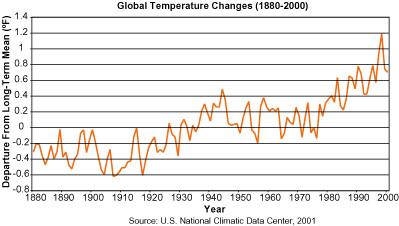
A warming trend of about 1°F has been recorded since the late 19th century. Warming has occurred in both the northern and southern hemispheres, and over the oceans. Confirmation of 20th-century global warming is further substantiated by melting glaciers, decreased snow cover in the northern hemisphere and even warming below ground.

Anyone who denies global warming has obviously not been to Alaska. There, anyone can plainly see that the glaciers are all in retreat, and have receded substantially in the last 25 years. If you have a doubt, fly to Anchorage, drive down to the Kenai peninsula, and hike the trail to Exit Glacier. There, the edge of the glacier has been marked each year, and it is somewhat amazing to see how far and how rapidly it has retreated over the last several years.

The neo-cons, the Crichtonists and the creationists can stick their heads in the sand and ignore the obvious evidence and the scientific certainty of global warming, but considering the rising sea levels, I only ask them: How long can you hold your breath?

Tuesday, February 01, 2005

Am-Iraq-A

According to today's New York Times, many teachers in America are afraid to present evolution in the classroom, and are afraid to even discuss the issue in public, because of potential backlash from fundamentalist Christians. In school districts around the country, even when evolution is in the curriculum, it may not be taught in the classroom. Superintendents or principals have been discouraging teachers from discussing the subject, or teachers themselves avoid the topic, fearing protests from fundamentalists in their communities. In fact, this fear has made it impossible to say precisely how many teachers are avoiding the topic.

In some classrooms, the teaching of evolution has been hampered by the beliefs of the teachers themselves, who are creationists or supporters of the teaching of creationism. Data from various studies in various states over an extended period of time indicate that about one-third of biology teachers support the teaching of creationism or "intelligent design."

Although there is no credible scientific challenge to the idea that all living things evolved from common ancestors, that evolution on earth has been going on for billions of years, and that evolution can be and has been tested and confirmed by the methods of science, the National Science Foundation found in a 2001 survey that only 53 percent of Americans agreed with the statement "human beings, as we know them, developed from earlier species of animals." And that was an increase from previous polls.

This attitude sets the United States apart from all other industrialized nations. In other industrialized countries, 80 percent or more typically accept evolution, most of the others say they are not sure, and very few people reject the idea outright. In Japan, something like 96 percent accept evolution. Even in socially conservative, predominantly Catholic countries like Poland, perhaps 75 percent of people surveyed accept evolution. In fact, two popes, Pius XII in 1950 and John Paul II in 1996, have endorsed the idea that evolution and religion can coexist.

Americans have been evenly divided for years on the question of evolution, traditionally with about 45 percent accepting it, 45 percent rejecting it, and the rest undecided. Polls consistently show that a plurality of Americans believe that God created humans in their present form about 10,000 years ago, and about two-thirds believe that this belief should be taught along with evolution in public schools.

Further, scriptural literalists are moving beyond evolution to challenge the teaching of geology and physics on issues like the age of the earth and the origin of the universe. They have now decided the Big Bang also has to be wrong, and are insisting that the Big Bang be called only a theory, without any supporting evidence.

So what we're facing here is the suppression of science by religious zealots, at the expense of our own children's education. To me, America is becoming more and more a fundamentalist state, different from Taliban-era Afghanistan only in the particular religion being endorsed and in the degree of enforcement. This state of fear not only inhibits teaching the science of evolution, but also of global warming, another concept not popular with the American conservative movement but widely recognized across the rest of the industrialized world.

More and more, Michael Crichton's case against the science of global warming is sounding like the tactics of the creationists - instead of supplying a credible scientific alternative, the Crichtonists and the creationists cite random studies, often of questionable scientific merit, and isolated data that they claim "refute" the science, and then claim that their "alternative" must be correct (when in fact, no credible alternative was ever offered).

The Crichtonists and the creationists also accuse the scientific community of advancing their ideas for purely self-serving reasons. The teaching of evolution is often portrayed by religious groups not as scientific instruction but as an assault by the secular elite on the values of God-fearing people. Again, according to the Times, the great variety of religious groups in the United States leads to competition for congregants. This marketplace environment contributes to the politicization of issues like evolution among religious groups.

The motives for those denying the existence of global warming are a little harder to discern. Crichton has repeatedly proposed that environmentalists have been advancing completely unfounded fears and creating false concerns in order to advance their own political agenda and to obtain power and authority. But why does this peculiar view resonate with the neo-cons?

It is possible that their position stems from a reaction to the realization that unchecked energy consumption cannot go on forever without having a consequence. In the "religion" of the Crichtonists, America has the right, if not the duty, to a higher standard of living than the rest of the world, and Americans should be free to consume as much energy and fossil fuels as they wish. The fact that there's a price, a consequence, to this consumption is upsetting to them, and they seem to feel that it's better to kill the messenger than to accept the truth.

But meanwhile, here on the home front, January was a good month for this little blog. Since I started this blog last May, I received very, very few hits each day until around November of last year. Then, for some reason, traffic strated to pick up. By December, I started getting still more hits, many related to the tsunami disaster in Asia, plus the link over on Mumon's site, and finally, due to Wampum's Koufax award nomination.

So I entered the year averaging about 50 hits a day, much, much better than the 10 or so I was averaging, and during the month of January 2005, the hits have doubled to over 100 per day, with a peak of over 200 on January 27!


Thanks, everyone, for your support, even if you were coming here only for the pictures of Courtney Love, Norah Jones, Jimi Hendrix and David Bowie. . . .