WASHINGTON (Reuters) - Lucien Carr, a muse and catalyst of the "beat generation" who brought Jack Kerouac together with other writers to spark a counterculture revolution, died on Friday at George Washington University Hospital of complications from cancer treatment on Friday in Washington. He was 79.
Mr. Carr was a student at Columbia University in New York in 1944 when he introduced Kerouac, Allen Ginsberg and William Burroughs, who formed the literary nucleus of the countercultural "beatnik" movement of the 1950s. By some accounts, including his own, Mr. Carr played a role in Mr. Kerouac's legendary speedwriting of the breakthrough novel "On the Road," by supplying a Teletype roll for the manuscript. Mr. Carr was portrayed as Kenneth Wood in Kerouac's novel "The Town and the City."
Mr. Carr served two years on a manslaughter conviction for stabbing dead an older man, David Kammerer, who had a romantic crush on Carr, and throwing his body into the Hudson River in 1944. The conviction cast a pall over the emerging beats who were striving for authenticity in the gritty urban streets of America, and probably kept Carr from playing a more public role for the rest of his life.
LONDON (Reuters) - Traffic drummer Jim Capaldi died on Friday after a brief fight with stomach cancer. The 60-year-old Mr. Capaldi, born in England of Italian immigrant parents, died in his sleep at the London Clinic in the early hours with his wife and family at his bedside.
Along with Steve Winwood and Dave Mason, among others, Mr. Capaldi's driving rhythms and songwriting ability helped make the groundbreaking band Traffic a household name in the 1960s and 70s. Traffic finally broke up in 1974 after releasing 11 albums, including the iconic songs 40,000 Headmen, Dear Mr Fantasy and Paper Sun. Traffic reformed in 1993 followed by a major five-month tour of the United States in 1994, including appearing at Woodstock and playing alongside The Grateful Dead.
Mr. Capaldi was five times winner of BMI or ASCAP awards for the most played songs in America and cooperated closely with Eric Clapton, George Harrison, Bob Marley, Carlos Santana and the Eagles, among others.
In 1975 he married Brazilian-born Aninha and spent much time with her helping the street children of her native country.
"Death is neither depressing nor exciting; it is simply a fact of life." - Sogyal Rinpoche
"You see, we are all dying. It's only a matter of time. Some of us just die sooner than others." - Dudjom Rinpoche
As I recall, I have something like 8,523 days left in my life. This thought is neither depressing nor morbid - it's just a recognition of what is.
This past week of my life (don't want to call it "my short life," because after all, what is longer than your life? You will never experience anything longer than your life - your life is the longest thing you will ever know) has been pleasant enough, and very little of that pleasure has been chronicled here in this blog. Sunday, after the morning Zen service, L. called me while I was picking up a salad at Eatzi's and asked if I could also pick one up to bring over to her. I did, and we wound up spending a whole blissful day together. We saw each other again briefly at the Monday evening service.
Tuesday, we hit something of a bump in the road, but as I blogged that day, we had a long, soulful talk that evening and possibly identified a path for a more sustainable way of being together. On Wednesday, I attended a meeting of the Buckhead Community Planning Unit to discuss solid waste issues (boring!), and Thursday, I stopped by L.'s after karate for an impromptu and affectionate visit.
Tonight, we had dinner at Bone's, a great Atlanta steak house.
As predicted, the weather's turned cold once again and the furnace has been running continuously. They say that at midnight, the freezing rain and sleet will hit and possibly coat my steep driveway with a sheet of ice, trapping my car where it's parked and, ergo, effectively trapping me in my house. "The car has become the carapace, the protective and aggressive shell, of urban and suburban man" (Marshall McLuhan).
Bring it on, I say. I'm ready . . .
Friday, January 28, 2005
Thursday, January 27, 2005
The History of the Book in Approximately 100 Words
You may miss the comment posted today to my December 26, 2004 blog entry "Tragic," in which I quoted Eric Schulman's "The History of the Universe in Approximately 200 Words" to distract myself from the tragedy of the tsunami in Asia. That being the case, here is a copy of this morning's comment, presumably by Mr. Schulman:
Anonymous said...
Thanks for posting my History of the Universe. You might also enjoy the book I wrote based on the piece, A Briefer History of Time.
7:56 AM
I downloaded the book, and it's great and entertaining and very interesting, and perhaps best of all, it's free. I encourage you to do the same.
"The future of the book is the blurb." - Marshall McLuhan.

Anonymous said...
Thanks for posting my History of the Universe. You might also enjoy the book I wrote based on the piece, A Briefer History of Time.
7:56 AM
I downloaded the book, and it's great and entertaining and very interesting, and perhaps best of all, it's free. I encourage you to do the same.
"The future of the book is the blurb." - Marshall McLuhan.

Wednesday, January 26, 2005
The Deadliest Day

"Where in the waste is the wisdom?" - James Joyce
Another sleepless night. Although I fell off quickly enough, I woke up around 3:30 a.m. and couldn’t get back to sleep. I finally got up around 4, put on some coffee and started cleaning off the hard drive on my computer.
At least I (uncharacteristically) made it to the office on time this morning.
Today's coffee consumption:
One home-brewed pot (~ 4 cups) - 4 - 6 a.m.
Large Caribou dark roast - 8 - 10 a.m.
Starbuck's Quad Venti Vanilla Latte - 2 - 4 p.m.
Today’s Headlines
"The price of eternal vigilance is indifference." - Marshall McLuhan
Architect Philip Johnson died today at his home in Connecticut
He was 98.
Condoleezza Rice won the Senate confirmation to be the new Secretary of State by a vote of 85 to 13
Rice's confirmation had the second largest number of nay votes against a Secretary of State nominee in U.S. history; in fact, the highest number since 1825, when Henry Clay was confirmed in a vote of 27 to 14. Since World War II, seven senators voted against Henry Kissinger and six each against Dean Acheson and Alexander Haig. In the history of the United States, the Senate has never rejected a Secretary of State nominee, and since 1789, only eight nominees have received any votes against their confirmation.
31 Marines have tragically died in a helicopter crash near the Syrian border in Iraq
As Frank Rich will say in this Sunday's New York Times, "Iraq is Vietnam on speed - the false endings of that tragic decade re-enacted and compressed in jump cuts, a quagmire retooled for the MTV attention span." As for the crash, the military is blaming bad weather.
Speaking of weather, here in the ATL, the forecast calls for freezing rain this weekend. Although the weather’s been delightful the past few days (sunny and 60s), on Friday the highs will fall to the mid-40s with a 30 percent chance of rain. By Saturday, there will be a 40 percent chance of light freezing rain, with temperatures from the upper 20s to the low 40s. Sunday will be partly cloudy, with a 20 percent chance of showers, lows in the mid-30s and highs in the mid-50s.
This is typical for this time of year. On January 12, 1982, my first full winter in Atlanta, a blizzard coated the town with 6 inches of snow and left me stranded in traffic on the in-town connector for at least four hours in the infamous "Snowjam ’82." On Jan. 22-23, 2000, the weekend before Atlanta hosted the Super Bowl, an ice storm knocked out power at about 300,000 homes and businesses.
This forecast worries me on a couple of fronts. First, this house of mine isn’t doing too well against the cold – when it’s below about 30 degrees outside, the heat runs all night, and the temperature still keeps dropping. And the power is prone to go out here due to all of the trees – I lost power during each of the hurricanes that came through last fall. If icy conditions this weekend do knock out the lights, it might get very cold indeed.
Secondly, I have an exceptionally steep driveway, so even if I try to escape the dark and the cold, I may not be able to make it down the driveway if we get the dreaded black ice. This was one of my few real reservations back when the house was on the market.
What a fucking mess. I refer here to the weather forecast, today's news, my mental condition and this blog entry. I'm out of here.
Let me close with some more quotes of Marshall McLuhan:
The story of modern America begins with the discovery of the white man by the Indians.
Only puny secrets need protection. Big discoveries are protected by public incredulity.
The nature of people demands that most of them be engaged in the most frivolous possible activities — like making money.
With telephone and TV it is not so much the message as the sender that is "sent."
Money is the poor man’s credit card.
We look at the present through a rear-view mirror. We march backwards into the future.
Spaceship earth is still operated by railway conductors, just as NASA is managed by men with Newtonian goals.
Invention is the mother of necessities.
The car has become the carapace, the protective and aggressive shell, of urban and suburban man.
Why is it so easy to acquire the solutions of past problems and so difficult to solve current ones?
The trouble with a cheap, specialized education is that you never stop paying for it.
People don’t actually read newspapers. They step into them every morning like a hot bath.
The road is our major architectural form.
Today each of us lives several hundred years in a decade.
Today the business of business is becoming the constant invention of new business.
News, far more than art, is artifact.
When you are on the phone or on the air, you have no body.
Tomorrow is our permanent address.
All advertising advertises advertising.
The answers are always inside the problem, not outside.
"Camp" is popular because it gives people a sense of reality to see a replay of their lives.
The specialist is one who never makes small mistakes while moving toward the grand fallacy.
One of the nicest things about being big is the luxury of thinking little.
Politics offers yesterday’s answers to today’s questions.
The missing link created far more interest than all the chains and explanations of being.
In big industry, new ideas are invited to rear their heads so they can be clobbered at once. The idea department of a big firm is a sort of lab for isolating dangerous viruses.
When a thing is current, it creates currency.
Food for the mind is like food for the body: the inputs are never the same as the outputs.
Men on frontiers, whether of time or space, abandon their previous identities. Neighborhood gives identity. Frontiers snatch it away.
The future of the book is the blurb.
The ignorance of how to use new knowledge stockpiles exponentially.
A road is a flattened-out wheel, rolled up in the belly of an airplane.
At the speed of light, policies and political parties yield place to charismatic images.
I may be wrong, but I’m never in doubt.
Tuesday, January 25, 2005
Where Black Is the Color and None Is the Number
Today is the first full moon since the winter solstice, and already I can feel the days growing longer, the nights shorter.
Last night, I was very aware of the passage of time as I tossed and turned, unable to sleep. I estimate that I got about three hours of sleep - net, not all at once. An hour here, 90 minutes there.
The night seemed very long, indeed.
L. and I had a long, soulful talk this evening, interrupted by a third party's crisis. The crisis was a legitimate and necessary interruption (the party's in the hospital), but before the feces hit the fan, we were able to cover a lot of ground and hopefully not only resolve some of the issues that kept me up all night, but possibly build a foundation for a more sustainable way of being together.
Time will tell, and the longer days will give us the time to find out.
Monday, January 24, 2005
Study: Watching Fewer Than Four Hours Of TV A Day Impairs Ability To Ridicule Pop Culture
from The Onion:
A Columbia University study released Tuesday suggests that viewing fewer than four hours of television a day severely inhibits a person's ability to ridicule popular culture.
"An hour or two of television per day simply does not provide enough information to effectively mock mediocre sitcoms, vapid celebrities, music videos, and talk-show hosts — an essential skill in modern society," said Dr. Madeleine Ben-Ami, a professor of cognitive science and chief author of the study. "The average person requires a minimum of four to six hours of television programming each day to be conversant on the subject of The Apprentice or able to impersonate Anna Nicole Smith."
Tracking 800 individuals between the ages of 15 and 39, researchers found that people who watch fewer than four hours of television a day have difficulty understanding the references made on VH1's Best Week Ever, and are often unable to point out the absurdity of infomercial products or the cluelessness of American Idol finalists.
"Study participants who watched television inconsistently were less personally invested in what they saw than regular viewers," Ben-Ami said. "While some sporadic viewers were able to enjoy jokes made by others, they were unable to make jokes of their own. . ."
. . . or, apparently, write original blog entries of their own. My television viewing, on average, is now well below one hour a day. In fact, if it weren't for The Daily Show, I would be below a half-hour a day on average. Personally, I blame the prevalence of reality t.v., the continuing absence of new episodes of The Sopranos, and the refusal of the networks to allow the cast of Desperate Housewives to do full-frontal nudity. Of course, we can blame the FCC for the latter, although even what with Michael Powell stepping down and all, that's not likely to change any time soon.
So, I guess my underviewing of television leaves me pop-culture impoverished, and I have to resort to cutting and pasting articles from The Onion to fill my blog.
Sunday, January 23, 2005
Saturday, January 22, 2005
Got my second stripe in karate today.
Also, went with L. and her friend Linda to Dad's Garage Theatre to see their show "8 1/2 x 11: Uncensored," a series of eight and a half short plays (skits really), each 11 minutes long, on the subject of censorship. The show was entertaining in places and quite funny at times, but also a little uneven, as could be expected from 8 1/2 plays by 8 1/2 different playwrights and 8 1/2 directors. And for the most part, the plays weren't about censorship, but rather included topics (usually sexuality or profanity) often the subject of censorship. But it's great to see local theatre at least take a stab at something original.
Friday, January 21, 2005
Inaugural Blues
Seems that once again I've fallen a day behind on the blog: Wednesday, I was writing about Monday and Tuesday's meals; Thursday, I was writing about Dogen's Wednesday birthday; and now it's Friday, and I'm writing about Thursday's inauguration.
Of course, I'm writing about trivial things on the fringes of my real life. Since I've violated Tony Pierce's rule of not telling friends about my blog, it's once again become difficult to discuss what's really been on my mind. Not that I don't think about what I eat or Dogen's birthday or W.'s inauguration, but other things have also been on my mind lately. But to discuss those things here would only hurt those involved and make matters worse, and it is not the aim of this blog to inflict more pain and suffering on the world.
So let's talk instead about yesterday's inauguration and Bush's rather evangelical speech. None other than Peggy Noonan, former Nixon speechwriter and former campaign worker for W., found the inaugural speech startling. "It left me with a bad feeling, and reluctant dislike," she stated.
"This world is not heaven," she wrote. "The president's speech seemed rather heavenish. It was a God-drenched speech. This president, who has been accused of giving too much attention to religious imagery and religious thought, has not let the criticism enter him. God was invoked relentlessly."

During his speech, Mr. Bush said, "It is the policy of the United States to seek and support the growth of democratic movements and institutions in every nation and culture, with the ultimate goal of ending tyranny in the world."
Ms. Noonan: "Ending tyranny in the world? Well that's an ambition, and if you're going to have an ambition it might as well be a big one. But this declaration, which is not wrong by any means, seemed to me to land somewhere between dreamy and disturbing. Tyranny is a very bad thing and quite wicked, but one doesn't expect we're going to eradicate it any time soon. Again, this is not heaven, it's earth."
Toward the end of his speech, Mr. Bush included the following rather remarkable statement: "Renewed in our strength - tested, but not weary - we are ready for the greatest achievements in the history of freedom."
That statement is - how else to put it? - over the top. According to Ms. Noonan, "It is the kind of sentence that makes you wonder if this White House did not, in the preparation period, have a case of what I have called in the past 'mission inebriation.' A sense that there are few legitimate boundaries to the desires born in the goodness of their good hearts. One wonders if they shouldn't ease up, calm down, breathe deep, get more securely grounded. The most moving speeches summon us to the cause of what is actually possible. Perfection in the life of man on earth is not."

From a Zen perspective, of course, "perfection" and "heaven" are merely human concepts, and the world is neither "perfect" nor "imperfect," neither "heaven" nor "hell." The world is simply thus, impermanent and beyond any of our labels, and suffering derives from our attempts to make it conform to our expectations. The world includes both tyranny and our desire to eradicate the world of tyranny. Peace is found in tolerance and acceptance.
Thursday, January 20, 2005
Dogen's Birthday

With all of my talk about food yesterday, I completely forgot that it was also Dogen's birthday!
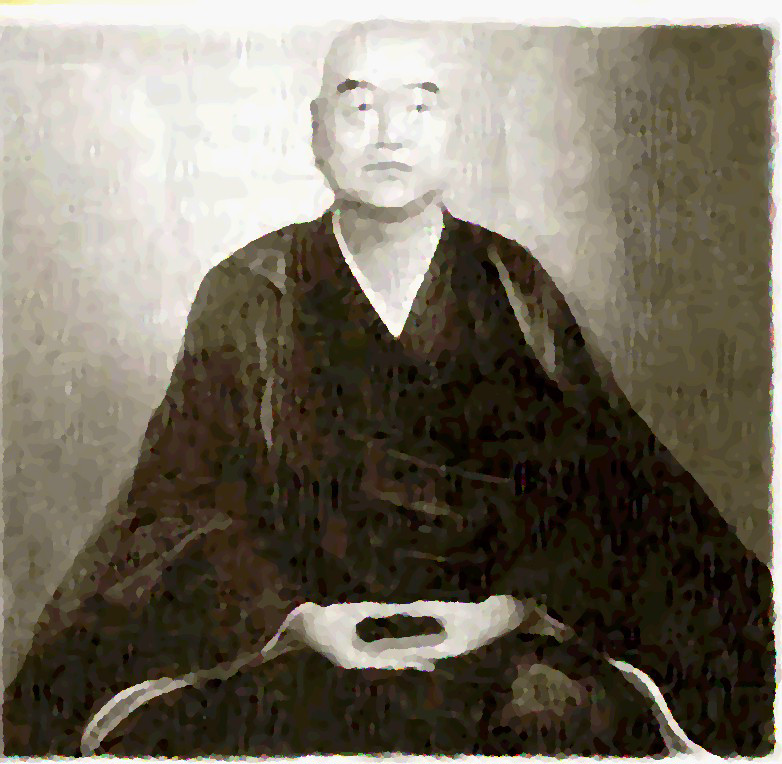
Dogen Zenji (January 19, 1200 - September 22, 1253), a title which translates literally to "Elementary-Way Zen-Master," was a Japanese Zen teacher and founder of the Soto school of Zen in Japan. He was a leading religious figure and important philosopher.
He came from a noble family and he quickly learned the meaning of the Buddhist word "mujo" (impermanence). His parents died when he was still young, and it is said that this early glimpse of impermanence inspired him to become a monk. He went first to Mt. Hiei, which was the headquarters of the sect he studied. In his young age, he questioned that "Both the esoteric and external doctrines of the Buddha teach that enlightenment is inherent in all beings from the outset. If this is so, why do all the Buddhas, past, present, and future, seek enlightenment?" This doubt led him to study Buddhism under the Rinzai teachers Eisai (1141 - 1215) and Myozen for nine years.
In search of the truth, he went to China accompanied by his teacher, Myozen, at the age of 24, even though crossing the ocean was dangerous at that time. After visiting well-known monasteries, he came to study with Ju-tsing (J. Nyojo), the 13th Patriarch in Mt. Tien-tung (J. Tendo). This lineage would become known as the Soto school in Japanese. Two years after, he finally realized liberation of body and mind, free from ego.
Dogen came back to Japan after four years abroad. In 1244, he established Eihei-ji, the main Soto monastery, in Echizen (now Fukui) to spread his Buddhist religion. The temple is still one of the two head temples of the Soto sect today. He spent about 10 years teaching there.
Dogen's masterpiece is the Shobogenzo, a collection of essays on the Buddhadharma in 95 chapters that reveal his thoughts and faith. He employed Japanese language to write, which was unconventional in that time, and put down the point in simple, logical and concise style. He was followed by Keizan (1268 - 1325), who popularized Soto Zen.
"Cease from practice based on intellectual understanding, pursuing words, and following after speech, and learn the backward step that turns your light inward to illuminate your self. Body and mind of themselves will drop away, and your original face will be manifest."
- Dogen
Wednesday, January 19, 2005
Food
I've been eating well, lately. Perhaps too well. Probably too much.
OF course, you are what you eat. What we eat or have eaten recently has a direct bearing on how we are being, our chi, and our consciousness. The environment is the source and the creator of all our food, providing the ingredients of soil, air and water. As we cook and digest this food, it becomes our blood. Half of our blood is made up of plasma, which regenerates itself every ten days. Therefore, it is easy to see that if we change our diet for ten days, it will affect how we feel and perceive the world around us.
After last Saturday's great dinner at Floataway Cafe, I had a grouper sandwich the next night, following the Rebecca Martin concert, at the Treehouse Lounge with my friend Jeff. Monday, a bunch of my co-workers and I went to lunch together, and I ate a far-too-large chicken burrito at Pappasitto's. I was still full at 9:00 p.m. following the evening service at the Zen Center, so I passed on going out to the unfortunately-named Thai Coon for our customary after-zazen meal with the Monday Night regulars.
However, that night, L. - not a Monday Night regular - stopped by the Center to join us for the sitting, and we went back to her place aferwards, stopping at Wild Curry to pick up two orders of chicken panang. So even though I was still too full from my lunchtime burrito to eat at the unfortunately-named Thai Coon, I wound up eating a full Thai meal that night anyway.
The Thai theme continued into the next day. Tuesday, I met sensei for lunch at Harry & Sons in Virginia Highlands, and I ordered the pad prik, but when it came, it was basically the same dish as the chicken panang. However, I still enjoyed it and ate all of it.
As long as I was out and about, I had made an appointment at my doctor's office for a routine check up. It was small wonder then that my weight was up a few pounds. The doctor raised his eyebrows as he looked at the results, and asked if I had stopped working out. "No," I wanted to reply, "I've just been on a marathon eating binge, and if fact just came from Harry & Sons with a belly full of chicken pad prik panang!" The good news was that my weight was still in the "normal" range for my age and height, although my BMI was one point (one point!) over the "recommended" zone.
But the binge continued. That night (last night), my office had a business function at Pappadeaux's, the cajun cousin of Pappasitto's, where I managed to gorge myself on a full plate of crayfish etouffe, followed by a huge slice of key lime pie.
I managed to show a little more restraint today, taking only a half plate of Dave's barbecue as our business meeting continued. However, I'm still eating, even right now as I'm writing - in this case, a Whole Foods thick-crust pepperoni pizza. The good news is this should be the end of the binge - I don't have any social or business meals planned for the next 48 hours or so.
Moving my focus up a few chakras from the stomach to the face, everyone's been reacting to my newly shaven chin. The consensus at the office, where four of the five males have goatees, is that shaving was a mistaken. "You should grow it back" seems to be the consensus. "It makes you look like a Republican," Dave viciously noted.
The cruelest comment, however, came as I picked up my morning coffee. The 20-something kid who serves me nearly every day did a triple take when he saw me and said that he didn't recognize me at first. "You look 15 years older," he offered by way of explanation.
There are few things less unkind to say to a man my age.
Personally, I think I look pretty much the same, only, well, somehow less intelligent. But maybe that's the same thing as Dave was trying to say.
Moving my focus up a few chakras from the stomach to the face, everyone's been reacting to my newly shaven chin. The consensus at the office, where four of the five males have goatees, is that shaving was a mistaken. "You should grow it back" seems to be the consensus. "It makes you look like a Republican," Dave viciously noted.
The cruelest comment, however, came as I picked up my morning coffee. The 20-something kid who serves me nearly every day did a triple take when he saw me and said that he didn't recognize me at first. "You look 15 years older," he offered by way of explanation.
There are few things less unkind to say to a man my age.
Personally, I think I look pretty much the same, only, well, somehow less intelligent. But maybe that's the same thing as Dave was trying to say.
Tuesday, January 18, 2005
Pandering
Condoleezza Rice is having her confirmation hearings today. But meantime, this from the Wonkette:
Blogging: Deep Thoughts
We hear there is a conference at Harvard this weekend on blogging and ethics. They're going to work on some ideas about standards and accountability. So glad Harvard is looking into this because we're not sure anyone could figure out whether or not to trust blogs unless Harvard tells them what the deal is. We look forward to future chin scratching to come on even weightier topics: Crossing the Street: Should You Look?; Mixed Nuts: Why Does the Brazilian Nut Always Wind Up on Top? and Spending Endowment Money: Let's Just Roll Around Naked In It, Shall We?. The upside is that this conference takes place on a weekend, so there's a good chance that everyone will be bombed by noon. Oh wait, it's Harvard. Well, maybe they'll drink a lot of green tea and get gassy.
Meanwhile, this little blog has been getting a whole bunch of hits lately based on picture searches. Specifically, searches for pictures of Courtney Love, preferably wallpaper sized, although some searches have also been for Jimi Hendrix and for Mount Everest. Somewhere, in the archives of this blog, all those pictures exist, and for some reason, the Google searches have started pointing the searchers to this blog today.
So the traffic volume to this blog is still going strong - at least by the low-volume standard of previous months' traffic. Last week, I started getting noticeably more hits after Wampum nominated my MSNBC screenshot of December 12, 2004 for The Koufax Awards: Most Humorous Post. That surge was soon replaced by hits from horny young men Googling after the nude pictures of Damon Gregory's wife. I mentioned Ms. Gregory in my SexBlog 2005 post of January 14, and it amuses me to wonder how many of those Googling Monkeys think that the pictures I posted there were actually of the underdressed and overexposed Ms. Gregory.
But this leads to the question of whether it is pandering to drop words like "Damon Gregory's wife" in a blog that otherwise has nothing to do with Ms. Gregory in an attempt to attract more hits. If I use the terms Courtney Love and Damon Gregory's wife, or even Michael Creighton - State of Fear (whatever happened to all of those hits?), does that constitute pandering, and if so, is that ethical?
Or do I need to go to the Harvard conference to find out?
Oh, by the way, this morning I shaved off my beard.
Monday, January 17, 2005
Why Do Women Live Longer Than Men?
From The Economist
Jan 13th 2005
WOMEN live longer than men. It is unfair, but true. In developed countries, the average difference is five or six years. In the poor world the gap is smaller, owing to the risks of childbirth. But nowhere is it absent. The question is, why?
That question can be answered at two levels. An evolutionary biologist would tell you that it is because women get evolutionary bonus points from living long enough to help bring up the grandchildren. Men, by contrast, wear themselves out competing for the right to procreate in the first place. That is probably true, but not much help to the medical profession. However, a group of researchers at John Moores University, in Liverpool, England, has just come up with a medically useful answer. It is that while 70-year-old men have the hearts of 70-year-olds, those of their female peers resemble the hearts of 20-year-olds.
David Goldspink, who revels in the title of Professor of Cell and Molecular Sports Science at John Moores, and his colleagues looked at 250 volunteers aged between 18 and 80 over the course of two years. All the volunteers were healthy but physically inactive. The team's principal finding was that the power of the male heart falls by 20-25% between the ages of 18 and 70, while that of the female heart remains undiminished.
Each volunteer's heart function was measured before exercise and at peak exertion on a treadmill. In particular, the researchers measured blood flow and blood pressure. Their subjects were also given an ultrasonic scan to measure the size of the chambers of their hearts, the thickness of the heart's muscular wall, and its filling and emptying actions.
The researchers found that between the ages of 20 and 70, men lose one-third of the contractile muscle cells in the walls of their hearts. Over the same period, women lose hardly any contractile cells. There is a strong link between the number of these cells and the function of the heart. What remains a mystery is why men lose these cells and women do not.
A previous theory of why women outlive men suggested that the female sex hormone, oestrogen, could have a protective effect on the heart. But Dr Goldspink dismisses this idea, saying that there is no discernible drop-off in female heart function after menopause, when oestrogen levels decrease dramatically. However, oestrogen does have a beneficial effect on blood vessels. The study found that blood flow to the muscles and skin of the limbs decreases with age in both sexes. The changes in the structure of the blood vessels occur earlier in men, but women catch up soon after menopause.
It's not all bad news for men, though. In a related study, the team found that the hearts of veteran male athletes were as powerful as those of inactive 20-year-old male undergraduates. But can men really recover lost heart function after a lifetime of inactivity and poor diet? Is it ever too late to start exercising? "I think the answer is no," says Dr Goldspink. "The health benefits to be gained from sensible exercise are to be recommended, regardless of age."
Jan 13th 2005
WOMEN live longer than men. It is unfair, but true. In developed countries, the average difference is five or six years. In the poor world the gap is smaller, owing to the risks of childbirth. But nowhere is it absent. The question is, why?
That question can be answered at two levels. An evolutionary biologist would tell you that it is because women get evolutionary bonus points from living long enough to help bring up the grandchildren. Men, by contrast, wear themselves out competing for the right to procreate in the first place. That is probably true, but not much help to the medical profession. However, a group of researchers at John Moores University, in Liverpool, England, has just come up with a medically useful answer. It is that while 70-year-old men have the hearts of 70-year-olds, those of their female peers resemble the hearts of 20-year-olds.
David Goldspink, who revels in the title of Professor of Cell and Molecular Sports Science at John Moores, and his colleagues looked at 250 volunteers aged between 18 and 80 over the course of two years. All the volunteers were healthy but physically inactive. The team's principal finding was that the power of the male heart falls by 20-25% between the ages of 18 and 70, while that of the female heart remains undiminished.
Each volunteer's heart function was measured before exercise and at peak exertion on a treadmill. In particular, the researchers measured blood flow and blood pressure. Their subjects were also given an ultrasonic scan to measure the size of the chambers of their hearts, the thickness of the heart's muscular wall, and its filling and emptying actions.
The researchers found that between the ages of 20 and 70, men lose one-third of the contractile muscle cells in the walls of their hearts. Over the same period, women lose hardly any contractile cells. There is a strong link between the number of these cells and the function of the heart. What remains a mystery is why men lose these cells and women do not.
A previous theory of why women outlive men suggested that the female sex hormone, oestrogen, could have a protective effect on the heart. But Dr Goldspink dismisses this idea, saying that there is no discernible drop-off in female heart function after menopause, when oestrogen levels decrease dramatically. However, oestrogen does have a beneficial effect on blood vessels. The study found that blood flow to the muscles and skin of the limbs decreases with age in both sexes. The changes in the structure of the blood vessels occur earlier in men, but women catch up soon after menopause.
It's not all bad news for men, though. In a related study, the team found that the hearts of veteran male athletes were as powerful as those of inactive 20-year-old male undergraduates. But can men really recover lost heart function after a lifetime of inactivity and poor diet? Is it ever too late to start exercising? "I think the answer is no," says Dr Goldspink. "The health benefits to be gained from sensible exercise are to be recommended, regardless of age."
Subscribe to:
Posts (Atom)
-
If laughter makes you well, what if the well runs dry? - David Byrne, Office Cowboy Also, if whiskers on kittens is one of your favo...
-
It's 325 miles from Atlanta to Jekyll Island, or roughly the distance from Boston, Massachusetts to Wilmington, Delaware, but I made...