Saturday, August 31, 2013


HAPPY BIRTHDAY, MOM!!!
July 1954 - The brave woman above, although herself no more than barely a post-adolescent at the time, gave birth to the author of this blog. Some 20-some years before that, on this very day, another brave woman, age unknown to this author at this time, also gave birth, this time to the woman pictured above. 

Flash forward back to the here and now, and we have the son, off on a semi-hedonistic adventure to hear as much music as he possibly can in one week, nearly forgetting to even as much as call his own mother on her birthday.  Thank Jobs for the internet, so at least he can send this virtual birthday card, and wish her the very best.

Love you, Mom!  Have a great birthday and a terrific year!

Thursday, August 29, 2013

Really, Who Are You?


When the First Chinese Patriarch Bodhidharma was asked, "Who are you?" he famously replied, "I don't know," or more accurately "Mu knowing," or "not knowing," or "not known," or "unknown," or even, "the unknown."  Personally, I like "that which is unknown."

Five generations of students and teachers later, the Sixth Chinese Patriarch Hui-Neng asks a monk, "What is this that comes thus?" Both Hui-Neng's question and Bodhidharma's earlier answer were directly pointing at buddha-nature, that which cannot be grasped with the mind, but is the substrate from which the mind divides all things into separate entities.  It is both empty of any individual identity and it is our potential to become a Buddha.  The monk answered Hui-Neng by saying "To describe a thing misses the mark."

The Fourth Chinese Patriarch, meeting the Fifth Patriarch when the latter was just a young boy, asked "What is your name?"  "What is your name?," "Who are you?," and "What is this that comes thus?" are all tests to see if the one being questioned grasps the essence of buddha-nature, whether the one asking the question realizes it or not.

The boy answers "I have a name, but it is an unusual one."

Intrigued, the Fourth Patriarch asks what this unusual name is.

"It is Buddha-nature," the boy replies.

"You do not have buddha-nature," the Fourth Patriarch tells the boy.

"Buddha-nature is emptiness," the boy replies, "so we call it being without."

Years later, the Fifth Patriarch asks Hui-Neng, the Sixth Patriarch, "Where are you from?"  Do not think that just because the question this time is about geographical origination rather than individual identification that it is any different from the other three questions.

Hui-Neng answers straightforwardly,  "I am from south of the Great Mountains."

The Fifth Patriarch asks him, "Why do you come here?"

Still answering straightforwardly, Hui-Neng says "I come to become a Buddha."

The Fifth Patriarch tells him, "People from south of the Great Mountains do not have buddha-nature.  How can you expect to become a Buddha?" 

This sounds rude, certainly provincial and possibly even racist, but the Fifth Patriarch was correct - people from south of the Great Mountains do not, in fact, have buddha-nature.  But then, neither do the people from north of the Great Mountains.  No one "has" buddha-nature in the same sense that no one "has," say, atoms. To say that I "have" atoms implies that there is a "me" not composed of atoms that can possess these particles, yet there is no "me" that isn't itself completely composed of atoms.  I do not "have" atoms, I AM atoms. Similarly, we do not "have" buddha-nature, we completely and totally ARE buddha-nature through and through.

Hui-Neng understood.  He calmly told the Fifth Patriarch, "North and south exist in the minds of people, but in buddha-nature there is no north and south."

So this test, "Who are you?" was thrown at Bodhidharma, the First Chinese Patriarch, and has been passed down from generation of teacher to generation of student over the years, being posed by the Fourth Patriarch to the Fifth, and by the Fifth Patriarch to Hui-Neng, the Sixth Patriarch, and by Hui-Neng to his students, the many teachers of the seventh generation.  

This question still is being asked this day.  Quick, without referring to any other person or relying on a name (a mere label applied on you by some other), who are you? 

Wednesday, August 28, 2013

Trompe L'œil?


"Conservatism in human beings may be characterized as behavior by individuals who possess a reluctance to update their beliefs in the face of new information. This property is a natural result from information theory. . . the information one can receive is information sent minus equivocation, which is reduced gradually as the receiver’s background knowledge about the source increases. Hence, conservatism reflects the gradual reduction of equivocation by the receiver of any given information." (Jing Chen, The Entropy Theory of Human Mindhttp://web.unbc.ca/~chenj/1.pdf).

Tuesday, August 27, 2013

Meanwhile, Back In Athens


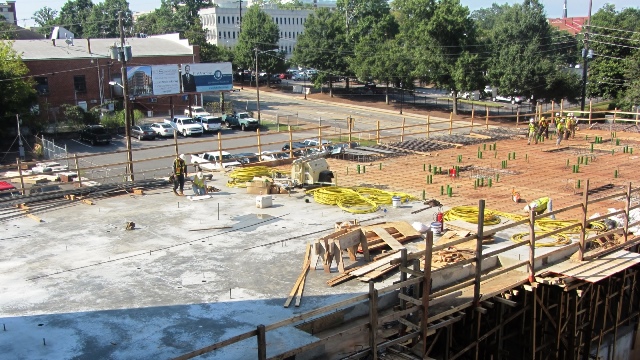
Nature has given us a break from the longest stretch of rainy weather I can remember in a long time, at least a temporary break.  The weather this week has been cool for August (by Georgia standards) - high 70s to low 80s, but most mercifully of all, relatively dry.

I took advantage of the pleasant conditions today to make my monthly visit to the construction site in Athens.  I don't have anything particularly profound to say about it (or even slightly profound, for that matter), other than it's nice to be outside on a day like today, and it's nice to have work.  

More nice days and more work would be good, but then who's to say what's good or what's bad, or what days are "nice" and what days aren't.  All days just simply are, and whether we consider them "good" or "bad," or "nice" or "not" simply depends upon us.  We make of it what we want.

Monday, August 26, 2013

Monday


“Impermanence is, of course, Buddha Nature, and permanence is, in fact, the mind dividing up all things into good or bad.” - Hui-Neng (638-713 AD)

Sunday, August 25, 2013

Against Entropy


Entropy, when taken as a measure of the disorder or randomness in a closed thermodynamic system, has obvious similarities to impermanence.  Granted, they are not the same thing and much of what is considered entropy and much of what is considered impermanence cover separate topics, but the overlap in the Venn Diagram of the two is considerable.  Among other differences, entropy might be considered to apply to closed systems, while impermanence is usually thought of as applying to individuals or individual objects in that system.

Regardless, living beings are every bit as subject to entropy as are gas molecules in a room, the classic example of entropy.  It takes effort for a living being to not succumb to entropy and not have its body dissociate and disperse across the biosphere, but that is exactly what happens in death and decay.  Every living body eventually succumbs to entropy, and the highly organized bodies and organs that contained and sustained its life do not stay that way forever.  To say that everything is impermanent is to say that everything ultimately succumbs to entropy.  A physicist might say that life-and-death is a sequence from a low to a high state of entropy. 

Have you ever seen one of those time-lapse movies of an animal decaying, like during the title sequence of the HBO show True Blood?  That's entropy - the body itself becoming disorganized and literally falling apart, and then those parts entering the food chain and dispersing across the globe, or becoming part of the soil, or being taken up by plant life and entering the food chain in that manner.  The inability to keep a body intact and highly organized forever is also known as impermanence.

All living beings, in order to survive, work to maintain a state of low entropy and to avoid states of high entropy.  But reduction of entropy in an individual results in an increase in entropy outside of the individual. As described by Ling Chen of the University of Northern British Columbia, "Living organisms need to extract low entropy from the environment, to defend their low entropy sources, and to reduce the diffusion of the low entropy. The struggle to stay in low entropy states is called natural selection."  It's even more obvious when stated that natural selection is the struggle to avoid impermanence. 

Displays of low entropy levels evolved as a signal of attractiveness in the process of natural selection, and organisms can advertise their suitability as potential mates by appearing to avoid impermanence. According to Chen,
"As both natural selection and sexual selection favor low entropy state, the pursuit of low entropy becomes the main motive of human mind and animal mind. Indeed, the low entropy state is the main way of advertisement for most sexually reproducing species. Large body size, colorful and highly complex feather patterns with large amount of information content, and exotic structures are all different representations of low entropy states."
Among us humans, displays of apparent permanence are accomplished through the accumulation of wealth, conspicuous consumption, demonstrations of athletic prowess, and creation of works of art, all of which represent different forms of  low entropy.  People signal their low-entropy state by buying ever-more expensive houses, cars and clothes, going to more expensive restaurants, and attending more exclusive schools. The great efforts human beings put into these activities reflect the importance of hiding the appearance of impermanence.

So much of human suffering revolves around the inevitability of impermanence and the effects entropy has on us.  However, it appears that clinging to low states of entropy is something that is hard-wired into our DNA. The Indian sage Nagarjuna said that the mind that sees the impermanence of the world is the mind of wisdom.  I wonder if Max Planck ever thought that wisdom was the recognition of entropy.

Saturday, August 24, 2013

Tanyard Creek


Tanyard Creek, Atlanta, Georgia, Saturday afternoon. This poor little urbanized waterway has faced more than its fair share of challenges, from flash flooding due to all the urban pavement in its upstream catchment to sewage overflows and fish kills. Despite all this, it still remains beautiful.

The neighborhood takes water samples from the creek every Thursday and delivers them to the Chattahoochee Riverkeepers for analysis of E. coli. The EPA considers levels above 250 mpn to be unsafe - only once has Tanyard Creek has been below the safe level in 2013. 

This summer has been particularly problematic, with readings of 2,370 (5/16/13), 120,980 (7/2/13), 60,165 (8/1/13), and most recently 675 (8/15/13), which sounds good compared to the previous readings, but is still over two-and-a-half times the EPA safe level. If you want to see readings since 2010, you can go to http://georgiaadoptastream.com/db/Sites.asp (enter "Tanyard Creek" to get the results).

"I love that dirty water," The Standells sang back in 1966. It may take a certain leap of faith to love the Charles River, but the beauty of Tanyard Creek certainly appeals for better treatment than it's receiving.

Friday, August 23, 2013

On The Neurology Of Consciouness


Some 2,500 years ago, Shakyamuni Buddha taught that consciousness (vijnana) was a product of our "mental maps" or schema (sanskara), which in turn arise out of our subconscious mind or ignorance (avidya).  This is not mystical thinking or superstition, but his own observations of the working, functioning mind, and in this TED lecture on the neurology of consciousness, although he never once mentions Buddhism, Antonio Damasio shows that science is now reaching the same or similar conclusions.

According to this lecture, there are little modules in the brain stem that produce maps of different aspects of our body. Damasio describes these maps as "exquisitely topographic and exquisitely interconnected in a recursive pattern."  To be sure, these maps are not the "mental maps" (sanskara) of Erich Fromm, but this interconnection between brain stem and body provides the grounding for the self. The proto- or core self is grounded in this very tight interconnection between the brain stem and the body and is experienced in the form of primordial feelings.  The conscious mind cannot exist without this interconnection between brain stem and body.

The cerebral cortex, in turn, provides the great spectacle of our minds, the profusion of images to which we normally pay the most attention.  Just as a conscious mind cannot exist without an interconnection between the brain stem and the body, a conscious mind likewise cannot exist without an interconnection between the cerebral cortex and the brain stem. 

The design of the brain stem throughout the vertebrates is very similar to our own, which suggests that other species also have conscious minds.  However, their experience is not as rich as ours because they don't have a cerebral cortex like that of humans. The difference is in the cortex. Consciousness should not be considered as the great product of the cerebral cortex. The richness of the conscious experience is generated by the cortex, but not the fact that we have a sense of self at all.

Damasio describes three levels of the self - the proto-self, the core self, and the autobiographical self.  The first two, the proto-self and the core self, are shared with many other species, coming out of the brain stem and whatever there is of cortex in those species.  All sentient beings probably have at least some sense of proto-self, likely as a defense mechanism - it's been said that if you attempt to kill something and it runs away, it's sentient.

Some species additionally have an autobiographical self.  To a certain degree, cetaceans and primates probably have an autobiographical self.  Dogs also appear to have an autobiographical self to a certain degree.

According to Damasio, the autobiographical self is built on the basis of past memories and memories of the plans that we have made.  It's based on the lived past and the anticipated future, or what the Buddha called sanskara.  It is the autobiographical self that results in extended memory, reasoning, imagination, creativity and language, and out of these come the instruments of culture -- religions, justice, trade, the arts, science, and technology. 

So if I'm understanding Damasio correctly, the autobiographical self, what can be called the ego-self, is built on the basis of past memories and the mental templates or models that we have developed and use to comprehend the world.  These are the mental maps of Erich Fromm, also called schema or sanskara. Proto- or core consciousness may exist at lower levels of awareness in the brain stem, but the vivid experience of our own selves (vijnana) relies on the cerebral cortex and its mental maps.

Finally, since we are not aware or do not experience the arising of our consciousness (how could we be aware of such a thing? - it would be like "seeing" our own eyes without use of a mirror), sanskara arises subconsciously outside of our knowledge, that is, out of ignorance (avidya).  This process, consciousness arising out of schema, and schema arising out of ignorance, is the first three steps of the Buddha's teaching of dependent co-origination, and is now apparently affirmed by neuroscience.

Wednesday, August 21, 2013

Who Are You?


When he arrived in China around about, I don't know, 500 AD, the Indian sage Bodhidharma was asked by Emperor Wu, "Who are you?"

Bodhidharma famously replied, "I don't know."

Many people, including myself, have misunderstood this answer.  Was he oblivious to who he was?  Was he somehow being humble?  Was he just trying to pull the rug out from under the Emperor?  In any event, Wu didn't understand either, and Bodhidharma was lucky to get out of there with his head still on his shoulders.

Recently, while we've been talking about buddha-nature during Monday Night Meditation, I've come to a new (at least for me) understanding.  Buddha-nature, of course, is more than just something that all sentient being have - all sentient beings completely are buddha-nature.  And since we're all of the same substance, there's no differentiation between any two sentient beings - we're all one.  And since buddha-nature encompasses more than just sentient beings but all phenomena, too, everything is buddha-nature and everything is everything - it's all nothing but buddha-nature.  That "all phenomena" also includes our thoughts, memories, mental maps and models, ideas, concepts, and so on.  And since those are a mere part of the seamless whole of buddha-nature, by definition buddha-nature itself goes beyond any concept we might have of what it is.  However we try to wrap our mind around it, we're still limiting it to "it's this" and "not that."  Whatever we think it is, it isn't.  It's beyond, it transcends, any concept of what it is.

Okay, got all that?  Good.  Everything is everything, and in the absolute sense, nothing is separate from anything else and therefore nothing exists individually.  But that's not how we experience the world.  In this relative world, I am me and you are you, mountains are mountains and rivers are rivers.  I can see them, I can identify them, I can describe them to others and get separate confirmation that these things exist.  But in the absolute sense, it's all buddha-nature, all part of a seamless whole, and it's only the mind that tries to subdivide the true fabric of reality into separate "things."  We can directly experience the absolute in a deep state of meditation - when the "thinking mind" finally stops its chatter and clams down, it also stops subdividing everything into separate "things," and we can experience the absolute.  But as soon as a thought arises, even, "Ah, so that's what the absolute is," we fall right back into the world of the relative.

So meanwhile, back in China, Emperor Wu asks Bodhidharma "Who are you?"  His question is "stuck" in a relative mind-set - he's really asking "Of the millions of separate individuals out there, none of whom, incidentally, are me, which one are you and how do you fit in?"

Bodhidharma answers not from the relative, but from the absolute.  Why?  Perhaps to test Wu to see if he understands the difference (if so, Wu failed the test).  Perhaps to teach the Emperor, by showing him another way of seeing the universe.  Or perhaps, and I don't think this is the case, because Bodhidharma abode in the absolute and saw things only from that perspective.

In any event, the absolute answer to the relative question, "Who are you?" is that we are all buddha-nature, we are all that which transcends even our own understanding or conceptualization of what it is.  We are beyond our "knowing" or, for that matter, our "not-knowing."  Bodhidharma's answer, "I don't know" means that he absolutely does know (pun intended), but further knows that it's beyond the realm of words and thoughts.

He gives an absolute answer to a relative question.  Five generations of teachers and students later, a monk approaches the Sixth Chinese Patriarch Hui-Neng to begin his study under him as his teacher.  Hui-Neng asks the monk, "What is this that comes thus?"

Hui-Neng knew that the monk knew the story of Bodhidharma and Emperor Wu, and wouldn't fall into the trap of blurting out a casual answer to "Who are you?" without showing off his learning, so he surprises him by asking essentially the same question ("What is this that comes thus?" is basically "Who are you?"), but posing the questions from the absolute perspective rather than the relative.  "What?" instead of "Who?" "That which comes thus" acknowledges things just as they are, without underlying presumptions or conceptions.

The monk thought about the question for eight full years, and then came back to Hui-Neng and said, "Now I understand your question, 'What is this that comes thus?'."  Hui-Neng asks him how he understands this.

The monk replies, "To describe a thing misses the mark."

Hui-Neng suspects that the monk understands, but to test him he asks, "Does your answer rely on your practice and experience?"  He might understand that what comes thus is buddha-nature, but does he understand that even his practice and experince are buddha-nature, too?  Is his mind free of some things, but still sticking to others?

The monk says, "It is not that there is no practice and experience, but to taint it with words is impossible."

Bulls-eye!  He got it!  In confirmation, Hui-Neng comfortably slips back into the relative perspective, and tells him, "I am like that, you are like that, and the buddhas and patriarchs of India were also like that."

All things are buddha-nature, and all things are therefore "empty" of a separate, individual existence.  This is the absolute view.  But it doesn't feel that way to us, and we experience the world in a relative sense - "self" relative to "others," "this" relative to "that."  One view isn't "right" and the other "wrong,"  it's just two different ways of looking at things.  The enlightened mind can hold both views simultaneously without sticking to one of the other.  

You can hold both views simultaneously yourself without sticking to one or the other by practicing  meditation - calming the mind, stopping the discriminating thoughts that try to separate things out from each other, and engaging in shikantaza ("just sitting").   You will discover the state of practice-enlightenment and abide in that state - at least until the bell rings ending the meditation period.           

Tuesday, August 20, 2013

Upward Mobility


Although Atlanta is one of America’s most affluent metropolitan areas, according to a July 22, 2013 article in the New York Times, it is also one of the most physically divided by income.  Low-income neighborhoods "often stretch for miles, with rows of houses and low-slung apartments, interrupted by the occasional strip mall, and lacking much in the way of good-paying jobs."  This geography makes Atlanta one of the metropolitan areas where it is most difficult for lower-income households to rise into the middle class and beyond.

Climbing the income ladder occurs less often in the Southeast and industrial Midwest, with the odds notably lower in Atlanta, Charlotte, Memphis, Raleigh, Indianapolis, Cincinnati, and Columbus.  By contrast, some of the highest rates occur in the Northeast, Great Plains, and West, including New York, Boston, Salt Lake City, Pittsburgh, Seattle, and large swaths of California and Minnesota.

Economists have found that a smaller percentage of people escape childhood poverty in the United States than in several other rich countries, including Canada, Australia, France, Germany and Japan.  Yet the parts of this country with the highest mobility rates, like Seattle, have rates roughly as high as those in Denmark and Norway, two countries at the top of the international mobility rankings. In Atlanta, by comparison, upward mobility appears to be substantially lower than in any other rich country.

The variation does not stem simply from the fact that some areas have higher average incomes: upward mobility rates often differ sharply in areas where average income is similar, like Atlanta and Seattle.  On average, poor children in Seattle, those who grew up in the 25th percentile of the national income distribution, do as well financially when they grow up as middle-class children from Atlanta who grew up in the 50th percentile.

Economists are confident that the characteristics of different regions — as opposed to something inherent and unchangeable in the local residents — are helping cause the varying mobility rates.  When poor communities are segregated, everything about life is harder. All else being equal, upward mobility tended to be higher in metropolitan areas where poor families were more dispersed among mixed-income neighborhoods. Income mobility was also higher in areas with more two-parent households, better elementary and high schools, and more civic engagement, including membership in religious and community groups.

In Atlanta, the most common lament seems to be that concentrated poverty, extensive traffic, and a weak public-transit system make it difficult to get job opportunities.  In interviews, residents reflected many of the national concerns and many of the patterns in the study.
  • A 40-year-old man who runs a local painting crew said he wished he had enough time, amid work and parenthood, to go back to school.
  • A recent graduate of a chiropractic program who has struggled to find work called herself “a loner” and said she wished she knew more people to help with her job search.
  • A father of three in Gwinnett County with a temporary job as a network engineer said that the struggle to build a better life often felt similar to “a lottery.” His job comes with no health insurance for him, his wife and his three children.
  • His wife recently left a job at a diner that required an hour’s commute by bus. She would like to find a new job with health insurance, but the family has only one car.

It's not something lacking in the people that's causing this problem.  They're not undermotivated, or content to rely on food stamps and subsidy programs, the "free stuff" that Republicans like to claim the government is handing out that keeps people in poverty.  What they need is the ability to get to the jobs.

Although not mentioned in the Times' article, Atlanta has been vehemently opposed to public transportation projects, other than widening its already vast yet still clogged highways. The existing MARTA transit system is constantly under attack and subjected to budget cuts, service cutbacks, and route reductions.  A recent transportation referendum was soundly defeated at the polls.  The only major new public transit initiative, the Beltline, can't seem to get its transit component going and has been primarily a parks and trails project for several years now.

More transit will mean less poverty, according to the economic study cited in the Times.  Less poverty, in addition to being a noble and worthy goal in and of itself, will also mean less crime, less tension, and more consumers and customers for businesses and retailers.  Frankly, it makes a city more fun to live in.  It's a good investment all around - everyone wins - yet there's no hope of a turnaround anywhere on the horizon around here.

Atlanta, it seems, is content to continue to be a third-world economy in terms of upward mobility.