Tuesday, January 31, 2006

The long version . . .

Daibai-zan (“Great Plum”) Mountain is in the city of Keigen-fu. Gosho-ji temple was established on this mountain, and its founder was Zen Master Hojo (Daibai Hojo [752-839], successor of Master Baso Do-itsu). Zen Master Hojo was a man of the Joyo district (in present-day Hupei province in east China).

In former days, when visiting Baso’s order, he asked, “What is Buddha?”

Baso said, “The mind here and now is Buddha.”

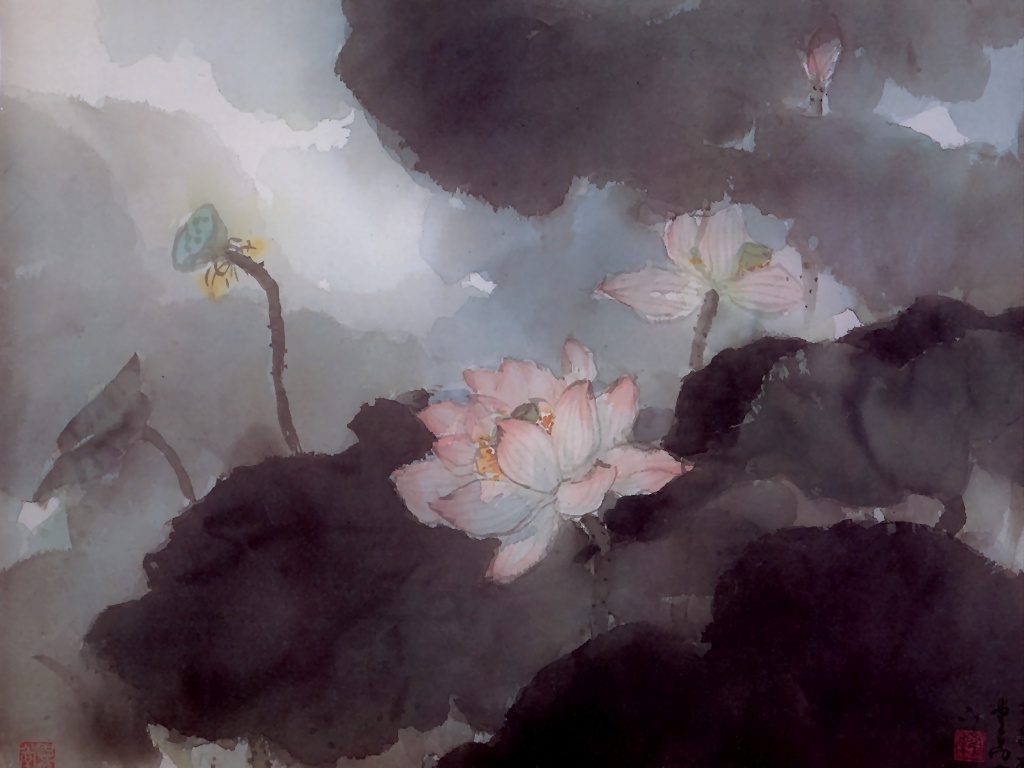
Hearing these words, Hojo realized the great state of realization under their influence. Consequently, he climbed to the summit of Daibai-zan (“Great Plum”) Mountain, away from human society, and lived in solitude in a thatched hut, eating pine nuts and wearing clothes made from lotus leaves: there was a small pond on the mountain, and many lotuses grew in the pond. He sat in Zazen and pursued the truth for more than thirty years. He saw and heard absolutely nothing of human affairs, and he lost track of the passing years, only seeing the mountains all around go from green to yellow. One pities to imagine what the winds and frosts were like.

In Zazen, the Master placed an eight-inch iron tower on his head, as if he were wearing a crown. By endeavoring to keep the tower from dropping to the ground, he did not fall asleep. The tower remains in the temple today: it is listed in the records of the temple storehouse. This is how he pursued the truth until his death, never tiring of the effort.

He had been living like this for years and months when a monk from Enkan’s order (Zen Master Enkan Sai-an [?-842], also a successor of Master Baso Do-itsu) happened to come onto the mountain looking for a staff. The monk had lost his way on the mountain and unexpectedly came upon the site of the Master’s hut. When, to the monk’s surprise, he saw the Master, he asked, “Master, how long have you been living on this mountain?”

The Master said, “I have only seen the mountains all around go from green to yellow.”

The monk asked further, “What is the way down from this mountain?”

The Master said, “Follow the stream down.”

The monk was struck. When he returned and told Enkan what had happened, Enkan said, “In former days when I was in Kozei (Kozei is where Master Baso had his order) I once met a certain monk, and I do not know what happened to him after that. This couldn’t be the same monk, could it?”

Eventually Master Enkan sent the monk to extend an invitation to Master Baso, but the Master would not leave the mountain. He replied with a verse:

“A withered tree, broken and abandoned, in a cold forest,
However many times it meets spring, it does not change its mind.
Passing woodsmen do not even look back.
Why should people from Ei be keen to search it out?”

In the end, he did not go. Later, when he decided to move even deeper into the mountains, he made the following verse:

“I shall never outwear the lotus leaves in the pond,
The flowers of a few pines are more than a meal.
Now my abode has been discovered by people of the world,
I shall move my shack deeper into seclusion.”

Finally, he moved his hut further into the mountains.

Once Baso sent a monk especially to ask Daibai Hojo, “Master, when you visited Baso in former days, what truth did you attain and then come to live on this mountain?”

The Master said, “Baso told me, ‘The mind here and now is Buddha.’ Then I came to live on this mountain.”

The monk said, “These days, his buddha-dharma is different.”

The Master said, “How is it different?”

The monk said, “Baso says ‘It is neither the mind nor Buddha.’”

The Master said, “That old man! If he is out to disturb others, I will have no sympathy for him. Never mind about ‘neither the mind nor Buddha.”

The monk reported these words to Baso. Baso said “The fruit of the Plum is matured.”
- from Dogen’s Gyoji, Shobogenzo Fascicle 30 (translated by Gudo Nishijima and Chodo Cross)

The short version . . .

Daibai asked Baso: “What is Buddha?”
Baso said, “This mind is Buddha.”

A monk asked Baso: “What is Buddha?”
Baso said: “This mind is not Buddha.”
- The Gateless Gate, Cases 30 and 33 (translated by Nyogen Senzaki and Paul Reps)

Monday, January 30, 2006

Karma can be a real bitch.

But first, and more importantly, my father is making very good progress in his hospital in Hawaii. The ventilator tube is out and he's talking now. I think they're just holding him until the biopsy results are back.

But karma, as I was saying, is inescapable. I was confronted today by my office manager about a hole punched in an office wall. I immediately offered to make restitution and pay for any damages, and was told that the estimate was for $150. That made me so mad that I threw a chair through a window.

Just kidding. But one moment of loss of self control and bam!, a one-fifty fine. I should have known that incident would come back to haunt me. And worse yet, the manager wants me to think about how to publicly acknowledge my regret for the incident. "I usually resort to self-deprecating humor, but that's just my approach," he said, and told me to think about it for a day or two to come up with a solution.

Matsuoka Roshi, my teacher's teacher, used to say that when you thought angry thoughts, it was like a knife through water. "But when you speak out of anger, it's like a knife through sand - it leaves an imprint, but it can be smoothed over. But when you act out of anger, it is like a knife through granite - it leaves a lasting mark that can hardly ever be erased."

Yeah, sure, but he never deleted a spreadsheet, I'll bet.

Coming home, I found a summons for jury duty in the mail.

The good news was that it was Monday - my night to open the zendo. I got to attend to others as they sat in meditation, take my mind off of my little problems and try to actualize my bodhisattva vows and allow others to attain realization.

Sunday, January 29, 2006

Today was my Zen teacher's ceremony. Those of you who might be reading this for a deeper understanding of the role of ceremony and liturgy in Zen traditions had better stop reading this right now - this is a totally egocentric, first person account of the ceremony from one self-perspective only. And I'm recounting it here not to praise myself, but just to document it for those who may have no idea what it might be like.

But as I was saying, today was the day. I got to the zendo at about 8:00 a.m. and the roshi insisted that I wear a borrowed black ceremonial robe, the hem of which kept getting under my feet and tripping me up as I rose from sitting. I sat in meditation for about 90 minutes to calm the mind before the 10:00 ceremony.

The ceremony itself consisted of the four candidates filing in to the room and the usual prostration bows and incense offering just like the initiate's and the disciple's ceremonies, but then went on to a sort of public test of the candidates' understanding. I've previously discussed the central koan (case study) for the ceremony here in this blog, although I had not identified it as such. The senior teachers put both prescribed and spontaneous questions to us. My prescribed question was, "A great master tumbles, dancing in the spring breeze. Falling in amazement, apricot blossoms scatter in a riot of crimson."

Very nice image, but hard to find a question in that. Responding to the imagery, I replied "Yes. And a single purple daffodil blossoms by the zendo door." Not a bad answer, I thought, because, after all, it was true - there was a single purple bloom in the otherwise seasonably dead garden by the front door (although I was later told it was an iris, not a daffodil), and the image also could symbolize the blossoming of wisdom and understanding through zazen.

All of you reading this can probably think of better answers, but you're not on the spot kneeling in front of the sangha in a borrowed ceremonial robe.

But then the senior teacher replied, "Can't you do better than that?"

Well, of course I could. All words miss the mark anyway, and a better answer would be silence. So I stood still and quiet for a minute, and could sense the sangha at first thinking I was struggling to formulate an answer, but then gradually realizing that the silence itself was my answer. Or so I thought, until the roshi cut in with a few words to help me out of my "predicament."

So, I mumbled something about "blossoms fade while weeds flourish," drank a big bitter cup of humility and waited on the next questions.

They were fairly easy after that, especially as I regained my Zen footing and tried to avoid answers that stuck to either the relative or the absolute. I was asked to recite some scripture, I was asked if Buddhas existed in both the mountains and the cities, I was asked if we shouldn't rather perform zazen standing on our heads than sitting on our asses.

Then I was asked to recite my poem based on the koan.

I had thought about the assignment all last week, and most of the poem came to me while in the shower last Friday morning. Arising, I said:

"Nanyue searched but could not find
The face that fronts ordinary mind.
Eight years spent in meditation,
Mind devoid of conversation,
Finally swung the dharma door.
If the face you're looking for
Is whiskers, nose hair and eyelashes
Your practice is dead wood and ashes.
If you yearn for silent thunder,
Then take Pittsburgh and the over-under.
But in pure practice, undefiled,
The Buddhas laugh, and Huineng smiled."

It was the best that I could come up with, and I'm not quitting my day job, but I did hear some gratifying laughter after the "over-under" line.

The roshi finally declared "Well done, Shokai" and after a few words, declared myself and the other three candidates senseis, and led the procession (or is it "recession"?) out of the hall. Hugs and congratulations all around, a meal, and that was that.

I'm sure others in the room have a different experience of the ceremony, and might recall the events differently, but there are as many different experiences as there were attendees. I can only recount mine.

Saturday, January 28, 2006

Today, I got the disappointing news that my father is in ill health and not doing well.

He lives in the State of Maine, and had come down with pneumonia. He recovered, no small feat for a man in this 70s, and decided to head to Hawaii for a previously planned and already delayed vacation to complete his recovery. However, he relapsed once he arrived in the islands and was not responding to any oral antibiotics, so they put him on IV antibiotics and steroids and moved him by ambulance to the largest medical facility in Honolulu for a surgical sampling of lung tissue.

He got through the surgery well with vital signs stable, etc., although his white blood count is low, which indicates infection, despite the antibiotics. He still has a ventilator tube down his throat to help him breathe and has to write out his requests and answers to questions. It looks like he will be in the hospital at least another 3 more days as he waits on the biopsy results.

He was refusing pain medication for the first day following the surgery, until the nurse told him that they needed to change his bed sheets, brush his teeth, and wash his face (general upkeep) which would all cause still more pain. He agreed at that point to have some pain meds put into his IV.

So at this point, I think it's safe to say that his vacation in Hawaii is not going the way he had planned.

It looks like the tough old bastard (and I use those words with respect and affection) will survive this ordeal. Everyone in my family seems quite understandably freaked out. Life and death is the great matter, and this episode is another uncomfortable reminder of our mortality.

Wednesday, January 25, 2006

Not that you care, but I'm listening to Coltrane again. Having chilled out a week or so with Claude Challe's Buddha Bar records, I'm re-listening to some of the Coltrane albums and still catching nuances that I missed the last time through.

My Teacher's ceremony is this Sunday at the Zen Center. I don't feel complete enough to be called a teacher of Zen, but I can console myself by remembering that there's nothing to teach.

Part of the filling of that sense of incompeteness included signing up for a three-day sesshin next month at Sanshin Zen Center in Bloomington, Indiana under the direction of Okumura Sensei. Friday and Saturday both start at 4 AM and will consist of 14 50-minute zazen and 10-minute walking meditation (kinhin) periods. No dharma talks, no tea breaks, no distractions (and no oryoki). Just sitting. Shikantaza.

Sounds perfect.

Sunday starts at 4 as well, but includes an oryoki breakfast and a dharma talk at 10:00. It sounds like the whole thing wraps up around noon.

Last Sunday, I had coffee with my friend Arthur, who's already a teacher at the Center, and he convinced me that I was no more or less worthy of being a teacher than he was. In fact, he took some measure of comfort in my discomfort, since it indicated to him that I did not take the role for granted, and would make great effort to be as good a teacher as I could.

There are four of us being certified - the three others are worthy candidates all - and if you're not doing anything else this Sunday feel free to come on by and participate in the ceremony.

We can listen to my Coltrane records afterwards.

Tuesday, January 24, 2006

Last Sunday, at 2:42 p.m., a Pac Bell Internet Services client in West Hollywood, California logged on to this site and became the 75,000th visitor to Water Dissolves Water.

Today, at 12:35 P.M., driving down Powers Ferry Road during lunch, just at the point south of the Windy Ridge traffic light where the road begins its descent into the Chattahoochee River floodplain, the odometer in my car rolled over to its 1500th mile.

These events don't have any intrinsic or significant meanings. However, attention to these kind of details keeps one's mind aware of the present moment, and can be used as a sort of reminder of the here and now.

I used to have a running game with Beth, an old girlfriend, where we'd each try to be the first to point out a digital clock reading either 1:11 or 11:11. A.M. or P.M., it didn't matter - just as long as the time was shown as a series of three or four straight lines. I don't recall how it got started, but it was always a reminder of "right now."

Recalling just when your odometer hits a mark, when your hit counter records a milestone, when it's a "special" time of day - all these can be used as mindfulness exercises to remain focused on the present moment.

When you fell asleep last night, was your breath on the inhalation or the exhalation?

Monday, January 23, 2006

“Sitting in Zazen is not learning Zen meditation. It is the great peaceful and joyful gate of Dharma. It is untainted practice-and-experience.”
– Dogen, Shobogenzo Chapter 58 (Zazengi)

The phrase "it is untainted practice-and-experience" alludes to the conversation between the Sixth Patriarch, Dajian Huineng, and his disciple Nanyue Huairang, to which Dôgen often makes reference:

Huineng asked his student Nanyue "Where do you come from?" when the latter first arrived.

Nanyue said, "I come from the National Teacher An on Mt. Song."

Huineng said, "What is it that comes like this?"

Nanyue was without means to answer. After eight years of consideration, he announced to the Patriarch, "I've understood what you put to me when I first came: 'What is it that comes like this?'"

Thereupon, Huineng asked, "How do you understand it?"

Nanyue replied, "To explain anything would miss the mark."

Huineng said, "Then should one engage in practice-realization or not?"

Nanyue replied, "It is not that there is no practice and realization, only that they cannot be defiled."

Huineng approved, saying, "Just this non-defiling is what all the buddhas keep in mind. You're like this, I'm like this, and all the patriarchs of the Western Heavens [i.e., India] are like this."

The teacher Dogen said: Huineng and Nanyue have spoken like this. Today, how can I not say something? Tell me, great assembly, do you want to understand this clearly? The highest fruit of arhat practice is the new attainment of extinction through discernment. Ajnatakaundinya was verified in his attainment of patience with non-arising. At just such a time, again, how is it?

After a pause, Dogen said: We must smile at the beginning of this story about that fellow Nanyue Huairang. Upon exerting his power, he could express eighty or ninety percent.
- Dharma Hall Discourse No. 374 (Eihei Koroku)

The teacher Dogen said: Do you want to clearly understand the meaning of this? If the sixth ancestor were to ask, “Where are you from?” I would say on behalf of Nanyue: For a long while I have yearned for the atmosphere of the master’s virtue. Arriving here to humbly make prostrations, I cannot bear how deeply moved I feel.

Suppose the sixth ancestor also asked, “What is this that thus comes?” On behalf of Nanyue, facing the sixth ancestor, I would bow and lower my head with hands clasped in shashu position and say: This morning in late spring it is fairly warm, and I humbly wish the venerable master ten thousand joys in your activities.

Suppose someone asked what was the meaning of Nanyue’s statement “To explain anything would miss the mark.” I would simply say to him: Even though the reeds are young and green, these spring days the sunlight remains later, and I would like to build a grass hut.” (The word translated as “reeds” refers to a kind of grass used for building thatched roofs. A grass hut is a metaphor for the space of practice.)

Suppose I was asked, “What did the sixth ancestor mean when he said, ‘Just this nondefilement is exactly what the buddhas protect and care for. You are thus, I am thus, and the ancestors in India also are thus’?” Then I would like to say: A blue lotus blossom opens toward the sun. (A blue lotus is utpala in Sanskrit, one of the four kinds of lotus flowers in India. The Mahaparinirvana Sutra, chap. 24, says that it represents diligence.)
- Dharma Hall Discourse No. 490 (Eihei Koroku)

Having fully cooked all his stuff, this Nanyue
Played with blowing winds and saw arising clouds,
Tasted the dragon’s scream, and loved the dragon’s howl.
Single-mindedly striving,
For eight years refining gold,
Dropping body, dropping body,
Did he clearly get it or not?
What is this thus come and thus appeared?
The mind before your father and mother were born.
Although directly attaining the wonder right now,
Vipasyin Buddha maintained this mind before.
- Verse 59, Master Dogen’s Verses Praising Ancient Koans

Sunday, January 22, 2006

Ralph Reed spoke Saturday at the Christian Coalition of Georgia's annual political forum at Mount Vernon Baptist Church in Atlanta. Ralph, a lieutenant governor candidate for Georgia, had led the national Christian Coalition to prominence, and subsequently made a career as a political strategist out of being able to move Christian conservatives to action. However, at least half the crowd of 350 were visibly supporting his opponent, state Sen. Casey Cagle.

The first question tossed to Ralph in his forum with Cagle was about what the moderator called "his biggest regret" — Ralph's gambling related work with disgraced Washington lobbyist Jack Abramoff. Ralph has worked on anti-gambling campaigns in several Southern states on behalf of Abramoff clients, Indian tribes out to protect their casino interests from potential rivals. Ralph also helped Abramoff defeat a proposed congressional ban on Internet gambling — work funded by a firm interested in selling state lottery tickets online.

Ralph replied, "If I knew then what I know now, I obviously wouldn't have done that work. To the extent that it caused any difficulty for the pro-family movement, I regret that. I have taken full responsibility.” He went on to say, "What I don't appreciate and what I think the voters of Georgia will reject is any unfair attempt by the liberal media and others to engage in guilt by association and to associate me with the misdeeds of others."

Classic political “spin.” By implying that it is only the “liberal media,” and not the U.S. Department of Justice, that is interested in his wrong doings, Ralph made it sound like the investigation was just a political ploy by his opponents.

The “guilt by association” remark implied that his only crime was no more than his 20-year friendship with Abramoff, not the fact that he was a close business and lobbying partner with the confessed criminal. “Guilt by association?” How about “guilt by collusion?” How about “accessory?”

Finally, by referring to his constituents as the “pro-family movement,” Ralph was trying to deflect the attention away from corruption and gambling and on to “pro-family” issues, such as abortion, gay rights and permissiveness. However, most of the discussion that evening revolved around the current Republican concerns over illegal immigrants, taxes and eminent domain.

What else were the Christian Coalition concerned about? The streets heading into Mount Vernon Baptist Church were lined with "Boot Perdue" signs put up by "flaggers" angry that Gov. Sonny Perdue didn't give them a chance to vote to restore the old Georgia flag containing the Confederate battle emblem. The flaggers stood outside the church, greeting people as they arrived.

Meanwhile, both this week’s Time Magazine and The Washingtonian are reporting the existence of unpublished photos of Bush and Abramoff grinning and gripping along with one of the admitted felon’s Indian tribe clients, despite White House denials that the President doesn't know Abramoff.

When ABC News first approached the White House about the alleged photo on Friday, the White House said the meeting happened but according to spokesperson Erin Healy, "Available records show that Mr. Abramoff was not in attendance." When asked to check more records about whether Abramoff was there, Scott McClellan told ABC News, "We have checked our records, and Erin's account is accurate — the records indicate he was not at the meeting."

As Mark Halperin wondered, “Strangely legalistic response from the Administration that vowed a change from Clinton era parsing. Makes us wonder, is it possible that ‘Everything they said was accurate but none of it was true?’"

Saturday, January 21, 2006

What Do You Think We Call Them "Animals" For?

Desire is part of the condition of all sentient beings. And any sentient being that reproduces via sexual reproduction has sexual cravings, and animals indulge in these sexual cravings without shame or self-consciousness, often to the chagrin of pet owners.

In humans, we have the ability to be aware of our desires, and see how our desires and craving can cause suffering both to ourselves and to others. We're also subject to shame and neuroses over our desires and cravings, sometimes because of the awareness of the suffering they cause, and sometimes because of repressive, societal influences. There is, however, nothing inherently wrong with desire. To be without desire is not only not to be human, it is to be non-sentient.

So if being sentient gives rise to craving, and craving gives rise to suffering, then suffering must be the ultimate condition of sentience.

No surprise there. Even the simplest interpretation of the four noble truths states "Life is suffering. Suffering is caused by desire. We can stop our suffering by stopping our desire. The way to stop our desire is the Eightfold Path."

The trouble with this simplest of interpretations is that anyone can see that life is not constant, non-stop suffering. In zazen, we can clearly see that there is always some level of pain and suffering present, but that life also has joyous, blissful and extremely pleasurable moments which cannot be denied.

And can we really say that all desire leads to suffering? The desire for awakening, for example, the arising of bodhi mind, leads to enlightenment, not suffering. And if the first two truths are not always so, the second two cannot always be true either.

To be mindful is to be aware of both pleasure and pain. But in looking carefully, one can see the pain in pleasure and pleasure in pain.The Middle Way, to me, is to live a life of neither asceticism nor indulgence. We can recognize our desires as they arise and see them for what they are - our preferences only, and not a mandate that things must alway be as we desire. To constantly give in to our desires is to be a slave to craving; to always suppress our desires is to be a slave to dogma.

This is not to deny the four noble truths. Life DOES contain suffering. This suffering DOES come from our desires. Recognizing these truths DOES lead to the cessation of this suffering, and the Buddha way IS the path leading to this recognition. But life following this recognition still contains craving and still contains suffering.

What I'm trying to say here is that given the choice of being an animal, constantly trying to satisfy its desires, and being a robot, living without any desires, I choose the Middle Way and to be human, and accept my actions and their consequences without equanimity.