Tuesday, January 31, 2006

The long version . . .

Daibai-zan (“Great Plum”) Mountain is in the city of Keigen-fu. Gosho-ji temple was established on this mountain, and its founder was Zen Master Hojo (Daibai Hojo [752-839], successor of Master Baso Do-itsu). Zen Master Hojo was a man of the Joyo district (in present-day Hupei province in east China).

In former days, when visiting Baso’s order, he asked, “What is Buddha?”

Baso said, “The mind here and now is Buddha.”

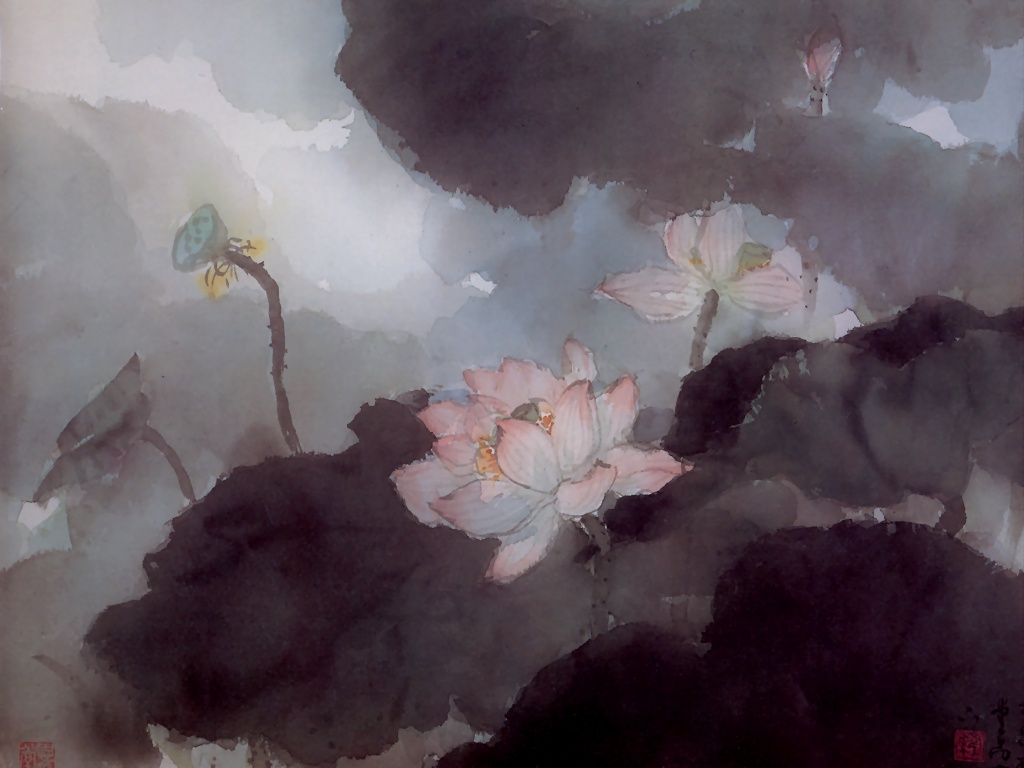
Hearing these words, Hojo realized the great state of realization under their influence. Consequently, he climbed to the summit of Daibai-zan (“Great Plum”) Mountain, away from human society, and lived in solitude in a thatched hut, eating pine nuts and wearing clothes made from lotus leaves: there was a small pond on the mountain, and many lotuses grew in the pond. He sat in Zazen and pursued the truth for more than thirty years. He saw and heard absolutely nothing of human affairs, and he lost track of the passing years, only seeing the mountains all around go from green to yellow. One pities to imagine what the winds and frosts were like.

In Zazen, the Master placed an eight-inch iron tower on his head, as if he were wearing a crown. By endeavoring to keep the tower from dropping to the ground, he did not fall asleep. The tower remains in the temple today: it is listed in the records of the temple storehouse. This is how he pursued the truth until his death, never tiring of the effort.

He had been living like this for years and months when a monk from Enkan’s order (Zen Master Enkan Sai-an [?-842], also a successor of Master Baso Do-itsu) happened to come onto the mountain looking for a staff. The monk had lost his way on the mountain and unexpectedly came upon the site of the Master’s hut. When, to the monk’s surprise, he saw the Master, he asked, “Master, how long have you been living on this mountain?”

The Master said, “I have only seen the mountains all around go from green to yellow.”

The monk asked further, “What is the way down from this mountain?”

The Master said, “Follow the stream down.”

The monk was struck. When he returned and told Enkan what had happened, Enkan said, “In former days when I was in Kozei (Kozei is where Master Baso had his order) I once met a certain monk, and I do not know what happened to him after that. This couldn’t be the same monk, could it?”

Eventually Master Enkan sent the monk to extend an invitation to Master Baso, but the Master would not leave the mountain. He replied with a verse:

“A withered tree, broken and abandoned, in a cold forest,
However many times it meets spring, it does not change its mind.
Passing woodsmen do not even look back.
Why should people from Ei be keen to search it out?”

In the end, he did not go. Later, when he decided to move even deeper into the mountains, he made the following verse:

“I shall never outwear the lotus leaves in the pond,
The flowers of a few pines are more than a meal.
Now my abode has been discovered by people of the world,
I shall move my shack deeper into seclusion.”

Finally, he moved his hut further into the mountains.

Once Baso sent a monk especially to ask Daibai Hojo, “Master, when you visited Baso in former days, what truth did you attain and then come to live on this mountain?”

The Master said, “Baso told me, ‘The mind here and now is Buddha.’ Then I came to live on this mountain.”

The monk said, “These days, his buddha-dharma is different.”

The Master said, “How is it different?”

The monk said, “Baso says ‘It is neither the mind nor Buddha.’”

The Master said, “That old man! If he is out to disturb others, I will have no sympathy for him. Never mind about ‘neither the mind nor Buddha.”

The monk reported these words to Baso. Baso said “The fruit of the Plum is matured.”
- from Dogen’s Gyoji, Shobogenzo Fascicle 30 (translated by Gudo Nishijima and Chodo Cross)

The short version . . .

Daibai asked Baso: “What is Buddha?”
Baso said, “This mind is Buddha.”

A monk asked Baso: “What is Buddha?”
Baso said: “This mind is not Buddha.”
- The Gateless Gate, Cases 30 and 33 (translated by Nyogen Senzaki and Paul Reps)

Monday, January 30, 2006

Karma can be a real bitch.

But first, and more importantly, my father is making very good progress in his hospital in Hawaii. The ventilator tube is out and he's talking now. I think they're just holding him until the biopsy results are back.

But karma, as I was saying, is inescapable. I was confronted today by my office manager about a hole punched in an office wall. I immediately offered to make restitution and pay for any damages, and was told that the estimate was for $150. That made me so mad that I threw a chair through a window.

Just kidding. But one moment of loss of self control and bam!, a one-fifty fine. I should have known that incident would come back to haunt me. And worse yet, the manager wants me to think about how to publicly acknowledge my regret for the incident. "I usually resort to self-deprecating humor, but that's just my approach," he said, and told me to think about it for a day or two to come up with a solution.

Matsuoka Roshi, my teacher's teacher, used to say that when you thought angry thoughts, it was like a knife through water. "But when you speak out of anger, it's like a knife through sand - it leaves an imprint, but it can be smoothed over. But when you act out of anger, it is like a knife through granite - it leaves a lasting mark that can hardly ever be erased."

Yeah, sure, but he never deleted a spreadsheet, I'll bet.

Coming home, I found a summons for jury duty in the mail.

The good news was that it was Monday - my night to open the zendo. I got to attend to others as they sat in meditation, take my mind off of my little problems and try to actualize my bodhisattva vows and allow others to attain realization.

Sunday, January 29, 2006

Today was my Zen teacher's ceremony. Those of you who might be reading this for a deeper understanding of the role of ceremony and liturgy in Zen traditions had better stop reading this right now - this is a totally egocentric, first person account of the ceremony from one self-perspective only. And I'm recounting it here not to praise myself, but just to document it for those who may have no idea what it might be like.

But as I was saying, today was the day. I got to the zendo at about 8:00 a.m. and the roshi insisted that I wear a borrowed black ceremonial robe, the hem of which kept getting under my feet and tripping me up as I rose from sitting. I sat in meditation for about 90 minutes to calm the mind before the 10:00 ceremony.

The ceremony itself consisted of the four candidates filing in to the room and the usual prostration bows and incense offering just like the initiate's and the disciple's ceremonies, but then went on to a sort of public test of the candidates' understanding. I've previously discussed the central koan (case study) for the ceremony here in this blog, although I had not identified it as such. The senior teachers put both prescribed and spontaneous questions to us. My prescribed question was, "A great master tumbles, dancing in the spring breeze. Falling in amazement, apricot blossoms scatter in a riot of crimson."

Very nice image, but hard to find a question in that. Responding to the imagery, I replied "Yes. And a single purple daffodil blossoms by the zendo door." Not a bad answer, I thought, because, after all, it was true - there was a single purple bloom in the otherwise seasonably dead garden by the front door (although I was later told it was an iris, not a daffodil), and the image also could symbolize the blossoming of wisdom and understanding through zazen.

All of you reading this can probably think of better answers, but you're not on the spot kneeling in front of the sangha in a borrowed ceremonial robe.

But then the senior teacher replied, "Can't you do better than that?"

Well, of course I could. All words miss the mark anyway, and a better answer would be silence. So I stood still and quiet for a minute, and could sense the sangha at first thinking I was struggling to formulate an answer, but then gradually realizing that the silence itself was my answer. Or so I thought, until the roshi cut in with a few words to help me out of my "predicament."

So, I mumbled something about "blossoms fade while weeds flourish," drank a big bitter cup of humility and waited on the next questions.

They were fairly easy after that, especially as I regained my Zen footing and tried to avoid answers that stuck to either the relative or the absolute. I was asked to recite some scripture, I was asked if Buddhas existed in both the mountains and the cities, I was asked if we shouldn't rather perform zazen standing on our heads than sitting on our asses.

Then I was asked to recite my poem based on the koan.

I had thought about the assignment all last week, and most of the poem came to me while in the shower last Friday morning. Arising, I said:

"Nanyue searched but could not find
The face that fronts ordinary mind.
Eight years spent in meditation,
Mind devoid of conversation,
Finally swung the dharma door.
If the face you're looking for
Is whiskers, nose hair and eyelashes
Your practice is dead wood and ashes.
If you yearn for silent thunder,
Then take Pittsburgh and the over-under.
But in pure practice, undefiled,
The Buddhas laugh, and Huineng smiled."

It was the best that I could come up with, and I'm not quitting my day job, but I did hear some gratifying laughter after the "over-under" line.

The roshi finally declared "Well done, Shokai" and after a few words, declared myself and the other three candidates senseis, and led the procession (or is it "recession"?) out of the hall. Hugs and congratulations all around, a meal, and that was that.

I'm sure others in the room have a different experience of the ceremony, and might recall the events differently, but there are as many different experiences as there were attendees. I can only recount mine.

Saturday, January 28, 2006

Today, I got the disappointing news that my father is in ill health and not doing well.

He lives in the State of Maine, and had come down with pneumonia. He recovered, no small feat for a man in this 70s, and decided to head to Hawaii for a previously planned and already delayed vacation to complete his recovery. However, he relapsed once he arrived in the islands and was not responding to any oral antibiotics, so they put him on IV antibiotics and steroids and moved him by ambulance to the largest medical facility in Honolulu for a surgical sampling of lung tissue.

He got through the surgery well with vital signs stable, etc., although his white blood count is low, which indicates infection, despite the antibiotics. He still has a ventilator tube down his throat to help him breathe and has to write out his requests and answers to questions. It looks like he will be in the hospital at least another 3 more days as he waits on the biopsy results.

He was refusing pain medication for the first day following the surgery, until the nurse told him that they needed to change his bed sheets, brush his teeth, and wash his face (general upkeep) which would all cause still more pain. He agreed at that point to have some pain meds put into his IV.

So at this point, I think it's safe to say that his vacation in Hawaii is not going the way he had planned.

It looks like the tough old bastard (and I use those words with respect and affection) will survive this ordeal. Everyone in my family seems quite understandably freaked out. Life and death is the great matter, and this episode is another uncomfortable reminder of our mortality.

Friday, January 27, 2006

Thursday, January 26, 2006


Wednesday, January 25, 2006

Not that you care, but I'm listening to Coltrane again. Having chilled out a week or so with Claude Challe's Buddha Bar records, I'm re-listening to some of the Coltrane albums and still catching nuances that I missed the last time through.

My Teacher's ceremony is this Sunday at the Zen Center. I don't feel complete enough to be called a teacher of Zen, but I can console myself by remembering that there's nothing to teach.

Part of the filling of that sense of incompeteness included signing up for a three-day sesshin next month at Sanshin Zen Center in Bloomington, Indiana under the direction of Okumura Sensei. Friday and Saturday both start at 4 AM and will consist of 14 50-minute zazen and 10-minute walking meditation (kinhin) periods. No dharma talks, no tea breaks, no distractions (and no oryoki). Just sitting. Shikantaza.

Sounds perfect.

Sunday starts at 4 as well, but includes an oryoki breakfast and a dharma talk at 10:00. It sounds like the whole thing wraps up around noon.

Last Sunday, I had coffee with my friend Arthur, who's already a teacher at the Center, and he convinced me that I was no more or less worthy of being a teacher than he was. In fact, he took some measure of comfort in my discomfort, since it indicated to him that I did not take the role for granted, and would make great effort to be as good a teacher as I could.

There are four of us being certified - the three others are worthy candidates all - and if you're not doing anything else this Sunday feel free to come on by and participate in the ceremony.

We can listen to my Coltrane records afterwards.

Tuesday, January 24, 2006

Last Sunday, at 2:42 p.m., a Pac Bell Internet Services client in West Hollywood, California logged on to this site and became the 75,000th visitor to Water Dissolves Water.

Today, at 12:35 P.M., driving down Powers Ferry Road during lunch, just at the point south of the Windy Ridge traffic light where the road begins its descent into the Chattahoochee River floodplain, the odometer in my car rolled over to its 1500th mile.

These events don't have any intrinsic or significant meanings. However, attention to these kind of details keeps one's mind aware of the present moment, and can be used as a sort of reminder of the here and now.

I used to have a running game with Beth, an old girlfriend, where we'd each try to be the first to point out a digital clock reading either 1:11 or 11:11. A.M. or P.M., it didn't matter - just as long as the time was shown as a series of three or four straight lines. I don't recall how it got started, but it was always a reminder of "right now."

Recalling just when your odometer hits a mark, when your hit counter records a milestone, when it's a "special" time of day - all these can be used as mindfulness exercises to remain focused on the present moment.

When you fell asleep last night, was your breath on the inhalation or the exhalation?

Monday, January 23, 2006

“Sitting in Zazen is not learning Zen meditation. It is the great peaceful and joyful gate of Dharma. It is untainted practice-and-experience.”
– Dogen, Shobogenzo Chapter 58 (Zazengi)

The phrase "it is untainted practice-and-experience" alludes to the conversation between the Sixth Patriarch, Dajian Huineng, and his disciple Nanyue Huairang, to which Dôgen often makes reference:

Huineng asked his student Nanyue "Where do you come from?" when the latter first arrived.

Nanyue said, "I come from the National Teacher An on Mt. Song."

Huineng said, "What is it that comes like this?"

Nanyue was without means to answer. After eight years of consideration, he announced to the Patriarch, "I've understood what you put to me when I first came: 'What is it that comes like this?'"

Thereupon, Huineng asked, "How do you understand it?"

Nanyue replied, "To explain anything would miss the mark."

Huineng said, "Then should one engage in practice-realization or not?"

Nanyue replied, "It is not that there is no practice and realization, only that they cannot be defiled."

Huineng approved, saying, "Just this non-defiling is what all the buddhas keep in mind. You're like this, I'm like this, and all the patriarchs of the Western Heavens [i.e., India] are like this."

The teacher Dogen said: Huineng and Nanyue have spoken like this. Today, how can I not say something? Tell me, great assembly, do you want to understand this clearly? The highest fruit of arhat practice is the new attainment of extinction through discernment. Ajnatakaundinya was verified in his attainment of patience with non-arising. At just such a time, again, how is it?

After a pause, Dogen said: We must smile at the beginning of this story about that fellow Nanyue Huairang. Upon exerting his power, he could express eighty or ninety percent.
- Dharma Hall Discourse No. 374 (Eihei Koroku)

The teacher Dogen said: Do you want to clearly understand the meaning of this? If the sixth ancestor were to ask, “Where are you from?” I would say on behalf of Nanyue: For a long while I have yearned for the atmosphere of the master’s virtue. Arriving here to humbly make prostrations, I cannot bear how deeply moved I feel.

Suppose the sixth ancestor also asked, “What is this that thus comes?” On behalf of Nanyue, facing the sixth ancestor, I would bow and lower my head with hands clasped in shashu position and say: This morning in late spring it is fairly warm, and I humbly wish the venerable master ten thousand joys in your activities.

Suppose someone asked what was the meaning of Nanyue’s statement “To explain anything would miss the mark.” I would simply say to him: Even though the reeds are young and green, these spring days the sunlight remains later, and I would like to build a grass hut.” (The word translated as “reeds” refers to a kind of grass used for building thatched roofs. A grass hut is a metaphor for the space of practice.)

Suppose I was asked, “What did the sixth ancestor mean when he said, ‘Just this nondefilement is exactly what the buddhas protect and care for. You are thus, I am thus, and the ancestors in India also are thus’?” Then I would like to say: A blue lotus blossom opens toward the sun. (A blue lotus is utpala in Sanskrit, one of the four kinds of lotus flowers in India. The Mahaparinirvana Sutra, chap. 24, says that it represents diligence.)
- Dharma Hall Discourse No. 490 (Eihei Koroku)

Having fully cooked all his stuff, this Nanyue
Played with blowing winds and saw arising clouds,
Tasted the dragon’s scream, and loved the dragon’s howl.
Single-mindedly striving,
For eight years refining gold,
Dropping body, dropping body,
Did he clearly get it or not?
What is this thus come and thus appeared?
The mind before your father and mother were born.
Although directly attaining the wonder right now,
Vipasyin Buddha maintained this mind before.
- Verse 59, Master Dogen’s Verses Praising Ancient Koans

Sunday, January 22, 2006

Ralph Reed spoke Saturday at the Christian Coalition of Georgia's annual political forum at Mount Vernon Baptist Church in Atlanta. Ralph, a lieutenant governor candidate for Georgia, had led the national Christian Coalition to prominence, and subsequently made a career as a political strategist out of being able to move Christian conservatives to action. However, at least half the crowd of 350 were visibly supporting his opponent, state Sen. Casey Cagle.

The first question tossed to Ralph in his forum with Cagle was about what the moderator called "his biggest regret" — Ralph's gambling related work with disgraced Washington lobbyist Jack Abramoff. Ralph has worked on anti-gambling campaigns in several Southern states on behalf of Abramoff clients, Indian tribes out to protect their casino interests from potential rivals. Ralph also helped Abramoff defeat a proposed congressional ban on Internet gambling — work funded by a firm interested in selling state lottery tickets online.

Ralph replied, "If I knew then what I know now, I obviously wouldn't have done that work. To the extent that it caused any difficulty for the pro-family movement, I regret that. I have taken full responsibility.” He went on to say, "What I don't appreciate and what I think the voters of Georgia will reject is any unfair attempt by the liberal media and others to engage in guilt by association and to associate me with the misdeeds of others."

Classic political “spin.” By implying that it is only the “liberal media,” and not the U.S. Department of Justice, that is interested in his wrong doings, Ralph made it sound like the investigation was just a political ploy by his opponents.

The “guilt by association” remark implied that his only crime was no more than his 20-year friendship with Abramoff, not the fact that he was a close business and lobbying partner with the confessed criminal. “Guilt by association?” How about “guilt by collusion?” How about “accessory?”

Finally, by referring to his constituents as the “pro-family movement,” Ralph was trying to deflect the attention away from corruption and gambling and on to “pro-family” issues, such as abortion, gay rights and permissiveness. However, most of the discussion that evening revolved around the current Republican concerns over illegal immigrants, taxes and eminent domain.

What else were the Christian Coalition concerned about? The streets heading into Mount Vernon Baptist Church were lined with "Boot Perdue" signs put up by "flaggers" angry that Gov. Sonny Perdue didn't give them a chance to vote to restore the old Georgia flag containing the Confederate battle emblem. The flaggers stood outside the church, greeting people as they arrived.

Meanwhile, both this week’s Time Magazine and The Washingtonian are reporting the existence of unpublished photos of Bush and Abramoff grinning and gripping along with one of the admitted felon’s Indian tribe clients, despite White House denials that the President doesn't know Abramoff.

When ABC News first approached the White House about the alleged photo on Friday, the White House said the meeting happened but according to spokesperson Erin Healy, "Available records show that Mr. Abramoff was not in attendance." When asked to check more records about whether Abramoff was there, Scott McClellan told ABC News, "We have checked our records, and Erin's account is accurate — the records indicate he was not at the meeting."

As Mark Halperin wondered, “Strangely legalistic response from the Administration that vowed a change from Clinton era parsing. Makes us wonder, is it possible that ‘Everything they said was accurate but none of it was true?’"

Saturday, January 21, 2006

What Do You Think We Call Them "Animals" For?

Desire is part of the condition of all sentient beings. And any sentient being that reproduces via sexual reproduction has sexual cravings, and animals indulge in these sexual cravings without shame or self-consciousness, often to the chagrin of pet owners.

In humans, we have the ability to be aware of our desires, and see how our desires and craving can cause suffering both to ourselves and to others. We're also subject to shame and neuroses over our desires and cravings, sometimes because of the awareness of the suffering they cause, and sometimes because of repressive, societal influences. There is, however, nothing inherently wrong with desire. To be without desire is not only not to be human, it is to be non-sentient.

So if being sentient gives rise to craving, and craving gives rise to suffering, then suffering must be the ultimate condition of sentience.

No surprise there. Even the simplest interpretation of the four noble truths states "Life is suffering. Suffering is caused by desire. We can stop our suffering by stopping our desire. The way to stop our desire is the Eightfold Path."

The trouble with this simplest of interpretations is that anyone can see that life is not constant, non-stop suffering. In zazen, we can clearly see that there is always some level of pain and suffering present, but that life also has joyous, blissful and extremely pleasurable moments which cannot be denied.

And can we really say that all desire leads to suffering? The desire for awakening, for example, the arising of bodhi mind, leads to enlightenment, not suffering. And if the first two truths are not always so, the second two cannot always be true either.

To be mindful is to be aware of both pleasure and pain. But in looking carefully, one can see the pain in pleasure and pleasure in pain.The Middle Way, to me, is to live a life of neither asceticism nor indulgence. We can recognize our desires as they arise and see them for what they are - our preferences only, and not a mandate that things must alway be as we desire. To constantly give in to our desires is to be a slave to craving; to always suppress our desires is to be a slave to dogma.

This is not to deny the four noble truths. Life DOES contain suffering. This suffering DOES come from our desires. Recognizing these truths DOES lead to the cessation of this suffering, and the Buddha way IS the path leading to this recognition. But life following this recognition still contains craving and still contains suffering.

What I'm trying to say here is that given the choice of being an animal, constantly trying to satisfy its desires, and being a robot, living without any desires, I choose the Middle Way and to be human, and accept my actions and their consequences without equanimity.

Friday, January 20, 2006

When Gravity Fails and Relativity Won't Pull You Through

Thursday, January 19, 2006

The last two days, I've been developing a detailed cost opinion for an attorney client for use in a property-damages case (we're representing the defendant). All of my calculations, tabulations and prognostications were recorded into one big Excel spreadsheet, and totaled up to almost $900,000.

It was literally 16 hours of work, and when I finished I SAVED the document (I'm no fool), called my client, and arranged a meeting for first thing tomorrow morning.

Well, funny thing. When I hung up the phone, I looked at the computer screen and the spreadsheet was . . . gone. The Excel program was still running, but where there had been the workbook, there was now just a field of grey.

Keeping Excel open, I went to "My Recent Documents" and clicked on the file name, and still saw nothing but grey. I closed Excel, rebooted my computer, went through Windows Explorer to recover the spreadsheet, and . . . grey.

Fuck. All my work was gone, and there was no way that I could reproduce all of the myriad calculations and cost opinions in time for the meeting tomorrow.

I called the IT department, but they were all geared up for an accounting system upgrade and couldn't be bothered about some old man in Atlanta who couldn't find his document.

I asked one of the tech-savvy young people in my office to take a look, and she agreed that it was about the damnedest thing she ever saw.

When it became apparent that I either had to try to reproduce the last two day's work by pulling an all-nighter or cancel tomorrow's meeting, I got so angry I literally punched the wall - and to my surprise actually broke through the plasterboard.

But meanwhile, as the tech-savvy young person was pecking away at my computer trying to find a backup somewhere in memory, I began dialing the client to cancel the meeting, racking my brain to think of an alibi other than "your consultant is a moron." But just before I got through to him, the t.s.y.p. had a breakthrough at my computer, and found the problem: I had somehow saved the file as a "hidden" workbook.

Oops.

The data were all recovered, the spreadsheet restored, and tomorrow's meeting is still on.

Now I have to think of a way to explain the hole in my office wall.

Wednesday, January 18, 2006

Fame

Bible classes for Georgia schools?
By The Associated Press, 01/18/06

Georgia public school students would be allowed to study the Bible under a plan proposed by Democrats in the state Senate Wednesday. The bill authorizes the state school board to approve an optional course that would teach about the Bible’s influence on literature, art, culture and politics.

The bill is sponsored by Sen. Tim Golden of Valdosta, chairman of the Senate’s Democratic caucus. Golden said it would allow for “nonsectarian, nonreligious academic study” of the Bible and would require it “be taught in an objective and nondevotional manner with no attempt made to indoctrinate students.” Sen. Doug Stoner of Smyrna, a co-sponsor of the plan, said the Bible was a major influence on works from Shakespeare’s plays to the Reverend Martin Luther King.

Civil liberties activists say there are ways to teach the Bible in public school without violating the Constitution, but that such a class would create potential problems. Maggie Garrett, legislative counsel with the American Civil Liberties Union’s chapter in Georgia, said even if the curriculum is carefully worded, a teacher could use the class as an opportunity to preach religious faith.


Georgia always seems to find new ways of embarrassing itself in front of the nation. Just when Dover, Pennsylvania had finally stolen the spotlight from Cobb County (which had previously disgraced itself in the 90s by passing an anti-gay referendum), the State Democrats decided that it's time to start teaching the Bible in public schools.

I wonder if I can get them to let me teach a non-sectarian, non-religious academic class in Zen Buddhism in the Georgia public schools? After all, Buddhist thought is a major influence on literature from Hesse to Thoreau to Kerouac, and many films from "Kundun," to "I Heart Huckabees" to the Matrix trilogy have incorporated Buddhist ideas. Think that will fly in Cobb County?

Meanwhile, we have Ralph Reed still running for lieutenant governor of Georgia. Ralph, the former head of the Christian Coalition, may have just suffered through the roughest week of his political career when his longtime associate and friend, Washington lobbyist Jack Abramoff, pleaded guilty to bribing public officials, yet inexplicably keeps of campaigning.

On Sunday's "Meet the Press," U.S. Sen. John Cornyn of Texas, a fellow Republican, accused Reed and Abramoff of "bilking their Indian clients for millions of dollars." On Monday, campaign finance reports showed Reed had been out-raised over the past six months by state Sen. Casey Cagle, his virtually unknown Republican rival in the race. At a North Georgia forum on Tuesday, Ralph denied to a restive audience that he was a possible target of the continuing Abramoff probe — and then declared himself "a happy warrior."

Over several years, Ralph worked with Abramoff and his partner, Michael Scanlon, on a series of anti-gambling campaigns across the South, conducted at the behest of casino-owning Indian tribes out to thwart any competition. Abramoff and Scanlon cheated several tribes of tens of millions of dollars, and have struck plea deals with federal investigators, confessing to attempts to bribe members of Congress.

Ralph, a longtime opponent of gambling, says he didn't know the true source of more than $5 million, although e-mail conversations between Reed and Abramoff cast doubt on that contention. In Alabama, Ralph helped Abramoff arrange money from the Mississippi Band of Choctaw Indians to be funneled through two organizations before arriving at his firm.

If you think there's no connection with sleaze in any of this, then consider the following: when my box of checks got stolen out of my mailbox, the first place the thief went to cash the checks was the Silver Star Hotel and Casino, a 24-hour gambling establishment on the Choctaw Indian reservation in Philadelphia, Mississippi. There, the thief found someone to check my account balance and to cash a $750 check. This casino is run by the same group that hired Abramoff to hire Ralph to campaign against an Alabama lottery.

I wonder if my stolen money was used to pay the lobbying bills.

Tuesday, January 17, 2006

My Internet connection has been down since Sunday evening, so I've missed a few days postings. And now Google's Blogger picture upload function isn't working, so I can't post any pictures. These might not all be bad things.

Things I was going to blog about:
  • Going to the airport the other day, I was running a little late so when I saw the "Lot Full" sign I despaired . . . until I saw that one of the gates was still open. Sensing that it was perhaps the height of folly, I entered the "full" lot anyway, and found the best airport parking spot of my life, perhaps the best in the airport - front row and at the end nearest the pedestrian walkway to the terminal. It was so good that I had to check twice to make sure it was legal. I actually hated to give it up when I got back home, and then I had to wait until someone else came along before I pulled out, because I wanted to share in their excitement of finding such an unbelievably prime parking spot.
  • My goddamn gas bill for the month of December arrived and it was for 490 goddamn dollars and 21 cents. However, since the usage occurred in 2005, it counts against my CO2 emission baseline. I also realized that I had forgotten to include my car in my baseline calculation, so my new baseline, considering the goddamn December gas bill and the miles that I drive, is now 77,829 pounds of CO2 a year. If I'm to reduce my emissions by 10%, my new goal is now 70,046 pounds per year. Since my old goal was to go down to 37,526 pounds, I've made significant progress in a George-Bush/Clear-Skies-Initiative sort of way (i.e., don't tighten the belt, raise the goal). If you decrease your expectations, your results will always improve.
  • I chipped a tooth over the weekend and had to go to the dentist today to get it fixed. The repair required a new crown ($1,000) and while he was at it, the dentist also filled a cavity in an adjacent molar ($70) and crowned that one too ($1,000). So it's only mid-January and I've already exhausted my deductible under my dental insurance and I still owe the dentist another $1,070.

So maybe it's just as well that I haven't been able to blog. At least the picture upload function is working now.

Saturday, January 14, 2006

Zen Porn

In my journeys across the internet, I came across a site called "Zenporn" (www.zenporn.com). I never claimed to be an arhat, so when I claim that I surfed over there just to see what was what, you can be sure that my motivations were about the same as yours when you clicked on the link.

I was disappointed by the site, but I wasn't sure what I was expecting. The only real difference between the site and a typical soft-core porn site was an apparent tolerance of different sexual orientations. But while tolerance is a hallmark of Buddhist practice, so is non-differentiation, and navigating through the site requires one to almost immediately pick and choose between "gay," "straight" and "pansexual." So right from the start, one is drawn into duality.

This made me wonder though what Zen porn would be like? Could there even be such a thing?

On the one hand, Zen, like all of Buddhism, is about letting go of desires, and porn is nothing if not about feeding the flames of desire. Further, the precept of honoring the body ("Do not misuse sexuality") makes one aware of the harm inherent in much pornography, including the exploitation of its subjects and the dehumanization of its users.

On the other hand, Zen is not about denying the reality of basic human impulses, including sexuality. Sexual desire is a normal and healthy part of human existence, and we seem to take great pleasure at observing the human form. There is nothing wrong in this. Tantric Buddhism includes techniques for bringing mindfulness and practice into sexual activity, and the fearless Zen Masters of the past would use any available method as a skillful means to point their students toward realization.

So would Zen porn consist of visual koans, intriguing images that use sensuality and nudity to draw your eye in and make you re-examine how you look at and perceive things?Challenging our conception of perception is the goal of much great art, so one must then conclude that either Zen porn is something else, or that all art is Zen porn. Either conclusion seems equally valid to me.

Yet another possibility might be to use depictions of the human body in art as a skillful means of helping the viewer transcend all dualities, including the difference between the sacred and the profane, and incorporate human sexuality into transcendental art, such as in Zan Cro's brilliant Man Connected to Nature:Alternately, Zen porn might examine the mechanisms of desire as a skillful means of demonstrating how covetous desires originate from greed and delusion. Craving extends beyond the desire for sex and sensual pleasures. Once it manifests in the mind, it also encompasses the desire for material things, for fame, for happiness, for love, and even for life itself (or for those wishing to commit suicide, for death). In the chain of dependent co-origination, the Buddha taught that craving arises from feeling, and that feeling arises from contact, and that contact arises from our senses. So in other words, we crave because we have the six senses (in Buddhism, thought is considered the sixth sense). To engage the senses then, either sight or touch or even thought, ultimately leads to craving and desire, as so skillfully illustrated below.The six senses, in turn, arise from name and form, which arise from consciousness, which arises from our mental formations, which arise from ignorance. Our craving and desire for the body ignores the fact that form is subject to sickness, old age and death.

Sensei points out that to fall in love requires an enormous leap of faith, overlooking the facts that our lovers are really just big sacks of skins containing organs and fluids and bone. We choose to ignore that the bodies that we crave so much also emit excrement, urine, pus, blood, sweat and tears. So another tactic for Zen porn might be to remind us of the impermanence of all things, including our bodies.But in a final analysis, I would argue that for porn to be truly "Zen," it would have to transcend all dualities, including pleasure and pain, attraction and repulsion, and one body part over another. Looking deeper, Zen porn would have to transcend the duality of "body" and "non-body," as well as the distinction between the perceiver and the object of perception. At the same time, it should skillfully make the viewer aware of all the lessons discussed above, including the nature of perception, our dualistic ways of thinking, the interdependent origination of our desire, and the impermanence of all dharmas.A tall order, not one taken on by zenporn.com. Little wonder there's so little of it around. And yet, at the same time, it is everywhere around us; it just depends on how we look at things.

Friday, January 13, 2006

Thursday, January 12, 2006

Why do we complete the sentences in our mind?

All of us have a constant, non-stop running dialog going on in our heads. We're constantly talking to ourselves, explaining to ourselves what we're experiencing, reliving past experiences, engaged in imaginary or prior conversations. Sometimes, we're just telling ourselves the same old story over again.

As I look carefully at the way thoughts occur in my mind, I can see that very complex ideas and concepts can appear in my mind all at once, but then I break them down and draw them out by telling them to myself in linear, grammatical ("subject, verb, object") fashion. And while I'm doing this, new ideas aren't coming into my head, or if they are I'm not aware of them because I'm too busy reliving the thought that I'm parsing out and repeating over and over.

But since I never surprise myself at the end of the sentence ("gosh, I didn't think that I was going to say that!"), why do I do this? Why can't I just think "I know where this is going," and just drop the sentence or even word in mid syllable?

Actually, I do this sometimes in zazen as a technique to stop associative thought. Just as I'm aware that I'm talking to myself in my mind, I'll cut off the sentence and listen to the silence that follows.

Kathleen Callon said, "Sometimes something strange happens when I let go of preoccupied or conscious thought, and it usually happens when I am doing routine physical activity. It probably happens with most of us... We leave our thoughts only to have an epiphany or a vision then come to us. A realization pops into our consciousness and though we think we know the thought comes from within ourselves, we also get the uncomfortable feeling that we may have just received a timely and almost celestine message. This feeling is analogous to our confused reaction when we are thinking of someone we have not spoken to in a long while and we know, as the phone rings and as we then pick it up, that the lost friend or relative we had been thinking of is on the other end of the line."

When we stop this associative thinking, our minds are open and receptive, both to great insights, inspiration, creativity, intuition, and other, stranger stuff. Ask any artist or musician how they came up with an idea and they almost inevitably say, "I don't know. It just came to me."

My argument is that we're all constantly generating creative and intuitive thoughts, whether we think of ourselves as creative or intuitive or not, but many of us don't allow these thoughts to raise to the surface because we're strangling the life out of them by trying to articulate them into "language" in our minds, and not giving them room to live and breathe. But sometimes, when we're doing some "mindless" menial task, or basking on the sun, or otherwise not engaging the intellect, poof!, one of those realizations manages to pop through, and suddenly:

"If I paint the bedroom blue it would match the lampshades and make it appear cooler in the summer."

"My friend's trying to express her frustration with herself, but lacks the insight and vocabulary to articulate it."

"I could write a poem based on rhyming color schemes, using 'door hinge' to rhyme with 'orange.'"

The only difference between artists and ordinary people is the ability to be receptive to these intuitive thoughts.

There's probably a lot of other information floating around in front of us, some of which is tapped in to by psychics and clairvoyants, who have simply found a way to tap into this information by allowing themselves to be receptive. Hence, the "spooky action."

Wednesday, January 11, 2006

Today, I returned to Pascagoula for the first time since Hurricane Katrina.

It was a remarkably beautiful January day, even for the Gulf Coast. The sun was shining in a clear blue sky, temps were in the low 70s, the humidity was down, and there was a nice offshore breeze.

We drove along Beach Boulevard, once the prettiest road in town, where I used to jog between the Gulf of Mexico on one side and the town's stateliest homes (including that of Trent Lott) on the other during my summer here.

I was amazed by the devastation. I had been in Grand Cayman the first week it had opened to tourists following Hurricane Ivan, but the destruction on the island was nothing compared to this.The homes on Beach Boulevard didn't have a chance. All that had stood between them and the surging Gulf at the height of the storm was the boulevard and a low concrete seawall. The brick houses fared better than the wood homes, a fact that would have made the third little piggie proud. But in either case, one could clearly see that the damage was from water, the storm surge, and not from the wind. The upper levels of the houses were generally intact, but the lower levels had been gutted. In this regard, the effect of the storm was more like last year's tsunami than Hurricane Ivan.

It's apparent from the remains that the buildings, designed as they were with hurricane-force winds in mind, had withstood the gale. One can only imagine, though, what it must have been like as the sea surged up against the house, the sheer weight of water buckling and then breaking the walls. The sea must have filled whatever structure remained, and then completed the one-two punch as the surge retreated and the walls were further reduced by the force of the exiting water.
In some cases, the lower portions of the homes were entirely gone, leaving otherwise intact roofs sitting on the ground. The wooden houses did not fare as well, although the effects were similar. Although the house above now looks like a shack, what is left now is just the uppermost portion of a formerly two-floor shorefront home. The rest is all gone. But rubble and scrap were all that was left of other homes.
The trees, groomed for millennia to withstand nature's forces, held up pretty well - the water would have surged around, not through, them.

After the hurricane and surge had passed, even Trent Lott and his wife, like their neighbors, could only pick through the debris that used to be their home. Across the debris field that was once their backyard, they searched tearfully for anything else they could save. On a sandy patch of ground, they carefully arranged family mementoes - a framed photo, a china serving plate, small brass sculptures.

It's heart-breaking to witness the remains of these ruined homes, and imagine the dashed dreams and aspirations associated with them. What these pictures can't convey is the accumulative visual effect of seeing block after block of buildings destroyed like this, both along the length of Beach Boulevard and for several blocks inland.

I felt vaguely creepy and voyeuristic taking these pictures. "If anyone asks, just say we're insurance adjustors," suggested my passenger, addressing the obvious discomfort, although, up to that moment, we had not spoken of it. Crude hand-letter signs in front of the homes identified the house number and insurance carrier for the benefit of real adjustors and for contractors, and warnings on dead-end streets read "Private Road - Trespassers Will Be Shot."

We avoided the dead-end streets.

After having been shown this vivid evidence of what real suffering is like, I feel shallow and trivial having complained about spending the summer here. A mere weekend after I was complaining that the best restaurant in town was only a Ruby Tuesday's, work crews were driving around picking up bodies left like garbage on sidewalks and depositing them in refrigerated mobile morgues, and coroners were conducting autopsies in parking lots because the only available light was from the sun.

In Pascagoula, 126 people died from Katrina, most of the victims having drowned or suffering severe injuries when buildings collapsed around them. By the time the coroner collected their corpses, their faces had been distorted from the water or the rubble, and they were starting to decompose. Their identification and clothes were swept away, and many bodies had drifted miles from home.

That evening, my waitress, a cute blonde formerly from Tennessee, talked to me about her experiences in Mobile during the storm. She and her daughter were unhurt, but for them the worst part was the next three or four days without electricity or air conditioning. They'd fill a kiddy pool with water and sit in it together until the afternoon sun made the water temperature too uncomfortable to sit in any longer. That was a level of suffering I could better relate too, and I went back to my hotel room after dinner hoping the mental picture I had constructed of them splashing in the pool would scare the 126 ghosts of Pascagoula out of my consciousness.

Tuesday, January 10, 2006

According to my Delta itinerary, I'm stuck inside of Mobile this evening with the Memphis blues again (first time since Katrina - I go back to Pascagoula tomorrow).

According to the U.S. EPA, Americans discard approximately 2 million tons of used electronics, including computers and televisions, each year. In addition, an estimated 128 million cell phones are retired from use annually. Me, I sit so patiently waiting to find out what price you have to pay to get out of going through all these things twice.

According to Karl Marx, religion is the opiate of the masses. The preacher looked so baffled when I asked him why he dressed with twenty pounds of headlines stapled to his chest. But he cursed me when I proved it to him, then I whispered, "Not even you can hide. You see, you're just like me, I hope you're satisfied."

According to a difficult dissusion with the Monday night sitting group, there is no point to the weekly dharma teachings (which is true, but I don't think they meant it in the correct way). I nearly got busted, and wouldn't it be my luck to get caught without a ticket and be discovered beneath a truck.

(with apologies to Robert Zimmerman)

Monday, January 09, 2006

"Proceed clearly. Do not cloud the mind with intoxicants."

It has been estimated that about twelve billion display ads, 3 million radio commercials and more than 200,000 TV commercials are aimed each day at North Americans. Three thousand marketing messages intoxicate our minds each day. Virtually no one is immune.

Vietnamese Zen master Thich Nhat Hahn has expanded the Fifth Precept to include junk television, advertising, magazines and candy as intoxicants. To that list I would add:

Politics
The Internet
Video Games
Consumer Electronics
Religion

I'm sure you could think of others (if you're not already too intoxicated).

Sunday, January 08, 2006

At the Zen Center, we precede each meal with a chant that begins with the verse, "Innumerable labors have brought us this food. We should know how it comes to us."

In the American service economy, the labors that have provided our food, our clothes, our heat, our electricity and so on are truly innumerable. We may be conscious of our recycling efforts at home, but what do we know of the efforts of the trucking company that carried our tomatoes from the farm to the supermarket? And what about the supermarket? We may be mindful of conserving gasoline by reducing the number of unnecessary trips, but what about the fuel consumption of the jet carrying troops to Iraq to fight a war to protect our access to oil?

Paul Hawken, one of the two founders of Smith & Hawken, is also a renowned author of environmental books - The Ecology of Commerce served as the wake-up call to Ray Anderson of Interface, Inc., and Bill Clinton called Natural Capitalism: Creating the Next Industrial Revolution one of the five most important books in the world today. Addressing the American consumer culture, Hawken noted that the average American family of four consumes four million pounds of material every year to support their lifestyle, or 11,000 lbs a day, 7.5 pounds per minute. Much of this consumption is out of sight and out of mind - it is offshore, in mines, stockyards, slag heaps, landfills, and wastewater treatment plants.

It's easy to fall into the trap of managing only a household's disposal end of the waste stream, and ignoring the upstream consequences of our consumption. But this ignores the fact that we are all part of a global web of supply and demand, and that our demand for fresh fruit in the dead of winter may create an oil slick in the waters of a Central American shipping port.

How can we take responsibility for a larger share of the impact? How can we personally move toward a more sustainable lifestyle?

Grist Magazine recently came up with an excellent idea for at least a part of the problem - instead of waiting for the United States to come around, if ever, to adopting the Kyoto treaty, adjust your lifestyle now and personally lower your greenhouse-gas emissions to 5 percent below 1990 levels, like the treaty calls for industrial nations to do. If enough people do it, it will make some difference in the national rate, and may change the national consciousnesss enough that the U.S. might actually ratify the treaty some day.

I decided to go ahead and take the plunge, and have committed to trying to achieve this goal.

The first step is to calculate your current GHG emission rate. This can be done using U.S. EPA's Personal Greenhouse Gas Calculator. It's pretty simple - you need only plug in your miles drove and average utility bills, and it even suggests nationwide "averages" in case you don't know those. Unfortunately, I don't have any records of my 1990 utility bills, and a guess at the weekly miles that I drove in 1990 would be, at best, haphazard. So, I am changing my personal resolution to a commitment to reduce my GHG emissions by 10% on their 2005 levels.

It turns out that this household emits 41,696 pounds of carbon dioxide per year, based on a four-month average ending December 31. That's already well below the 60,000 lbs/year U.S. average for a household of two, but I live alone and am still vowing a 10% reduction, or a goal of 37,526 lbs/year.

My biggest contribution to CO2 released is my natural gas consumption. However, with the coldest part of winter still ahead of me, that consumption is likely to increase before it goes down. But I can still program the thermostat to a lower daytime level for when I am out at work, and I can close off some areas of the house that don't require heating at all times (like the sitting room).

Realistically, how much difference will I really make in global CO2 levels as I freeze my ass off this winter? Alone, maybe not much, but if I blog about it and encourage others to follow suit, and they do the same, we might, collectively, make some difference.

Saturday, January 07, 2006

Nature Boy

Last week's rant was all about bodies and body image, but it has been pointed out to me that I was only talking about women's bodies.

To a degree, that's only natural. The point of departure for the discussion was a satirical Victoria's Secret photomontage (this being one case where the picture determined the text and not vice versa), and last time I checked, Victoria's did not have a men's department. Plus, my particular orientation is toward the opposite sex, so it shouldn't be surprising that women came to my mind as I went on to discuss erotica, pornography and body image.

But, it was argued, the Buddha always pointed to the Middle Way, not leaning toward one extreme or the other, so to balance things out, to provide a little yang for the yin as it were, I ought to post an equal measure of male nudity for the female posted last week. Also, since I had only posted pictures of others, I ought to post pictures of the self as well to balance things out. Or so it was argued.

The Buddha taught that one of the dualities that we fall into involves self and other. However, since the Middle Way is between "self and other" and "no self and other," the argument that self potraits should be posted to counterbalance pictures of others is actually predicated on a one-side view ("self and others"), while the other one-sided view ("no self and others") argues that posting pictures of others is the same thing as posting pictures of one's self. So either way, you're trapped in either the relative or the absolute.

In any event, the above is myself in my 51st year, as nature has shaped me, taking this blog into hitherto uncharted realms of narcissism. Rest assured, though, that this kind of material will not become a regular feature of this blog.

Friday, January 06, 2006

Thursday, January 05, 2006

Still More Chrono-Synclastic Infundibulum

The Story Thus Far:

Back on December 13, Kathleen Callon posed a question here about the relationship between synchronicity and "coincidences" in our lives. I replied with a post on December 22, and Kat, gracious as always, thanked me and posted my reply on her blog. Greensmile commented on my post as well, and I responded on December 29 with a follow-on post further discussing synchronicities. To illustrate the second posting, I chose a picture of the Horsehead Nebula that I had been using as desktop wallpaper for several months, well, ever since September 18, when I bought a new computer to replace my dying Hewlitt-Packard.

Well, funny thing. It turns out that Greensmile had independently selected the same picture of the Horsehead Nebula as the background for the planned redesign of his blog . And Summersun, from the UK, had just downloaded the Horsehead Nebula picture and posted it to another journal before going to Kat's blog and seeing her re-post of my original synchronicity discussion. Intrigued, she followed the link back here to Water Dissolves Water, and saw the second synchronicity posting, along with the same Horsehead Nebula picture she had just posted to another journal.

All of this can easily be explained by realizing that the famous Hubble photographic of the Horsehead Nebula is a very beautiful, and hence very popular, picture, and that it should not be surprising that bloggers as diverse as Kat, Greensmile, Summersun and I should all have downloaded the picture at some point, and since we're bloggers, gone on and also uploaded it somewhere else as well.

But can there be more to it than that? Quantum entanglement theory holds that some objects may be influencing the behavior of other objects, such that any measurement of one object instantaneously influences the behavior of the other object, despite physical separation of the objects. Einstein objected to this theory on the basis that the instantaneous transfer of information from one object to the other would have to travel faster than the speed of light, and he famously dismissed entanglement as "spooky action at a distance." However, quantum mechanics has been highly successful in conducting experiments suggesting that entanglement does in fact occur, although the mechanism for the transfer of the information still is not understood.

If atoms are capable of somehow instantaneously transferring information across space, could not the human brain also be capable of the same thing? Could what is commonly referred to as "ESP" not be a supernatural phenomena at all but simply a manifestation of quantum entanglement, or "spooky action" if you prefer that term?

If clairvoyance is simply a matter of quantum mechanics, why can't we all use our minds like psychics and overcome the physical barriers of space and time? I propose that the answer is because the intuitive receptive mind in all of us is over-ridden by the abstract conceptualization of the thinking mind, and we are not conscious of the information available to us by spooky action. By quieting the conscious mind using techniques such as zazen, we are more attuned to this information, but as soon as we have even the first smidgen of "awareness" of this information, it becomes abstracted by the thinking mind and, poof!, it's gone. In other words, we can plainly see it all of the time, but as soon as we realize that we're seeing it, we're simultaneously blinded to it.

Then again, maybe it's just a pretty picture.

Wednesday, January 04, 2006

According to the Boston Herald, Massachusetts Gov. Mitt Romney, who had originally been scheduled to return to Massachusetts from an 11-day family vacation in Utah, instead flew to Sea Island, Georgia where he will be attending something called the "Sportsmen Challenge."

Listen, with Ralph Reed running for Lieutenant Governor, we have enough problems of our own down here in Georgia. If he's not brought down by Jack Abramoff and is successful in the 2006 election, Reed is planning to run for Governor in 2010 and President in 2012 or 2016. So we don't need Mitt Romney running around here on "hunting expeditions." We understand that he's not very popular in Massachusetts, but please take him back and in return we promise not to send Newt Gingrich up your way any time soon.

Ah, life in Georgia. . . while driving home from work tonight, approaching the bridge where Windy Ridge Road crosses over I-75 on the northwest outskirts of Atlanta, I watched my odometer roll over to mile 1,000. It was a calmer, more serene moment that when it rolled over to 500, quite possibly because I was no longer listening to John Coltrane as I drove.

Look, I love Trane, as I've been blogging the last several weeks, but as I've said, the man's playing simply cannot function as "background music" and demands one's full attention. But while you're driving you can't always give it that, and there've been times when I've gotten out of my car all keyed up and feeling like I just drank a half-dozen four-shot lattes. After a month of nothing but hysterical saxophone in my car, I needed a change. Something a little bit more chill.

The Buddha Bar series are nothing if not chill. Now, I almost refrained from commenting on these CDs because everyone's going to think, "Oh, he's into Buddhism, so obviously he's into those Buddha Bar CDs as well, or anything with the word 'Buddha' in the title."

Hardly the case. In fact, when I first saw one of the disks on line, I thought, "Great! Another example of the commodification and commercialization of Buddhism." But curiousity got the better of me, and I downloaded it anyway (it turned out to be Buddha Bar III; there are now 7 CDs in the series).

Well, it turns out I kind of liked it, despite the title, despite the covers. A mix of ambient, world, acid jazz and a little new age, with a touch of electronica thrown in.

It seems that the Buddha Bar is the Studio 54 of Paris, and club owner Claude Challe is an idiosyncratic figure in France's cultural landscape. According to AMC, he opened the first unisex hair salon in Paris in 1964 and was a figurehead of the Parisian swinging '60s set. In 1968, he hung up his scissors and went to live in a commune in Sardinia before following the Hippy Trail to India, Nepal, and Indonesia. Always with an eye on how to turn a franc, Challe returned to Paris and immersed himself in the fashion business. He imported classic American urban styles, then picked up on what was happening in London and began importing clothes from the likes of Malcolm McLaren.

Challe then turned his attention to the Paris nightclub scene, opening Le Privé, an upmarket yet bohemian venue and the restaurant Le Centre Ville. The success of these ventures allowed him to become involved in running Les Bains Douches, a fading punk venue that he turned into Paris's premier night spot. It was the sort of place where he and Jack Nicholson would buddy up and chase women.

Of Tunisian descent, Challe's father was a rabbi who shifted the family to Paris when Challe was three. He claims that those early years — the mix of Arabic sounds, Jewish mysticism and French culture — shaped his destiny. Following his roots, Challe became involved with the Buddha Bar in 1998. A monument to Parisian chic, Buddha Bar was a deluxe restaurant dominated by a giant Buddha statue and surrounded by a bar serving sushi and cocktails. Challe was resident DJ and by blending his musical influences — house, ambient, North African, Asian, and a touch of French pop — he created soundscapes of mellow beauty. As more and more patrons asked for mix tapes of what Challe was playing — including Madonna and Princess Di — he issued the first Buddha Bar in 1999. Its success caused Challe to follow it with Buddha Bar II and so on. Challe now not only hangs out with celebrities but gets hired to DJ at events like Celine Dion's wedding and the Dalai Lama's Parisian appearances.

So what do the CDs sound like? Each volume is actually a two-disk set, thematically split along the lines of "Dinner/Party" and "Dream/Joy." The first disc typically has a more new age, ethnic-fusion feel with songs that span from nouveau flamenco to ethereal, hypnotic vocal samples. Music for dining, pleasant and polite with exotic touches of world music, providing a backdrop for food and civilized conversation. The second disc is generally less ambient and more uptempo, and may veer off into ecstatic territory with percussion-heavy cuts. They can occasionally get cheesey: the second disk of Buddha Bar IV includes a version of Celia Cruz covering "I Will Survive," of all things, while VI provides a rendition of "Whatever Lola Wants" by Sarah Vauhan.

Overall, they provide very soothing music for crossing I-75 on one's 1,000th mile, and are interesting to listen to if one chooses to give them one's attention, and forgettable in that's your preference.

Tuesday, January 03, 2006

At this point, I think it's appropriate to say a few words about practice.

Everything we do in our lives, whether we realize it or not, is our practice. Whether we're eating, sleeping or working; playing, laughing or crying; dreaming, fucking or shitting; reading, writing or acting - it's all practice. The question is - how much mindfulness do we bring to our practice?

Zazen - zen meditation - is training in mindfulness that we can then take to the rest of our practice. Zazen is part of our practice, but it is not separate from the rest of our practice. But since it provides the training in mindfulness, it is a very important part.

So a few clarifications, if I may. First, to approach zazen correctly, one must enter this training practice with no expectations of results. In this respect, it is unlike any other endeavor in one's life, where we take on a task in anticipation of a result. We boil water with the intention of preparing a meal, we sit and watch tv with the expectation of being entertained, we read a book to learn something. But one does not sit in zazen in order to gain enlightenment or understanding or even mindfulness, nor realization, calmness, wisdom, insight, self control, confidence or security. Sitting with any goal or purpose in mind is not zazen - it is sitting with a goal or purpose in mind.

What is the point of zazen, then? Well, to let you in on a secret. . . there is none! It has no purpose whatsoever. Although it's the training in which our mindfulness is developed, it does not have a "purpose" of developing mindfulness. This is not so strange - the "purpose" of a mountain is not to provide gradient for a stream, although a stream might flow from there; the "purpose" of a pond is not to reflect geese flying over it, although the geese might cast their reflection there.

Any striving toward a goal, even any conception of having a goal, is not the training. Zazen practice is just the letting go of everything, even of the "point" of practice. The Japanese term "shikantaza" means "just sitting," with the emphasis on "just." Not sitting and concentrating, not sitting and chanting, just sitting. No breath practice, no mandalas, no music, no jug of wine, no loaf of bread, no guidance, no deep thoughts, no purpose and no goal. Just sitting. And by letting go everything, the whole universe then opens up to you.

It takes great effort, though, not to make great effort.

There absolutely can be great psychological and other benefits from a purposeful program of meditation - there's no denying it - but shikantaza is not even really meditation and certainly not a "purposeful program of meditation," as the letting go also includes the letting go, not the concentration, of thought.

There is, then, neither "good" zazen practice nor "poor" zazen practice. Zazen is not "strong" or "weak." It's neither "perfect" not "imperfect." It transcends these thinking-mind distinctions, just as it transcends "purposeful" and "purposeless."

Monday, January 02, 2006

Al Kukhul

One of the first meditation techniques we teach beginners is, in addition to awareness of posture, focus on the breath. For obvious reasons, breathing is strongly associated with the very occurrence of life, and the word “spirit” comes from the Latin spiritus, meaning breath. "Spirit" has thus evolved to denote that which separates a living body from a corpse, and has attained a number of meanings, including the ultimate, unified, non-dual awareness or life force that combines or transcending all individuals.

The Arabic term for “spirit” is kukhul. Al-kukhul (“the spirit”), however, generally refers to alcohol or ethanol, also known as grain alcohol. Ethanol is a flammable, colorless liquid that has been used by humans since prehistory as an intoxicant. Dried residues on 9000-year-old pottery found in northern China imply the use of alcoholic beverages among Neolithic peoples. Its isolation as a relatively pure compound was first achieved by Islamic alchemists who developed the art of distillation during the Abbasid caliphate.

As a drug, al-kukhul is known to have a depressing effect that decreases the responses of the central nervous system. It has been shown to increase the growth of the bacteria responsible for pneumonia, meningitis and urinary tract infections, contradicting the common misconception that drinking alcohol can kill off a budding infection. However, several studies have shown that regular consumption of moderate amounts of alcohol lowers the incidence of coronary heart disease and raises the level of the “good cholesterol.”

In the human body, alcohol is first oxidized to acetaldehyde, and then to acetic acid. Acetaldehyde is more toxic than alcohol, and has been linked to cirrhosis of the liver and some forms of cancer. The body can quickly detoxify some acetaldehyde by reaction with glutathione and similar biomolecules. When acetaldehyde is produced beyond the capacity of the body's glutathione supply to detoxify it, it accumulates in the bloodstream. The headache and nausea associated with a hangover stem from a combination of dehydration and acetaldehyde poisoning.

People tend to conform to social expectations, and a common belief in most societies is that alcohol causes a loss of inhibition. However, in those societies in which people don’t believe that alcohol disinhibits, intoxication virtually never leads to unacceptable behaviors. If people in a society generally believe that intoxication leads to aggression, sexual activity or rowdy behavior, they tend to act that way when intoxicated. If the society teaches that intoxication leads to relaxation and tranquil behavior, it virtually always leads to those outcomes.

Interestingly, expectancies can operate in the absence of actual consumption of alcohol. Research has shown that men tend to become physically more sexually aroused when they think they have been drinking alcohol, even when they haven’t. Women report feeling more sexually aroused when they falsely believe the beverages they have been consuming contain alcohol, although a measure of their physiological arousal shows that they are actually becoming less aroused. Men tend to become more aggressive in laboratory studies in which they are drinking only tonic water but believe that it contains alcohol. They also become relatively less aggressive when they think they are drinking only tonic water, but are actually drinking tonic containing alcohol.

For many, many years, from the mid 1970s to just a little over two and a half years ago, I was a heavy drinker. My college years were characterized by binge drinking, refraining from alcohol while studying during the week, but weekends spent intoxicated. My career years were characterized by chronic drinking, anywhere from two to six drinks a night, with the occasional binge thrown in, and I paid the price for it in legal problems, inappropriate social behaviors, missed work days and weight gain.

Many religions, most notably Islam, the Church of Latter-day Saints, some schools of Buddhism, and some Protestant sects of Christianity, forbid or discourage the consumption of alcoholic beverages for various reasons. Zen Buddhism does not explicitly forbid alcohol consumption, but Bodhidharma (440-528), the “Great Sage of India” and the first patriarch of Chinese Ch’an Buddhism said “Self nature is inconceivably wondrous. In the intrinsically pure dharma, not allowing the mind to become dark is called the precept of refraining from using intoxicants.” Zen subsequently recognized a broader edict (The Fifth Grave Precept) stating, “Proceed clearly. Do not cloud the mind.”

Although consumption of alcohol was considered an unwholesome act to the Mahayana Buddhists, selling it to others was considered a much greater wrongdoing, especially for bodhisattvas. A bodhisattva vows to help others bring forth clear wisdom; therefore to act in any way that may bring about confusion in living beings’ minds is contrary to the bodhisattva’s fundamental intention. Consequently, there are a number of Zen teachers and followers who drink to excess, rationalizing that the precept only applies to providing intoxicants to others. They obviously are missing the point. Not only are they caught in the trap of the duality of self and others, but it’s also another example of bending the intention of the precepts to one’s own personal desires.

Alcohol clouds the mind, as do recreational drugs. However, there are many other ways we cloud our minds. John Daido Loori states “How we understand ourselves – all of our ideas based on the dualism of self and others – can be considered intoxicants. They cause the greatest darkness.” Reb Anderson takes it even further, noting “At the conventional level, the precept of no intoxicants is understood as encouraging us to control our behavior by not using addictive substances to manipulate our state of being. Ironically, using individual effort to try to control our behavior is itself a violation of the ultimate meaning of the precept, because it is akin to manipulating our experience.”

I take from these teachings that the spontaneous individual choice whether or not to consume alcohol or other intoxicants reflects the state of our practice. To consume intoxicants to change or alter one’s reality is a violation of the precept. To resist a glass of wine despite one’s desire for it is also a violation of the precept. To drink because one is thirsty, to refrain because of lack of desire is to live in accordance with the precept.

In the first few years of my practice, my drinking continued as it had before. I quickly learned. however, that trying to meditate after even a single drink was like trying to swim the English Channel with an anchor tied around my neck – it simply wasn’t possible – and I merely adjusted my drinking schedule to fit my sitting schedule. However, the sitting increased my awareness of the harm that drinking was doing to myself and to my relations with those around me, and in August 2003, I began refraining altogether.

It was one of the easiest things in the world for me to do, and didn’t need the assistance of support groups or the encouragement of my Zen teachers (they were actually somewhat skeptical of my intentions, perhaps because it challenged their own habits). When I refrained, whether I was out with friends, at a dinner or whatever, it was merely because I didn’t want to cloud the mind – once I had made up my mind, it would have taken far more will power to make myself imbibe than to refrain. I very quickly lost all desire for alcohol.

After about a year of total abstinence, I now allow myself an occasional drink when the occasion calls for it – like when friends bring a bottle of wine over to my house (it would be rude to my guests not to appreciate their present). I might occasionally savor a glass of brandy or whiskey for the way it stings the tongue and warms the belly. And what’s not to like about a cold bottle of beer on a hot summer day? But more often than not, my first reaction, my gut-level response, is to refrain and seek a bottle of cool, clear water instead.

As Bodhidharma said, self-nature is inconceivably wondrous, and any willed effort to change, alter or dilute that self-nature is a defamation of the dharma.

Sunday, January 01, 2006

Every New Year's Day, people all over the world make resolutions to somehow change something about themselves. Don't even try to go near a gym or health club for the next 30 to 45 days. However, since they still go about their lives essentially the same way as before, most people typically find that they cannot keep their resolutions and they soon fall back to their own ways, and the gym is once again clear by Valentine's Day.

The way of effecting real change in oneself can be found by examining the root of the failed resolution. For instance, contemplate the statement "I want to be more mindful," and you can see how it quickly breaks down to the core delusion:

I want to be more mindful . . .

I want to be more . . .

I want to be . . .

I want to . . .

I want . . .

I . . .